|
Photo of the Month
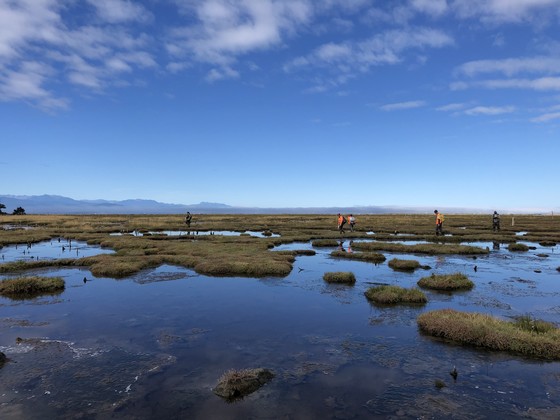 Skagit County's Noxious Weed Team scours the tidelands looking for Spartina. When they find it, they dig it up, or treat it with special, aquatic-approved herbicide.
What's it like to work in our Noxious Weed Program? You walk. A LOT. We survey large areas looking for weeds. In the photo above, our team is combing the tidelands looking for Spartina.
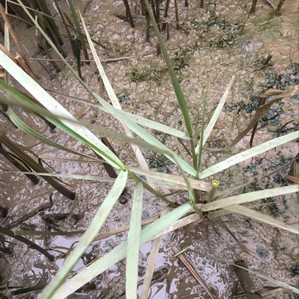
Skagit County's Noxious Weed Program works to control all noxious plants within County boundaries. Our program dedicates a large chunk of time to controlling Spartina anglica (Common Cordgrass). This plant is a Class A invasive tidal grass, meaning it is required to control by law. Spartina is a spiky grass that invades tidelands, crowds out our native eelgrass and ruins habitat for fish and other marine creatures. All summer long, we spend most days surveying tidelands that might have Spartina on foot, often walking 5-10 miles a day (depending upon terrain). This summer, we surveyed over 1,000 acres of habitat just in Spartina work. That's a LOT of walking!
Thanks to the help of a great crew of seasonal employees, some county funding, and grants, we work on all kinds of noxious weeds. Check out our website for information on the Noxious Weed Board (we have an opening!), our noxious weed lists, and how you can help!
|
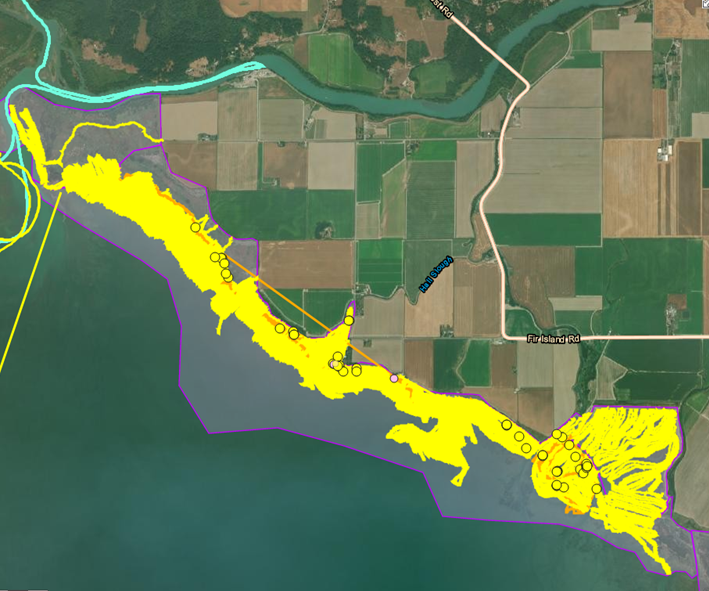 Each thin yellow line is a path that one of our Weed Crew walked looking for Spartina. Zoomed out to this scale, all those tiny lines look like one big blob of yellow!
|
|
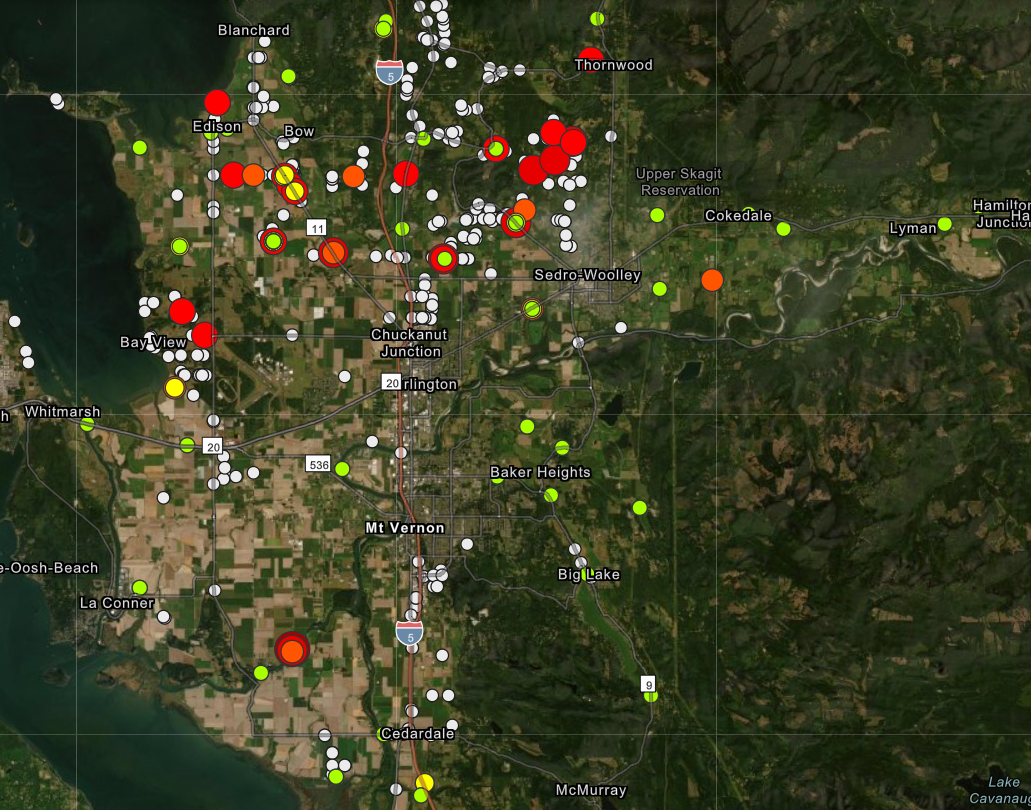 All water quality results from December 1 through the 31st. See the data yourself on our online map - just click the photo!
Our Ambient Water Quality Monitoring Program samples 40 sites throughout the county every other week to measure the general quality of our surface waters. Water quality in the beginning of December was generally pretty good. Most results were low, with fecal coliform counts under 100 bacteria per 100mL. No Name Slough, North Edison Pump Station, and lower Coal Creek all had slightly elevated bacteria numbers.
Things were a bit different in the second half of December. We had about a quarter inch of rainfall in the early morning hours of December 17, and runoff from that storm seems to have increased bacteria counts in some areas. Seven of 19 sites had results over 500! Four of those sites had results over 900: Fisher Creek, Sullivan Slough, Hill Ditch, and Nookachamps Creek.
December 21 was a day full of downpours – more than 1.25 inches in 24 hours. When we sampled the next day, December 22, we found that most sites were pretty low. However, five of the 21 sites had fecal coliform counts over 500 bacteria in 100mL. These included Swede Creek, the North and South Edison Pump Stations, Alice Bay Pump Station, and Joe Leary Slough.
It’s concerning to see such high levels of bacteria in these sites, especially when they’re larger streams that carry a lot of water like Nookachamps Creek. High levels of bacteria means that there’s poop getting in the water. A recent study done in the Samish watershed found dog poop to be a major source of bacteria at nearly every site we sampled. Cow, human, and ruminant (deer, goats, sheep, etc.) bacteria were also found in a wide variety of areas. That just underscores how important it is for everyone to manage their poop if we’re going to reach our clean water goals. Even dog poop in your yard matters! If you’re wondering how to help, head on over to our website at poopsmart.org to get more information about what you can do to improve water quality.
You can see all the results at the online water quality map at https://arcg.is/1iiifS. We’re still waiting for the lab to catch up after the holidays, so we don’t have the final results for December 17 and 22 up on the online map yet. We’ll get them up as soon as possible!
|
|
Tip of the month to Protect Life and Home
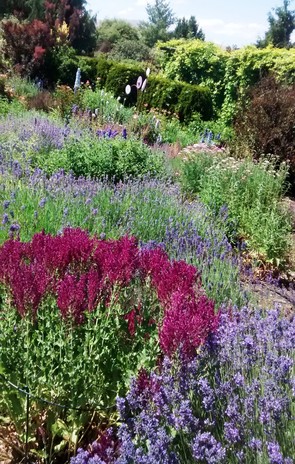
Have you caught yourself staring out into the desolate yard, wistfully thinking of spring? Me too! Decamping for sunnier climes just isn't in the cards for us this year. But there's a next best thing to lift your spirits when the skies are gloomy: plan your spring and summer garden!
|
|

Farm Tip of the Month
Is your property a winter wonderland? Or more of a muddy mess? If your answer is muddy mess, you're not alone. Our northwest winters are great for showing us where we need to do more work!
Now's a great time to take notes and photos to help you plan what projects to tackle this summer. What is making your chores harder? What's just plain annoying? What is hurting the health of your animals? Take notes so when summer arrives, you won't waste time trying to remember exactly what you were thinking in January. Your plans will be ready to go!
The Snohomish Conservation District has a great set of blog posts that will help you do things right the first time, and avoid costly mistakes. Here are a few good ones to start you off:
5 Tips for the winter farm: https://snohomishcd.org/blog/2017/11/20/5-tips-for-winter-horsekeeping
How to build a heavy use area: https://snohomishcd.org/blog/2020/3/6/heavy-use-areas-how-to-and-essentials
Whatever you do, just remember to take notes and photos. You'll be glad you did when summer arrives. Before and after photos are great for showing how much you've improved!
|
|
|
Program & Partner News
We're all working hard on our year-end reports, so we don't have much news today! Stay tuned - we'll let you know here when new reports are posted.
Managing Shoreline Erosion: Bulkheads or Natural Solutions. Did you know that most shoreline properties have very low risk for erosion, and don't need expensive bulkheads or armoring? Our partners at Northwest Straits Initiative have released a new video about the pros and cons of bulkheads and natural beaches. Check it out at https://www.youtube.com/watch?v=wZAmPBAd_KI.
|
Education & Volunteer Opportunities
Become a Salish Sea Steward, and join one of the greatest volunteer organizations in our area! The Salish Sea Stewards is a volunteer training program with 40 hours of training to citizens who are interested in learning about the marine environment and the different volunteer opportunities to help make a difference in your community. Classes are planned for February through March of 2021. Classes will be virtual this year, with a field component. They're working out all the details now. Get details, including the application here: http://www.skagitmrc.org/projects/education-outreach/salish-sea-stewards/.
The 2021 Country Living Expo and Cattlemen's Winterschool will be held virtually this year on January 29-31. There are classes about everything you can think of related to living here: raising farm animals, beekeeping, growing your own fruits and vegetables, pruning, pickling and canning, attracting bats, baking...the list goes on. Register at https://extension.wsu.edu/skagit/countrylivingexpo/.
|
|
Contact Us
For questions or more details, please contact Karen DuBose at kdubose@co.skagit.wa.us or 360-416-1460.
This project has been funded wholly or in part by the United States Environmental Protection Agency under assistance agreement PC01J18001-0 to the Washington Department of Health. The contents of this document do not necessarily reflect the views and policies of the Environmental Protection Agency, nor does mention of trade names or commercial products constitute endorsement or recommendation for use.
|
|
|
|
|