 Honey, I shrunk MudHoney!
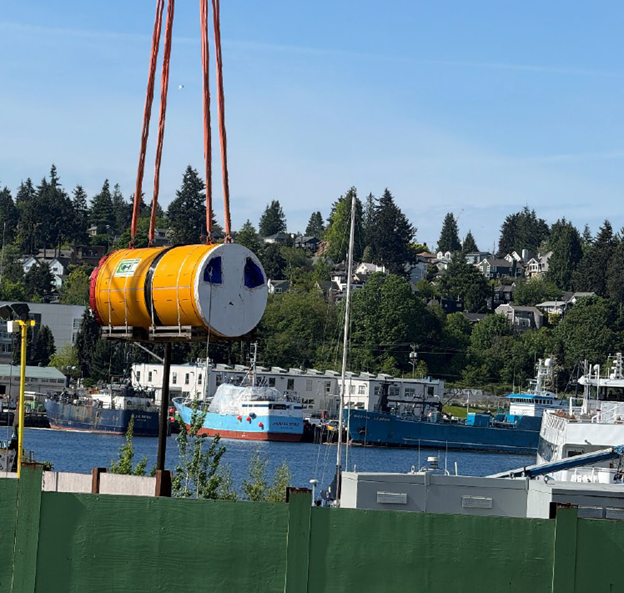 Tunnel boring machine lifted off the truck and into the site.
The spirit of MudHoney lives on in Ballard! Starting this week, we launched a brand-new tunnel boring machine (TBM) to dig a sewer pipe under 24th Ave NW and NW 56th St. While it may not be as massive as MudHoney (the 18-foot-diameter TBM that traveled along Ship Canal), this machine is built for the smaller spaces of the conveyance pipes. It’s basically MudHoney after a classic Rick Moranis shrink-ray mishap!
The new TBM is 7 feet in diameter, with 10 powerful disc cutters at the front. These heavy-duty metal rings crush through rocks as the machine tunnels underground. Even cooler: The TBM is operated remotely by an above-ground crew of 6 to 10 people, who guide the machine from a control station - our own NASA mission control center!
From now until late 2026, the TBM will be digging a new 7-foot-diameter pipe under 24th Ave NW, NW 56th St, and 28th Ave NW. The new pipe will connect the neighborhood with the storage tunnel and pump station.
The TBM’s journey starts at our shaft site on 24th Ave NW and Shilshole Ave NW and will travel due north along 24th Ave NW. Once it reaches 24th Ave NW and NW 56th St, it will be pulled out and rotated to turn west where it will continue its path along NW 56th St to its final destination at 28th Ave NW.
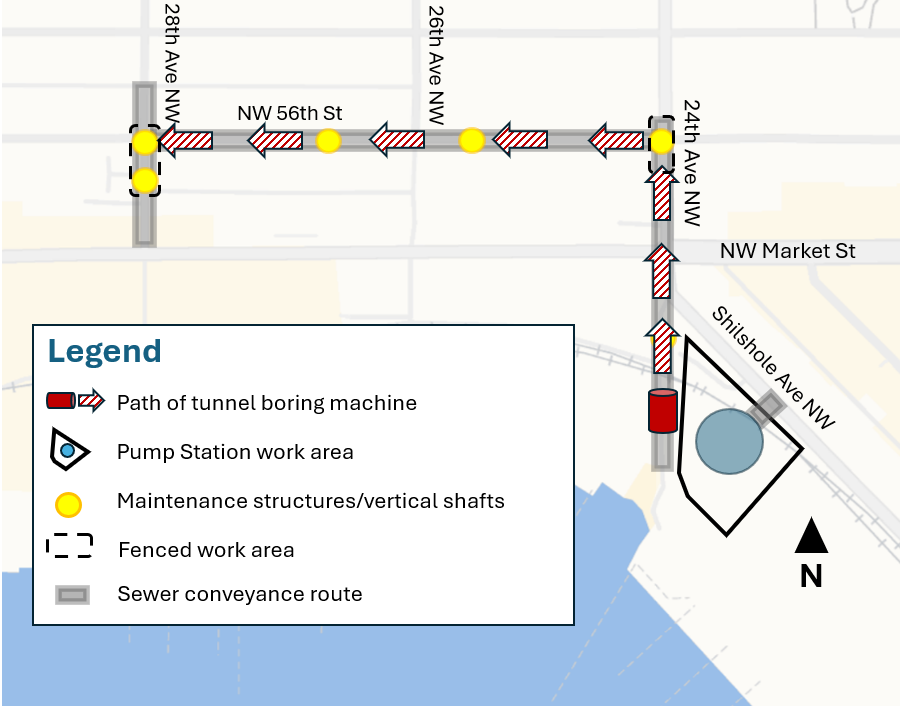 Map of the 7-foot diameter tunnel boring machine route.
Don’t worry - you likely won’t notice anything as the tunnel machine is working. We have contained most of the noisy and impactful equipment within the construction walls of our pump station site. After the tunnel is constructed along 24th Ave NW, there will be activities at 24th Ave NW and NW 56th St, where crews will shift the TBM and lower pipe segments into the shaft to be pushed into place.
We will monitor the 7-foot-diameter TBM’s progress at monitoring points located throughout the tunnel’s voyage. Monitoring points help track and collect data for any ground movement during construction. They come in many forms and are placed in various locations such as on utilities, pavement surfaces, and buildings. Types of monitoring points include:
- Utility monitoring points (UMP) are installed into the ground with the tip resting on a utility (such as a pipe) to monitor the vertical elevation changes over the project duration.
- Settlement Monitoring Points (SMP) are built into the ground to measure changes in surface elevation for the duration of the project.
- Optical Survey Targets (OST) are small glass markers installed on the outside of buildings and used with surveying equipment to detect even the slightest structural movement.
This new sewer pipe, along with the pump station and completed storage tunnel, helps reduce polluted stormwater and sewage from flowing into local waterways, protecting public health, fish, wildlife, and the overall ecosystem. Our project is a long-term investment that benefits current residents and future generations by keeping our local waterways cleaner and safer for recreation and improving water quality throughout the city to support a healthier Puget Sound.
What to expect
The tunneling operation began this week and will last until late 2026. Above-ground activities will be mostly contained within the pump station site, with the exception of the operation to rotate the machine at 24th Ave NW and NW 56th St, and to extract the machine after tunneling at 28th Ave NW and NW 56th St.
You should anticipate:
- Tunneling operations and work will be 12 hours a day from 6 am – 6 pm, 6 days a week (including Saturdays). Most of this work will take place at the pump station site on 24th Ave NW and Shilshole Ave NW.
- Parking restrictions, intermittent road closures, and local access only along 24th Ave NW, NW 56th St, and 28th Ave NW.
- Trucks bringing materials on-site and off-site.
- Noise, dust, and vibration typical of a construction site.
- Vehicle, pedestrian, and bicycle detours around the area.
- Increased traffic in the area as residents and commuters adjust to detour routes.
- The contractor will monitor noise, vibrations, and dust so they stay within permitted limits. When needed, the contractor also minimizes dust by covering truck loads, washing tires, and watering down the site.
Please watch for equipment and signs in the area. Travel slowly through active construction areas and follow directions from flaggers and signs.
Project updates are still being published quarterly. Our next update will be sent out later this summer. If you’d like to keep up to date on our progress in Ballard, send us an email at SPU_ShipCanalProject@seattle.gov and we will add you to the monthly Ballard email list.
Seattle Public Utilities and King County Wastewater Treatment Division are building the Ship Canal Water Quality Project (SCWQP) to significantly reduce the amount of polluted stormwater (from rain) and sewage that flows into the Lake Washington Ship Canal, Salmon Bay, and Lake Union from our sewer system.
Contact Us
Please email SPU_ShipCanalProject@seattle.gov with questions or comments or call our hotline at (206) 701-0233. You can also find information online at https://www.seattle.gov/utilities/ShipCanalProject.
|