RainWise Contractor News: Updated design specs, eligibility tools, introductions and more!

Seattle Public Utilities and King County logos - white
Icon of many falling leaves in reds, oranges, yellows, and greens

Happy Fall, RainWise Contractors!

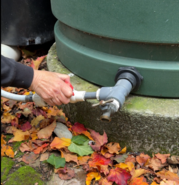
Close-up of a hand turning the valve on a green cistern with colorful fall leaves in foreground


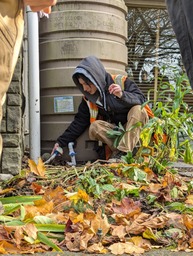
Days are growing shorter and leaves are changing: RainWise customers will soon be getting their reminders to clear debris and open the low flow valves on their cisterns in advance of the rainy season. We know many of you will be busy through the fall with installations.


Reminders on Inspection Requests

Photo of house with red leaves of a tree in the foreground and a "I'm RainWise" sign in the yard

As you submit those fall inspection requests, pay close attention to the details: with the uptick in inspection requests, we've seen an increase in errors and oversights. Incomplete or inaccurate paperwork will slow down your projects. A few reminders for you:

Inspection Requests:

  • Customer Understanding Forms must be initialed and signed
  • Infiltration Tests must include an infiltration rate, each box checked, and signature of contractor or homeowner


 Rebate Packages:

  • *NEW* Contractor invoices cannot contain the word “estimate”. The invoice should clearly be identified as
  • Include and sign all rain garden or cistern warranties
  • Be sure customer’s contact information is included on rebate forms
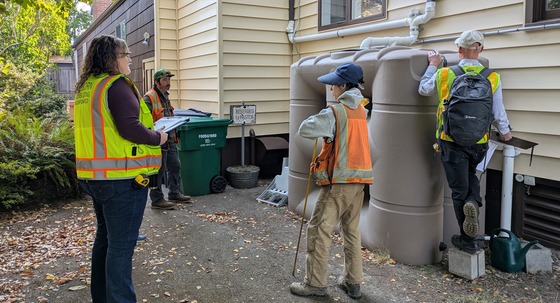
Four people in hi-vis vests look at a cistern next to a building.


Contractor Roundtable Follow Up

Graphic of group of five people talking with speech bubbles

Thank you to those who were able to join the Contractor Roundtable on September 9!

We hope the day was valuable for you: connecting with other contractors, sharing your experiences, and providing input on where the RainWise program should invest resources in addressing the challenges you face.


Contractors who joined us discussed the challenges and benefits of RainWise, and generated a list of proposed changes. These were the top suggestions:


  1. Solutions for material sourcing, including supplier lists and bulk discounts
  2. Target new homeowners with focused marketing to become RainWise
  3. Offer pre-assembled low flow assemblies and/or rain garden kits
  4. More cross-pollination between contractors including mentorship, consultations, and labor in exchange for hands-on training/experience
  5. Clarity in GSI mini-grant and Access grants

If you weren’t able to join us, please email us and let us know which of these proposed changes would best support you and your business!

icon of yellow maple leaf

Whether you joined us or not, please feel free to share your thoughts on the event, and what you’d like to see in the future.

Email us

Design Spec Update

icon of green oak leaf

Updated RainWise Design Specs have been released.


Changes to design specs are always meant to ensure performance and mitigate risk. We’ve also added and updated illustrations, and aimed to clarify language.

The most significant additions and updates include:

  • Tree protections: Siting and ground disturbance are not allowed in the inner half of a tree’s dripline diameter, and only 30% of the outer half may be disturbed (B:14). Updated to comply with municipal code.
  • Utility Setbacks: Rain gardens, cisterns, and all related piping must be at least 2’ from side and 3’ from front of any gas meter infrastructure; and at least 1.5’ from the side and at least 3’ from the front of any electric meter infrastructure (B:15).
  • Flexible tubing in low flow assembly: where previously optional, flexible tubing is now required at the terminus of flow control outlet to overflow piping. Flexible tubing allows easier maintenance access without risk of breaking, thus improving long-term performance.
  • Screw on lids are optional: Lids can and should be used where needed to minimize leaf drop and ensure cistern is childproof, but are at the discretion of the contractor. Over time, tight-fitting screw-in lids can warp and become a barrier to homeowner maintenance, thus decreasing the performance of the system.
  • Hose bibs are still optional on cisterns for homeowner use, but we’ve removed it from the low-flow assembly illustration. The preferred placement for a hose bib is a second connection directly on the cistern as this minimizes the chance of the homeowner damaging the low flow assembly when attaching and using a hose. Adding a hose bib in line with the low flow assembly is still acceptable if other options are not possible.

Be sure to review the complete updated design specs and let us know if you have any questions.


 Review the New Design Specs online


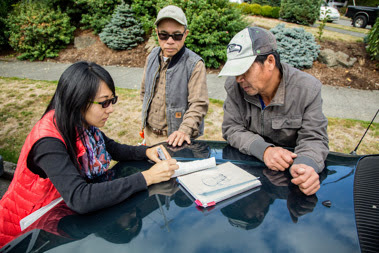
A group of three people review papers on the hood of a truck

For questions or to request a bound copy be mailed to you, please email Carrie via rainwise@seattle.gov

Request a Bound Copy of the New Design Specs

Eligibility & Feasibility

Determining if a property can have a RainWise installation requires first determining that the property is in an eligible basin, then determining that the parcel meets eligibility requirements based on their connectivity to the combined system and pre-existing stormwater control or GSI, and confirming that the site is feasible based on things like space, slopes, trees, and structures.
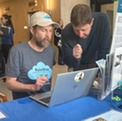
A man wearing a RainWise shirt and baseball cap sits at a laptop while another man looks over his shoulder

At the contractor roundtable, Bill Malatinsky (SPU Outreach Lead) presented on how he conducts pre-consultations with customers, and how contractors can use tools such as the DSO map to determine parcel eligibility.  

Tools to determine parcel eligibility:

DSO Sewer & Water Map: https://experience.arcgis.com/experience/95749d0993164eefa99300182e99bd43

Permit & Property Records: https://web.seattle.gov/dpd/edms/

Side Sewer Cards and Maps:  https://maps.seattle.gov/sdcisidesewercardviewer/

How to Read a Side Sewer Card:   https://www.seattle.gov/dpd/appdocs/sidesewer/howtoreadasidesewercard.pdf

Pre-consultations

If you have a customer who needs more information before proceeding with an in-person consult or feel like you have a property lead that would benefit from a virtual analysis before taking the time to visit, please point the customer to the link below, or via the RainWise homepage.

RainWise Online Pre-Consultation Interest Form Survey


icon of orange oak leaf

Get Help Determining Parcel Eligibility and Site Feasibility

Remember that you can always reach out to us directly with questions about specific sites – an inspector or program staff can take a closer look at a parcel, or help walk you through the tools we use. If you have questions, or could use a review of the tools, please email us!

Email Us


New King County Lead Inspector

2025 brings a bittersweet farewell as we congratulate former King County lead inspector Anna Lucero on her new position as an Engineer II in King County Water and Land Resources Division’s Asset Management Unit.  We wish Anna the best on her adventure and welcome aboard Benjamin (Ben) Gregory as the new lead King County inspector. 

Head shot photo of white woman with dark hair wearing hi-vis orange vest
head shot photo of white man with a dark mustache wearing a King County baseball hat and royal blue t-shirt

RainWise is thrilled to welcome Ben to the team. Ben brings valuable knowledge and insight to our Program. You’ll be seeing him more in the field – be sure to give him a warm congrats when you do!

Icon of many falling leaves in reds, oranges, yellows, and greens

Welcome New Contractors!

icon of two brown acorns

This summer we welcomed three new contractors to RainWise! Welcome to Building and Outdoor Solutions, Gravity Waterproofing & Drainage, and Total Construction. We hope to see you at upcoming events or for your first pre-inspection!


How do RainWise installations perform in the long run?

a woman in a hi-vis orange vest stoops in front of a cistern to point to valve

We’ll be conducting post-post inspections again this fall. These are inspections of RainWise installations that are 3 to 5 years old to evaluate how well cisterns and rain gardens are performing over time. We will conduct these on an annual basis to gain long-term data on the impact of RainWise. In 2024, 87 installations were inspected, and we saw that 100% of rain gardens and 93% of cisterns were rated as performing “good” or “fair”.

20% of those cisterns required some minimal intervention by the inspector (cleaning debris or replacing the orifice) to move from a “fair” rating to a “good” rating, demonstrating that customers benefit from some maintenance support.

These post-post inspections have also informed the design spec updates as we saw where customers couldn’t easily maintain systems due to warped lids or rigid piping at the flow control outlet.


Sign up to meet customers

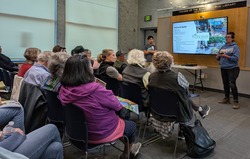
Group of people listen to a woman presenting a slide show

“How to Get RainWise” workshops and webinars are a chance for prospective customers to learn about RainWise, ask specific questions about their property, and connect directly with contractors.

Customers often don’t look further than the contractors they meet at these events, so this is an excellent way for you to solicit customers.


There are two in-person workshops in October:

Wednesday, October 1, 6:30-7:30pm at Southwest Branch Library

Thursday, October 16, 7:00-8:00pm at Jefferson Community Center

Yellow arrow points to text and reads "Next Week!"

And one webinar:

Thursday, October 23, on Zoom, from 5:30-7:00pm

Sign Up for Events Here


Contact Us

icon of two brown capped mushrooms with colorful fall leaves at their base

Questions? Comments?

Reach out anytime to rainwise@seattle.gov

Email Us

Icon of many falling leaves in reds, oranges, yellows, and greens