|
|

A program of the City of Seattle, Trees for Seattle is committed to growing and maintaining a healthy, awe-inspiring urban forest.
|
|
|
Water Your Plans for Watering?
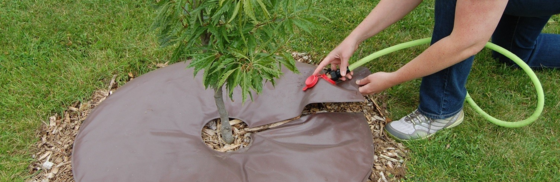 Person bending over filling a watering bag placed around a young tree.
It has been a dryer than normal May in Seattle, with 7 inches less of rain than average since October, according to the National Weather Service. Now is the time to begin a watering routine to ensure young trees in your landscape survive and thrive through our upcoming dry summer season.
How much watering do my trees need?
Newly planted trees need supplemental water in our hot and dry summer. You should be giving your young trees 15-20 gallons of water twice a week.
Water is important for all trees as our summers get hotter and drier. Even mature trees may need one or two good soakings a month during summer as they can lose over a hundred gallons of water on a hot, dry day.
What are the best methods for watering trees effectively and responsibly?
Water should always be applied slowly and throughout the root zone - not at the trunk.
Better: Take three 5-gallon buckets, make holes in the bottom using a hammer and a nail, and place the buckets at the base of the tree, and fill with water.
Good: A garden hose set to a very slow trickle and left for 30 minutes will do the trick. Soaker hoses that can attach to your garden hose and circle loosely around the tree root zone are also a great option.
If you are looking to install an irrigation system, drip irrigation is also a preferred method as it delivers water directly to the soil slowly (much like the bucket and bag methods above) and reduces water waste. Tilth Alliance offers drip irrigation classes regularly (there is one June 7!), with sliding scale fee options. Local nurseries are also a great resource for drip irrigation workshops. If you already own an operational, automatic irrigation system, you may qualify for a WaterSense sprinkler timer rebate which can help time watering around the weather.
How can I tell if I’ve watered enough?
To test proper watering, dig into the soil 2 inches below the surface. This soil should be damp, not dry and crumbling or saturated.
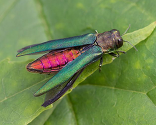
Protecting Trees from Emerald Ash Borer
Seattle Parks and Recreation’s (SPR) Urban Forestry team is taking a proactive approach to managing the threat of Emerald Ash Borer (EAB), an invasive insect pest that caused widespread death of Ash (Fraxinus) trees across North America (up to 99% of ash trees in some areas). Although EAB has not yet been detected in Seattle, there is no longer a question of if EAB will arrive in Seattle, but when, and the City is establishing a collaborative response plan. Our team is planning and implementing strategies now to reduce potential impacts of EAB, protect public and worker safety, and prevent ecological damage.
Part of our proactive management approach is selectively removing ash trees that are unsuitable for treatment—those already in poor health, with undesirable structural conditions, or without vehicle access for ongoing care. In particular, trees that require climbing for removal pose increased safety risks for arborists once the trees are infected by EAB. As part of a phased approach to gradually reduce vulnerable ash populations in our park system, the removal of 3-8 ash trees may be scheduled during the dry summer months when conditions are safest for tree work. Ash trees that are removed will be replaced with new young tree plantings as required by the Executive Order 2023-03 (One Seattle Tree Plan) and SPR’s Trees For Seattle Parks’ program goal of increasing tree canopy with an equity priority and stewardship of young tree care. Community members may begin to see informational signage in parks as part of our public outreach and safety preparations. We appreciate your understanding as we take these important steps to protect the long-term health of Seattle’s urban forest.
|
|
|
|
Is it safe to water trees with cistern water collected from a roof?
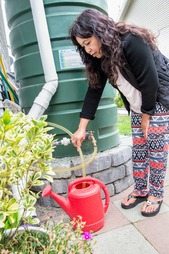
There are many benefits to using collected rainwater to water your trees. Collecting rain slows stormwater runoff which helps prevent sewer system overflows and pollutants being carried into nearby streams and lakes. Collected rainwater saves valuable municipal drinking water from being used for landscaping. If you have a cistern, you are saving money by not paying for drinking water to water your garden.
It is common to wonder if pollutants collected from your roof, or even flowing off of the sidewalks and turf areas, can harm trees. One of the many reasons that trees are a valuable resource for cities managing stormwater, is their ability to help filter out the pollutants in water. As water hits the ground and moves downward into the soil, pollutants cling to the soil particles, microorganisms and the web of roots under trees, cleaning the water as it is absorbed. Trees have also been found to break down pollutants, as they are able to use some of the nutrients to benefit their own growth. So, yes, it is safe to use water in a cistern for your trees.
One tip for using cisterns for watering trees and other plants, especially food producing plants, is to “Water the soil, not the food.” This means that the soil has a chance to do its filtering magic before plants uptake the water for their own use. This pamphlet about the safety of cistern water and tips on how to best use it, is a great resource.
Are you interested in getting a cistern to collect stormwater runoff and to protect local waterways? More Seattle neighborhoods are now eligible for the RainWise cistern rebate program! That means your home might now qualify to get a rain garden or cistern — with rebates that can cover up to 100% of the cost.
|
you can volunteer to water trees at schools?
 |
|
Do you live near Dunlap Elementary, Rising Star Elementary, South Shore K-8, Cleveland High, Bailey Gatzert Elementary or Thurgood Marshall Elementary?
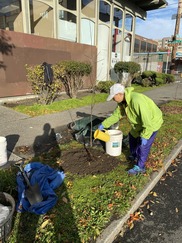
Seattle Public Utilities' Trees for Neighborhoods (T4N) program is looking for volunteers who are interested in doing some summer season watering shifts of recently planted trees at the above Seattle Public School sites. T4N helps support schools with summer watering in Seattle’s high heat, low canopy priority areas, so your help has a huge impact! Watering takes about one to two hours, depending on the number of trees) and can be done around your schedule. This is a great activity to do with neighbors, friends or family!
|
|
|
West Queen Anne Tree Walk
Ready to leaf your worries behind? Join volunteer tree guide, Kimberley, for a pun-derfully scenic tree tour through the historic Queen Anne neighborhood! We’ll wander past giant conifers that reach for the clouds, deciduous trees leafing out for summer and take a few moments to pine over the stunning local architecture. It’s a stroll that’s equal parts nature, history, and a little bit of arbor-amusement. Come get to the root of what makes this neighborhood so special!
First Hill Tree Walk
Join us for a stroll beneath the beautiful trees along University Street on First Hill. Our knowledgable guide from Seattle Public Utilities' Trees for Neighborhoods program will lead you on an informative journey, pointing out various tree species and sharing interesting facts along the way. This is a great opportunity to connect with nature and learn more about the greenery in our urban environment. Don't miss out on this chance to appreciate the natural beauty right in the heart of our neighborhood!
Meadowbrook Pond Tree Care and Skill Share
Saturday, June 21
10am-1pm
Meadowbrook Pond Volunteer Registration
Join Seattle Tree Stewards and Dirt Corps for our Mulching Tree Care and Skill Share event at Meadowbrook Pond! We will be learning best practices for mulching and watering trees. We’ll then practice our skills by mulching plants and young trees bordering the pond.
Montlake Tree Walk
Friday June 27
11:00 – 12:30 pm
Meet at the corner of E. Calhoun St. & 22nd Ave. E. near Montlake Elementary School
Montlake Tree Walk Registration
Join volunteer Tree Walk leader, Stone, on the Montlake Tree Walk. Stone will share about some favorite trees on this specific walk, as well as help you see the similarities or differences between trees through leaf and seed comparisons. Hopefully you walk away feeling like you know at least one tree well enough to identify it the next time you see it.
Longfellow Creek Tree Care and Mulching Skill Share
Saturday, June 28
10am-1pm
Longfellow Creek Volunteer Registration
Join Seattle Tree Stewards and Dirt Corps for our Mulching Tree Care and Skill Share event at Longfellow Creek! We will be learning best practices for mulching and watering trees. We’ll then practice our skills by mulching plants and trees on this beautiful, creek side property. Join us for fun and learning!
Green Seattle Partnership
The Green Seattle Partnership (GSP) is a collaboration between the City of Seattle, community groups and non-profits, businesses, schools, and thousands of volunteers working together to restore and actively maintain the City's forested parklands. Check out the GSP website and the GSP calendar of volunteer events and signup to support Seattle's forested natural areas.
Events & Volunteer Opportunities
|
|
|
|
|