Women's History Month recap
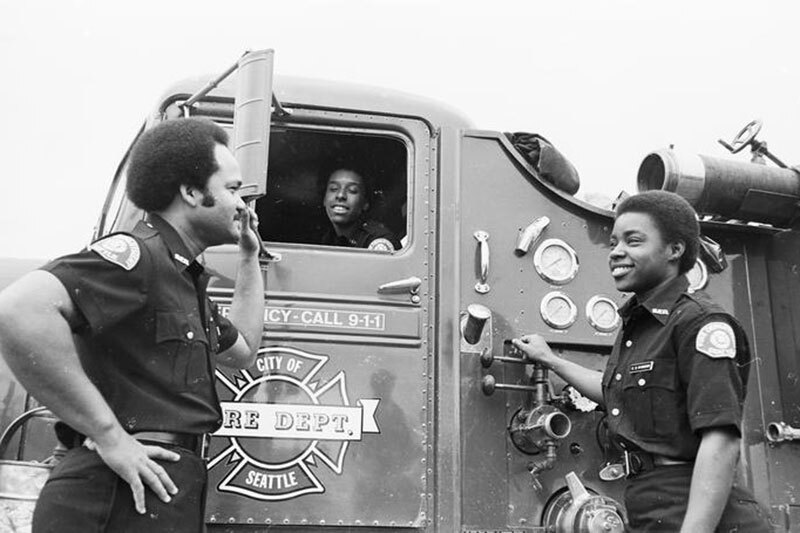 Janet Beal center - Courtesy of the Seattle Municipal
Archives, #73024, Series 2801-09
In honor of Women’s History Month, we spotlighted Janet Beal, the first Black woman firefighter hired by the Seattle Fire Department. In 1980, Janet Beal was part of recruit class #40 in which all 12 women made it through drill school. In 1996, Ms. Beal was promoted to Lieutenant and became the first Black woman to hold rank in the Seattle Fire Department. Lt. Beal retired in 2014 after 34 years of service to the community.
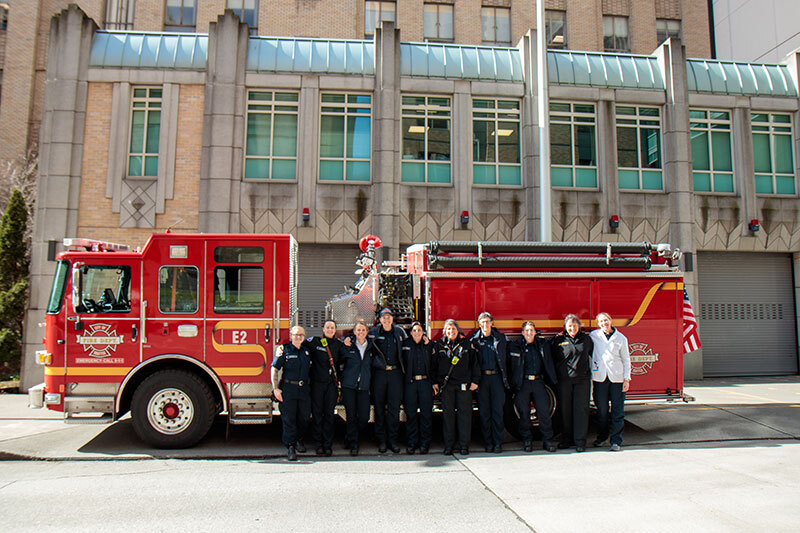 The SFD honors the incredible women who have shaped our world with strength, wisdom and resilience. From pioneers in science to first responders, artists, activists and everyday heroes, women have always been at the forefront of change.
Leukemia and Lymphoma Society Firefighter Stairclimb
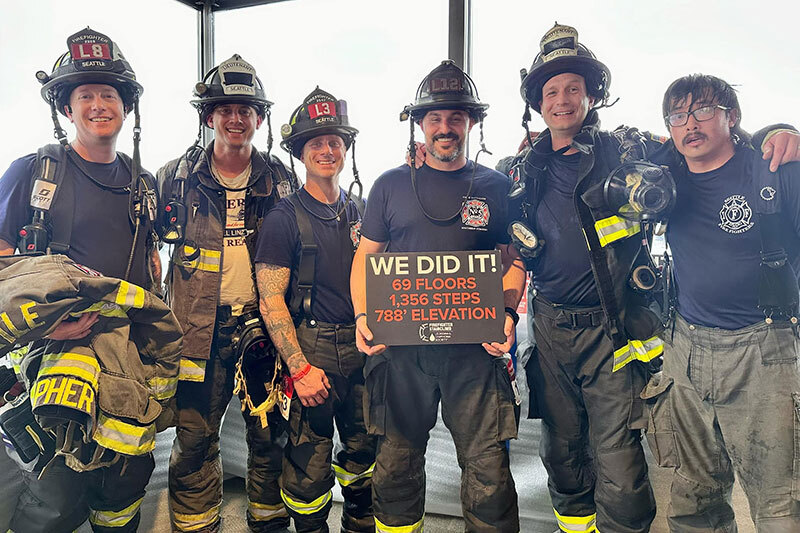 In March, many of our members participated in the Firefighter Stairclimb at Seattle's Columbia Tower to raise money for the Leukemia and Lymphoma Society. They joined firefighters from across the Nation in climbing 69 flights of stairs (1,356 steps) in full turnout gear. If you'd like to donate to this important cause, there is still time! Please consider doing so through our team site to help us meet our goal.
Rescue swimmer training
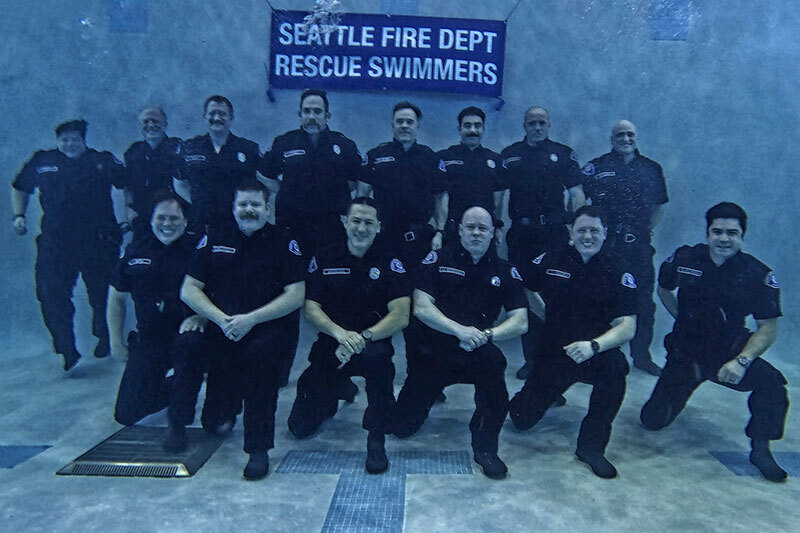 Seattle Fire's Rescue Swimmer cadre takes a group photo...submerged! They conducted their annual requalification swim test and a module training at Helene Madison pool, which included a major entanglement prop with hose water harassment, high entry, rescue can use and rescue swimmer emergency procedures.
Rescue swimmers utilize the peak inhalation technique to maximize the volume of air in their lungs before going subsurface and train to work calmly and methodically underwater on breath hold dives. You can tell by their relaxed poses in this photo (taken by Fire Dog Photos) that their training is paying off.
Multi-casualty incident drill
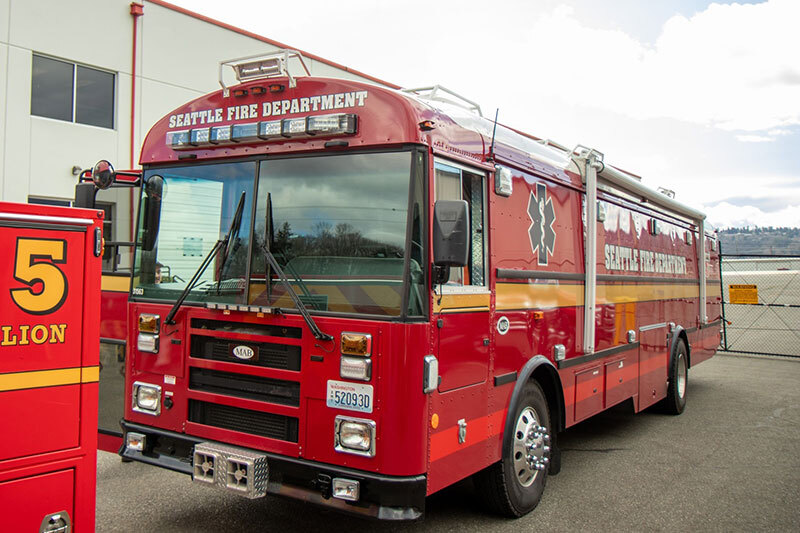
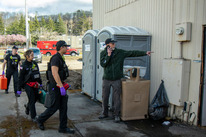
Engine 39 attended a Multi Casualty Incident drill with the South King County Fire Training Consortium. They brought Seattle Fire's Medical Ambulance Bus (MAB), which can be utilized outside of the City of Seattle as a resource for the region. Training with our partner agencies helps us to prepare for more wide-scale incidents when several jurisdictions may be involved.
|
While this drill was focused on an active shooter scenario, the MAB can be utilized for a multitude of incidents or scenarios. As an example, the MAB was utilized in Seattle during the cold weather spell in 2024, to help bring unhoused individuals to local warming shelters.
Patient reunification at Station 9
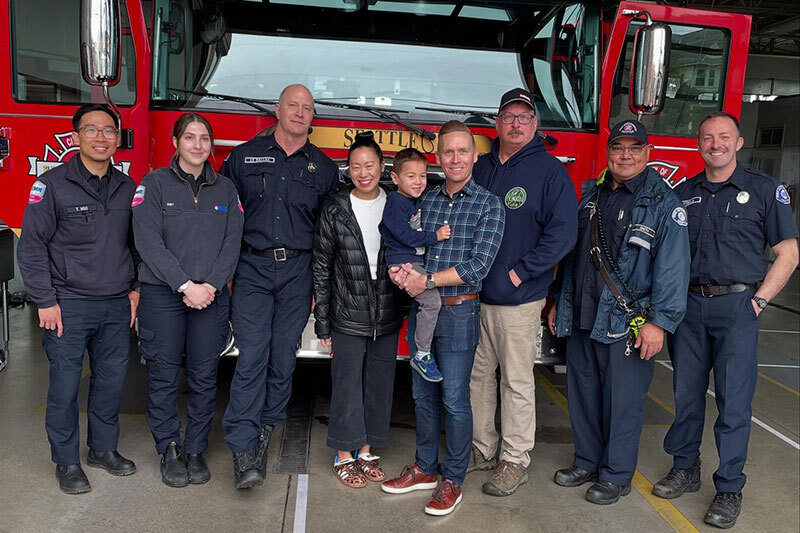 On Sept. 14, 2024, Eric Rimling suffered a cardiac arrest while on a run around Green Lake. A bystander immediately recognized the symptoms of cardiac arrest and began performing CPR. A crew from AMR happened to be in the area and was flagged down to assist. The AMR crew jumped right into action taking over CPR until crews from Seattle Fire Engine 9, Aid 31 and Medic 17 arrived. Medic 17 transported Eric to Harborview Medical Center where he made his recovery.
In March, Eric and his family stopped by Station 9 to meet the crews from Seattle Fire and AMR that helped save his life. Eric is back to running, skiing and spending time with his family, which he says - is thanks to the quick actions of everyone who came to his aid that day.
This serves as an example of the importance of knowing bystander CPR. Learn more about the Seattle Fire Department’s Medic 2 Bystander CPR Training program and the classes we teach.
Hydrant inspections – and what to do if you experience temporarily discolored water

The 19,000 fire hydrants located within the City of Seattle are maintained and repaired by Seattle Public Utilities (SPU), and are inspected by the Seattle Fire Department (SFD). Firefighters inspect all fire hydrants across the City on an annual basis to ensure they are working properly and will provide sufficient water when needed for fighting a fire. Inspecting hydrants can help save lives and protect property.
The SFD strives to inspect each hydrant within City limits once per year. Inspections occur between the hours of 9 a.m. and 4 p.m. and when the temperature is above 35 degrees. If you live near a fire hydrant that has recently been inspected, your drinking water may appear discolored for up to a few hours. This can happen when hydrant flushing changes the direction or rate of flow in a nearby water main. The discoloration comes from internal pipe rust and sediment getting stirred up. Drinking the water is not harmful but the water can be unsightly.
|
If you experience discolored water, SPU recommends running the cold water for a few minutes to see if it is clearing or still discolored. If the water does not clear, let the water sit for one to two hours. Then run cold water for a few minutes in your bathtub or shower. Do not run the hot water to try to clear the water. If the water remains discolored, please contact SPU’s 24/7 Operations Response Center at (206) 386-1800.
SFD and SPU are working in partnership to help minimize discolored water when hydrants are inspected. The two departments are also sharing information to help keep customers informed about inspections that may have occurred in their neighborhood. This includes a procedure in place whereby SFD notifies SPU’s Operation Response Center just prior to flowing water. Hydrant inspections within neighborhoods is dependent on when the fire station is able to work it into their schedule in between emergency calls and training. Firefighters may plan for or be in the middle of conducting hydrant inspections and get pulled away to an emergent incident, having to push inspections to a later date, which is why advance notice for inspecting the City’s 19,000 hydrants from within 33 fire station districts is unfortunately not feasible.
Spring fire safety tips
 As we gear up for spring and tackle those home and yard projects, it’s essential to prioritize fire safety every step of the way. Please check out our helpful safety tips and recommendations to minimize the risk of fires and associated hazards.
|