|
|

Director's Note—April 2025
April invites us to reflect on safety, justice, healing, and wellbeing—core values that guide our work at the Seattle Human Services Department (HSD). The following observances remind us that change happens when we work together.
This year’s theme for Sexual Assault Awareness Month is "Together We Act, United We Change," underscoring the importance of ending sexual abuse, assault, and harassment. Safety and dignity are human rights that must be protected. When we treat one another with respect and speak out against harm, we help create workplaces, schools, and communities where we can live, learn, and grow without fear.
National Crime Victims’ Rights Week, April 6-12, is themed KINSHIP, reminding us that supporting survivors starts with connection. Through our shared humanity and by showing up with compassion, we can help break down barriers to justice, healing, and support.
Join HSD by wearing denim on Denim Day, Wednesday April 30 as a visual way to say, there is no excuse and never an invitation to rape. Denim Day began in response to a wrongful court ruling in Italy, where a rape conviction was overturned because the survivor wore tight jeans. Since 1999, people around the world have been wearing denim on this day in honor of survivors of sexual violence.
Finally, National Public Health Week will be recognized April 7-12. Public health is a critical force that protects our safety and wellbeing. Public Health – Seattle & King County (PHSKC) oversees this work across the county, and HSD proudly partners with PHSKC to direct additional City funding in alignment with the Mayor's priorities, including expanding treatment and care for people living with substance use disorder (SUD). During this week, I invite you to take a moment to recognize the many dedicated public servants working daily to improve the health and welfare of communities in Seattle and across the country.
Thank you for standing in solidarity with community.
Best,
|
|
|
 Tax Day is April 15!
United Way of King County (UWKC) will provide free tax preparation to those making less than $80,000 a year (or less than $96,000 for non-single filers).
UWKC will help you understand your tax situation, plus take advantage of the Earned Income Credit, Child Tax Credit, and the Working Families Tax Credit to maximize your refund.
IRS-certified volunteers are available in person and virtually to prepare your taxes at no cost. In-person sites are open for service through April 19, 2025.
|
 Civic Coffee Recap: Chronic Illness Management
Age Friendly Seattle partnered with the East African Senior Center to host its monthly Civic Coffee, focusing on chronic illness management. Mary Pat O’Leary, BSN, RN, a Senior Planning and Development Specialist for HSD, delivered an insightful presentation on blood pressure, blood sugar, and cholesterol. She explained their impact on health, how to identify concerning levels, and practical steps for maintaining stability through lifestyle choices and medical care. Read more about what she shared or watch the video recording posted on our YouTube playlist.
|
|
 Employee Spotlight: Temesgen Melashu
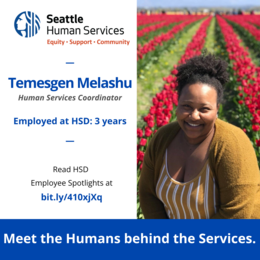
Temesgen Melashu has been a part of our HSD team for three years. She writes about working closely with providers to ensure that children and teens in our city have access to healthy, nutritious foods to foster environments where children can thrive. Visit humaninterests.seattle.gov to learn more about Temesgen and her impact on our community.
|
|
|
Giving Youth a Glimpse of a “Day in the Life”
Back in February, a cohort of youth participating in the Seattle Youth Employment Program’s Learn & Earn program was invited to participate in a Day in the Life event. Youth had the opportunity to ask questions about careers at the City of Seattle, take tours around some of the offices and buildings, and do practical hands-on activities.
As part of the hands-on activity for the business track, participants had to develop a mock budget for a service organization focusing on providing meals for seniors. They learned about why the City contracts with people in the community and how those contracts have to be planned for, written, and then financially monitored to steward the public’s tax dollars
Participants also enjoyed a panel where staff shared their career paths to employment with the City of Seattle in classifications that included contracting, communications, and finance. One of the messages that resonated with some participants was that one’s career path isn’t linear, and that path can change due to various reasons. Not only does the City have employees working in all types of positions, but as a large organization, it can offer growth opportunities for moving between career sectors, investment areas, and offices and departments, even while remaining an employee of a single organization.
The Day in the Life event gave participants an idea of the workings of various departments around the City of Seattle, helped them learn more about fields they potentially want to get into, and helped them build those connections along the way towards their futures.
A longer version of this article—written by one of the Learn & Earn participants—originally appeared on HSD’s Human Interests blog.
|
Seattle City Light Announces New Time of Use Rate for 2025

Seattle City Light is introducing a Time of Use (TOU) rate in 2025, giving customers a new way to save on energy bills by using electricity during off-peak hours.
What You Need to Know:
-
Save money: TOU rates let you pay less by shifting energy use to off-peak hours, like running your dishwasher at midnight instead of 6 p.m.
-
Boost efficiency: Using energy during off-peak times helps balance the power grid, improving reliability and efficiency.
-
Support sustainability: TOU rates align with Seattle’s goals for cleaner energy, making it easier to rely on renewable resources like solar and wind.
TOU Rate Structure:
-
Peak Hours: 5 p.m. to 9 p.m., Monday to Saturday
-
Mid-Peak Hours: 6 a.m. to 5 p.m. and 9 p.m. to midnight, Monday to Saturday, and all day on Sundays
-
Off-Peak Hours: Midnight to 6 a.m. daily
Plan your energy use for maximum savings and sustainability. Visit the Utility Services Website to set up your account and get started today.
Explore Seattle City Light's TOU rates and start saving!
|
You Can Sign Up to Get Fresh Fruits and Veggies from Local Farms
If you’re looking to support local farmers and consistently stock your kitchen with fresh produce, joining a Community Supported Agriculture (CSA) program might be for you!
What is Community Supported Agriculture?
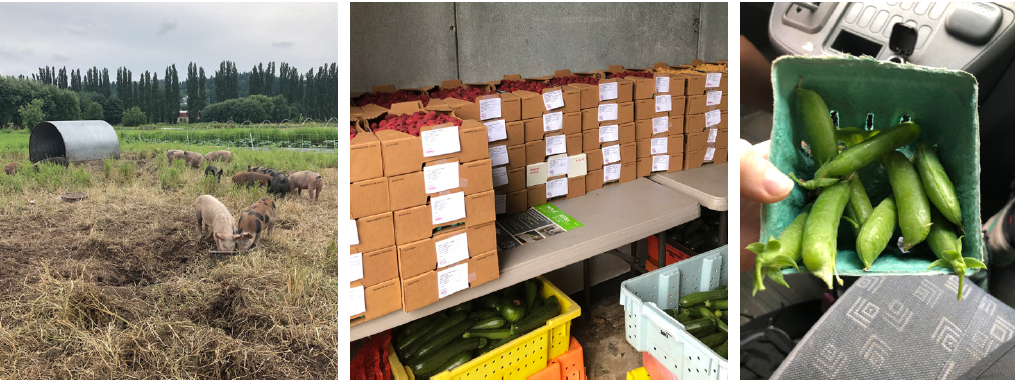
A CSA is an arrangement between a farmer and a customer where the customer buys a subscription for a local farm’s produce. At the beginning of the year, when interested participants sign up for a CSA, their subscription helps a farmer purchase seed and supplies and cover other pre-season costs. When the harvest comes around from June to October, farmers drop off weekly boxes for CSA members to pick up. While most programs don’t have deadlines, they can fill up quickly, and some Seattle CSAs are already full.
Learn more about how CSAs strengthen Seattle’s food system on the Greenspace blog.
How to Sign Up for a CSA
Enter a ZIP Code in Eat Local First’s CSA Finder. To help get you started, Seattle’s Office of Sustainability & Environment compiled a list of some CSAs that support BIPOC farmers or serve communities with limited access to fresh foods:
While HSD is not affiliated with a specific CSA, we support locally grown produce and increased food access through a lot of our work, as does the City of Seattle as a whole—and we love opportunities to highlight some of our amazing food partners! Here’s a list of some food and nutrition resources.
Get FREE Health Services at the Seattle/King County Clinic

Seattle/King County Clinic is a volunteer-driven, FREE health clinic that occurs for four days each year at Seattle Center. The Clinic welcomes anyone in the region who struggles to access and/or afford healthcare.
On April 24–27, 2025, healthcare professionals from across Washington will offer dental, vision, and medical care at Seattle Center. Patients do not need ID, proof of income, insurance, or immigration status to receive care. Patients do not need to be residents of Seattle or King County. Interpreters are available.
Over nine years, the time, expertise, and care of 31,000+ volunteers have helped to save 30,000 patients more than $26 million in out-of-pocket healthcare costs.
Patients should come prepared for a long day with food, comfortable clothing, and any daily medications. For more information, Download a Flyer: English | Amharic ( አማርኛ) | Arabic (عربى) | Chinese (中文) | Chinese (傳統的) | Dari (دری ) | French (Français) |Khmer (ខ្មែរ) | Korean (한국어) |Marshallese (Kajin M̧aje) | Oromo (Afaan Oromoo) | Portuguese (Português) | Russian (русский) | Somali (Soomaali) | Spanish (Español) | Tigrinya (ትግሪኛ)| Ukrainian (Українська) | Vietnamese (Tiếng Việt)
|
On AgeWise: How Medicaid Funding Caps Would Harm Older Adults
On Human Interests: Standing in Solidarity with Our LGBTQ+ Community
On Public Health Insider: Mental Health Services Expand at Seattle School-Based Health Centers | Leer en español
From the Office of Mayor Bruce Harrell: Mayor Harrell Signs Legislation Fortifying Local Protections for People Seeking Gender-Affirming and Reproductive Health Care
|
|
|
|
|