|
|
 |
|
A program of the City of Seattle, Trees for Seattle is committed to growing and maintaining a healthy, awe-inspiring urban forest. |
During and after the severe windstorms of late November, City crews worked together to respond, remove debris, and keep our city safe and accessible. We are grateful for the many people- City employees, private crews, and volunteers who responded during and after the big storm. While there is still a backlog of maintenance after the storm, much of the storm cleanup itself is complete, thanks to many hours of dedicated, skilled response.
Thank you to residents for their work cleaning up and disposing of yard debris and fallen branches. It's important to note that departments like Seattle City Light are not responsible for cleaning up privately owned trees or debris left behind after power restoration, for example. Property owners are encouraged to arrange for proper disposal of any storm-related debris on their property. Check out the link below for tips! We appreciate your understanding and partnership in keeping our community safe and our services, like power, reliable!
-
Seattle City Light’s Power Line Clearance team works tirelessly during and after storms to ensure public safety and restore power as quickly as possible. The team clears hazardous trees and limbs from power lines to prevent outages and maintain safe clearance.
-
Seattle Public Utilities responds to water outages city-wide, provides waste removal services, and keeps drainage and water systems functional.
-
Seattle Parks and Recreation’s Natural Resources Team responds to dangerous conditions in Parks after storms. This important work prevents serious injury to people and properties after a storm event.
|
|
Winter is the dormant time for trees and a great time to prune out any small, broken branches without causing stress to the tree. Promptly pruning any ripped branches will help prevent them from ripping deeper into the trunk bark and also keep people and other plants safe from future falling branches. Only perform tree work on snow and ice-free ground, and if broken tree branches are touching or within 10 feet of power lines, make sure to contact Seattle City Light rather than pruning it yourself.
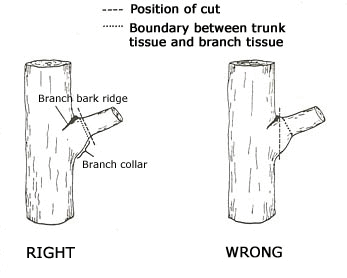
It’s important to make proper pruning cuts to allow the tree to recover from the breakage or pruning wound. Sometimes when a branch breaks, it doesn’t allow for an ideal cut, but care should still be taken to cut outside of the branch collar connecting the branch to the trunk. This Trees for Seattle video tutorial provides a good visual of how to remove a dangling small branch.
Pruning of street tree (in the public right-of-way of your property often called the parking strip), branches larger than 2” in diameter or multiple branches that will remove more than 15% of the tree’s foliage, requires a free tree pruning permit from SDOT. Some trees are planted and owned by SDOT and you can use the Find It, Fix It app to report broken branches. If you aren’t sure if it’s an SDOT or privately owned tree, you can use the Trees for Seattle Storymap tool to look it up.
Consider hiring an ISA certified arborist if you don’t have the tools or aren’t feeling sure about what to do. Seattle’s Tree Service Provider directory provides a list of registered tree care professionals that are approved for work on street trees and yard trees. You can also get free arborist referrals from Plant Amnesty.
 |
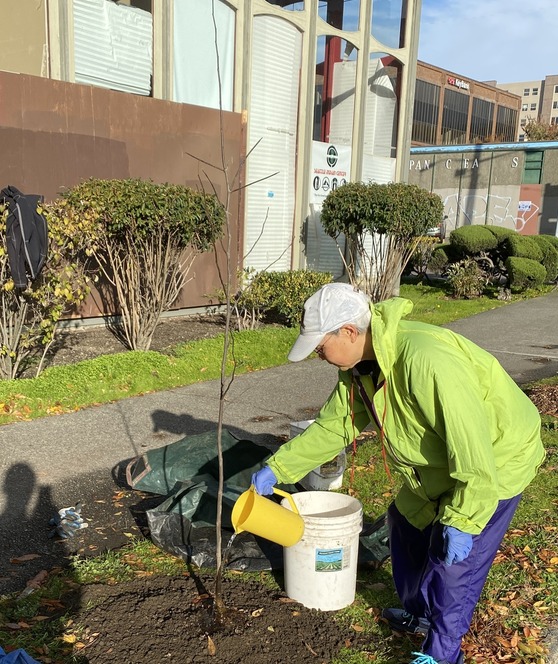
This past July, Trees for Neighborhoods staff members ventured out into the heat to check on the health of some street trees planted through the program. Every year we complete health evaluations for street trees planted in the last 2 years, our 10-year cohort, and all school trees planted. We check for signs of water stress as well as basic maintenance like the presence of mulch and a watering bag and provide updates and suggestions to the residents caring for that tree. Our special cohort of street trees planted in 2014, 10 years ago, have been evaluated every summer since planting. 10 years into these evaluations, our 2014 cohort graduated this year with over 88% of trees surviving! For trees living in urban environments, right next to a road, and with the stress of prior years’ heat domes- this number is incredible! A special thanks to all of the residents throughout the years caring for your trees. It truly matters and we all should be proud of this incredible survival rate!
What happens next? In 2025 we will start a new 10-year cohort and will follow those trees for a 10-year period.
Why not yard trees? Because of privacy considerations, we do not monitor private property yard trees. With the support of Seattle Public School staff, volunteers, and our partners at Dirt Corps, and UW Botanic Gardens, we continue to plant trees in school yards and will be monitoring the health of these trees annually.
|
|
|
|
|
The Seattle Art Museum is currently hosting an exhibit called Following Space, displaying the works of Thaddeus Mosley and Alexander Calder, side-by-side. Thaddeus Mosley’s large-scale wooden sculptures seem to defy gravity. In this video interview, he explains why he was inspired to work with wood and large discarded logs, as well as his creative process in approaching designs. Free First Thursdays are a great time to visit, from 10 am to 8 pm.
The Green Seattle Partnership is a collaboration between the City of Seattle, community groups and non-profits, businesses, schools, and thousands of volunteers working together to restore and actively maintain the City's forested parklands. Check out their website and their calendar of volunteer events and signup to support Seattle's forested natural areas.
Events & Volunteer Opportunities
|
|
|
|