|
|
 |
|
A program of the City of Seattle, Trees for Seattle is committed to growing and maintaining a healthy, awe-inspiring urban forest. |
As we enter the season of the “big dark” it can be heartening to see seasonal holiday lights twinkling on trees around Seattle. To make sure trees remain healthy and strong, it's important to use best practices when installing string lights, or even landscape lighting that shines on trees.
Choose trees that are mature and strong enough to hold string lights without their branches bending or visibly weighted down. Winter, when lights are typically added, can be an especially windy time of year, which adds even more stress to heavy branches. Never tie smaller branches together with wires or lights to make the tree carry more weight.
Do not use staples, nails or hooks that are fastened into the tree bark to hang lights, as that can damage the tree, opening it up to diseases and pests.
Limit the number of hours the lights are on by using timers to turn off lights when they aren’t needed. The number of hours a day that trees are exposed to light impacts their growth and reproductive cycles. Trees don’t differentiate between sunlight and artificial light, and just like people, trees need to "sleep”, or be dormant, for certain periods of time in a 24-hour cycle. Tree species have developed based on specific seasonal day lengths, so some trees are more sensitive to extended artificial lighting than others. This Purdue University Forestry and Natural Resources info sheet has more detailed info on the impact of different types of lighting and a list of tree species’ day length preferences. Visit Dark Sky International for a deeper dive into many more reasons why it's important to turn lights off at night.
Remove string lights when the season is over. The tree’s trunk and branches will continue to grow and thicken, and string lights can restrict that important growth when they are left on indefinitely, year after year. String lights can even girdle a tree as the tree bark grows over and around them.
|
|
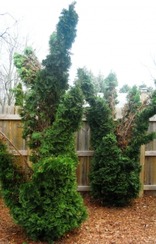
Meteorologists are predicting a snowy winter for Seattle. Young trees need care during and shortly after heavy snow falls to prevent injury to precious branches and leaves. Evergreens are most vulnerable since there is more surface area for snow accumulation. Our wet, Pacific Northwest snow is heavy, even a couple of inches of snow accumulation can weigh down your evergreen's needles and leaves. As the weight grows, branches can snap, leaving wounds on your tree. The crown (top) of the tree takes the most impact and may need to be removed leading to an unhealthy tree. Conifers like Western red cedar or arborvitae, and broad leaf evergreens like rhododendron and madrone should be gently brushed with your hands or a soft broom to remove accumulated snow before it freezes and hardens. Getting outside as soon as the snow falls is ideal. Once snow freezes into ice, it should no longer be removed.
Newly planted deciduous trees would also appreciate a bit of extra care during snow events. While on the ground, brushing or gently shake the tree’s trunk to remove snow accumulation on branches which reduces the likelihood of ice forming around the branches. While most tree branches can withstand being incased in ice, young trees are more vulnerable, and this support can help your tree thrive. Do not shake trees incased in ice as this will lead to branch breakage.
Safety First: Please remember to stay on the ground –do not climb ladders in the snow and ice.
Photo credit: Michigan State University
|
This year, SDOT interns and staff surveyed existing street trees and updated our street tree database. The team made 47,000 edits to our Street Tree Inventory upping the total number of inventoried street trees to over 200,000 trees! We are so grateful for all of their hard work.

|
|
|
Nurturing Forests and Futures: Youth Engagement in Seattle’s Urban Forest was the theme of this year’s Seattle Forest Week during the last week of October. It was exciting to see so many families, students and young adults participate in and co-lead events.
-
Rainier Beach Youth Stewards led an event with Tilth Alliance at the Rainier Beach Urban Farm
-
Cleveland High and Nova High students planted 2 trees on Cleveland's Campus
-
Hundreds and hundreds of native, habitat-supporting trees and plants were planted in park natural areas by volunteers and community partners on Green Seattle Day. Check out these photos of events throughout the day.
-
Seattle Arbor Day capped off the week by planting 11 new trees at Maplewood Playfield and 10 new street trees along 13th street in SW Beacon Hill! Several city urban forestry teams supported over 70 community volunteers who did a great job getting these large trees in the ground. Visit Trees for Seattle Instagram to watch a video highlight!
The WA State Noxious Weed Control Board (NWCB) is considering whether to add the tree, Ilex aquifolium (also knows as English holly or feral holly), to the Class C Noxious Weed list for WA state. This designation would not restrict the growth, sale or planting of English holly, and would not require municipalities to eradicate it, but it would allow for improved focus, funding and awareness around managing the increasing spread of English holly trees into natural forest lands and parks where they are spread by birds and grow to crowd out native plant species. Ilex aquifolium is already a King County Weed of Concern.
The WA NWCB will make a decision in March, so if you have feedback, you can email it to: noxiousweeds@agr.wa.gov or via mail to: WSNWCB; P.O. Box 42560; Olympia, WA 98504-2560.
|
|
Meadowbrook Pond Tree Care Event and Luminaria Walk
Saturday, December 7th
Tree care 12:30pm - 3:30pm
Luminaria Walk Dusk - 8pm
Register Here
Coordinates
Meet at the end of 36 Ave NE, 10700 36th Ave NE
Join Trees for Seattle and Dirt Corps for December's wrap-up tree care event at Meadowbrook Pond! We'll continue our efforts to enhance tree health in the Meadowbrook Pond ecosystem by removing harmful English ivy from mature trees and applying mulch around them to keep them healthy through the winter. We'll also take the chance to learn how to use fallen leaves and branches as mulch in your own yard. At dusk the Luminaria Walk at Meadowbrook Pond begins, a magical annual event where volunteers place 900 bags of lights, create a bandstand, and welcome community to stroll around the pond and enjoy a light and music-filled evening. There will be treats and hot drinks!
All skill levels are welcome. Please wear clothing that can get dirty, including long sleeves, long pants, and closed-toed shoes. We’ll be working rain or shine, so make sure to bring rain protection as needed. We’ll be providing the tools, gloves, snacks and water. We hope you’ll join us!
Gateway Park Tree Care Event
Dirt Corps and the Georgetown Youth Council invite you to join us for a community gathering at Gateway Park North, a local riverside park that we have worked for years to restore and enhance. We will be caring for the lovely poplar trees and learning about the value of added tree canopy in industrial areas. We will also be winterizing the garden beds and rain gardens by removing weeds and tucking our plants in with mulch. We want to make sure this place is snug for the winter season!
All skill levels are welcome! Please wear warm clothing that can get dirty and closed-toed shoes. We'll be providing the tools, snacks, and water to keep you hydrated and energized. Bring work gloves if you have them; if not, we'll have some you can borrow. We hope you'll join us!
West Queen Anne Tree Walk
Sunday, December 15, 2024
12:30 pm – 2:00 pm
Register Here
Location: Meet in front of Queen Anne Library, 400 W. Garfield St.
Join volunteer Tree Walk Leader Kimberley Slater for a walk in the West Queen Anne neighborhood to get to know and learn about several trees in this historic neighborhood. We will start and end at the Queen Anne library. There is so much to see! Please wear comfortable walking shoes, dress for the weather and bring a water bottle or umbrella, if desired.
The Green Seattle Partnership is a collaboration between the City of Seattle, community groups and non-profits, businesses, schools, and thousands of volunteers working together to restore and actively maintain the City's forested parklands. Check out their website and their calendar of volunteer events and signup to support Seattle's forested natural areas.
Events & Volunteer Opportunities
|
|
|
|
|