Amy (Smith) Barden Appointed and Sworn In.
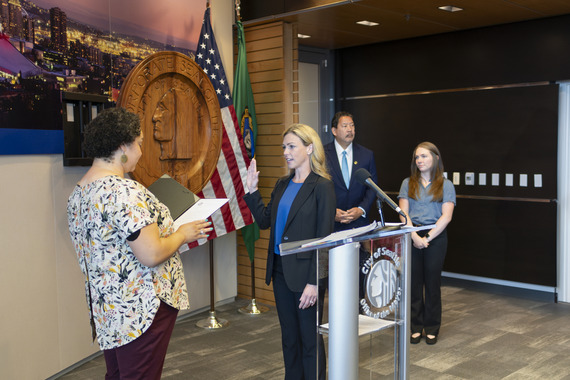
The appointment of Amy (Smith) Barden as Chief of the Seattle CARE Department was unanimously confirmed by the Seattle City Council on July 30, 2024, following recommendation by the City Council's Public Safety Committee during its July 23, 2024 convening.
During the Seattle City Council appointment hearing process, Chief Barden expressed her abiding belief that we can "reimagine how we respond to and how we prevent human suffering," and that we must "redesign our systems to better support positive change and healing in individual lives.”
With her appointment, Chief Barden has outlined goals for the Seattle CARE Department, including (but not limited to) the following:
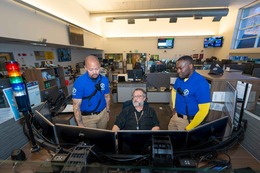
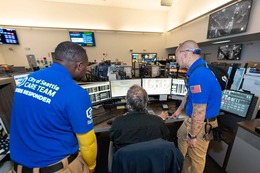
- The Seattle CARE Department will optimize its Seattle 9-1-1 Communications Center as both a public safety data center and a public safety center of innovation, which will inform and spearhead the development and implementation of diversified and specialized first response options for 9-1-1 call events. Accomplishing these goals will involve working to optimize the Seattle 9-1-1 Communications Center for rapid response to all public safety and public health emergencies.
- The Seattle CARE Department will partner with social service providers in both the public sector and the private sector in its implementation of specialized first response options for 9-1-1 call events and build upon those partnerships to co-create a robust continuum of interventions and supports focusing on outcomes.
- The Seattle CARE Department will increase positive public perception of the services provided by its 9-1-1 Communications Center employees and the public's readiness to avail itself of those services.
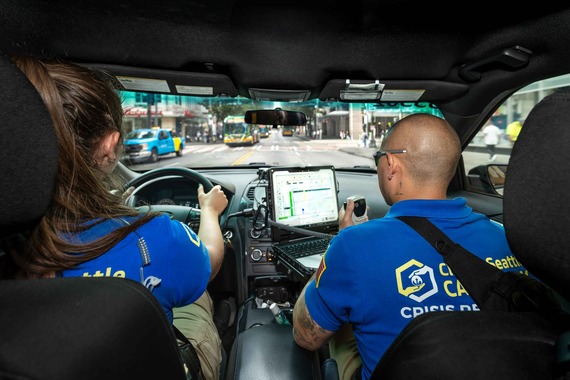
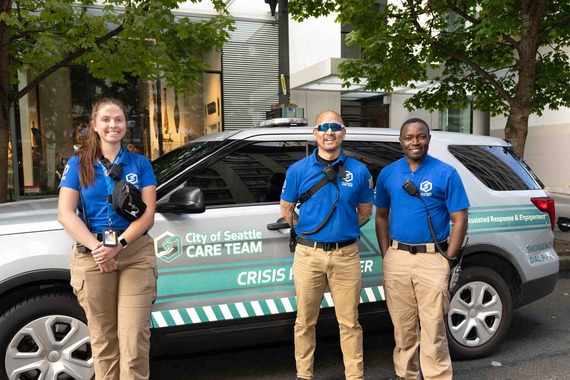
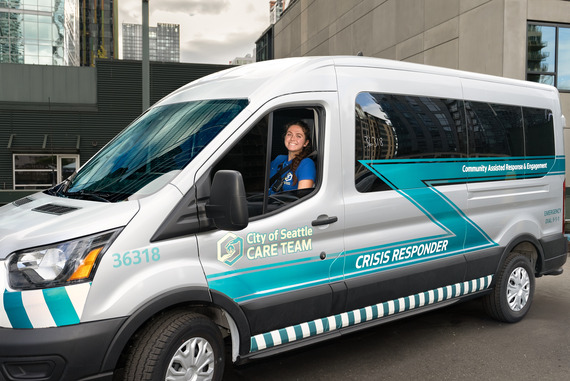 CARE Community Crisis Responders Expanding Citywide
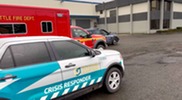
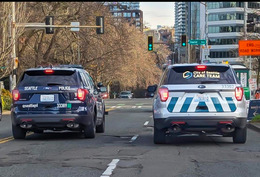
The Seattle CARE Department Community Crisis Responder Team is currently comprised of nine (9) Community Crisis Responders (CCR) and a manager, all of whom are qualified behavioral health professionals. CCRs assist Seattle Police Department (SPD) patrol officers in responding to a range of non-violent and non-life-threatening 9-1-1 call events, involving persons experiencing crisis and behavioral health challenges. By assisting SPD in responding to these types of call events, CCRs free up patrol officers to respond to higher priority calls, while connecting people to services and thereby reducing additional 9-1-1 call events.
On June 26, 2024, Mayor Bruce Harrell introduced his proposal to expand the CCR Team citywide and increase the number of CCRs. The proposed expansion will provide the community a total of twenty-seven CCRs, including three CCR supervisors and nine additional responder vehicles. Already underway, the expansion will initially bring additional assistance for SPD patrol officers and services for community members into East Precinct, before expanding into North Precinct and then into South Precinct and Southwest Precinct.
Since October 2023, CCRs have intervened in nearly one-thousand events, and thereby provided considerable assistance to SPD in terms of freeing up police officers to respond to higher priority call events. Out of those nearly one-thousand interventions, there were only four events during which SPD patrol officers were called back to the scene by CCRs, with three of those four callbacks having required CCRs to enlist SPD patrol officers to make formal referrals to the Downtown Emergency Services Center (DESC) Crisis Solutions Center (CSC). As of June 19, 2024, following the signing of a Memorandum of Understanding (MOU) between the Seattle CARE Department and DESC, CCRs can now directly make referrals to CSC.
What People are Saying about the Expansion
Tahir Duckett, Executive Director, Center for Innovations in Community Safety, Georgetown University Law School
“Response programs like CARE are among the most important innovations in municipal governments in recent years. These programs allow cities to finally provide the right response to the most vulnerable residents while reducing the burden of the rest of the first response infrastructure. But they only work if we invest seriously in their success; they need the necessary resources to put responders on the streets, to improve operations and efficiency, and to solve the inevitable problems that arise when you’re building something new."
Barry Friedman, Jacob D. Fuchsberg Professor of Law and Director of Policing Project, New York University School of Law
“The clear trend in public safety is incorporating alternatives to sole police response as part of a jurisdiction’s choices for responses to people in need. Jurisdictions around the country are finding increasing demand, and public satisfaction. Police in many places support these alternatives, permitting them to focus on their primary task of fighting violent crime. Seattle, a trend-setting city in so many ways, is well-advised to expand its alternatives in dealing with people who are unhoused, or in crisis in some way. Although there are a variety of models, the most forward-looking cities are creating new departments of public safety that include and house these alternatives.”
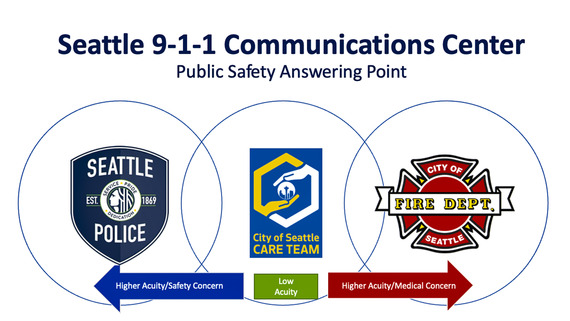 The Venn Diagram above represents how the Seattle CARE Department 9-1-1 Communications Center is a public safety answering point (PSAP), which dispatches the Seattle Police Department for high acuity public safety events, the Seattle Fire Department for high acuity public health events, and the Seattle CARE Department's Community Crisis Responders for low acuity behavioral health events.
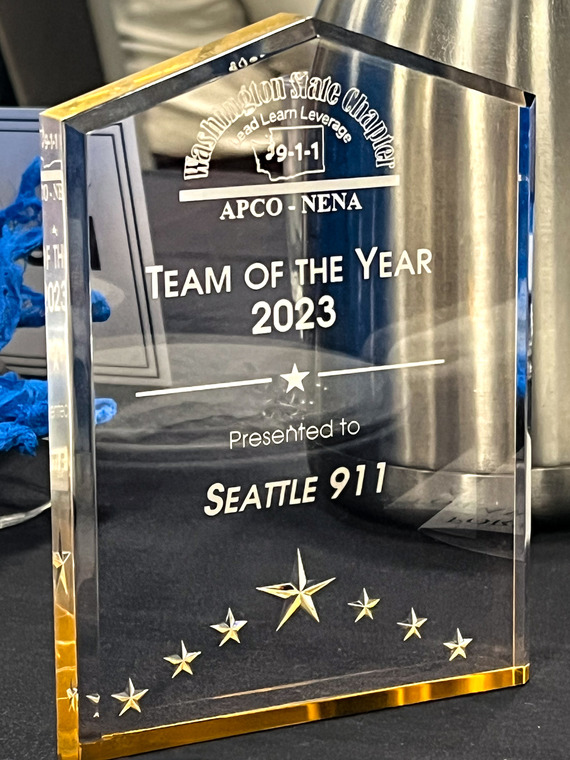 The above photo represents the APCO - NENA Washington State Chapter Team of the Year Award, with which a team of Seattle CARE Department 9-1-1 Dispatchers were recently honored, owing to their exceptional handling of a major shooting incident in the Capitol Hill neighborhood during the early morning hours of July 23, 2023.
To receive a firsthand account of the exceptional work Seattle CARE Department 9-1-1 Dispatchers did to earn the named award, please visit the Seattle CARE Department YouTube page here.
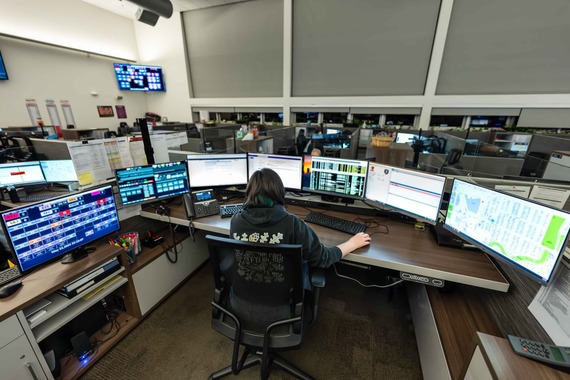 Seattle 9-1-1 Communications Center Innovations
The Seattle CARE Department's 9-1-1 Communications Center continues to advance innovation and efficiency to better serve the public:
- In partnership with the Seattle Police Department (SPD) and the Seattle Fire Department (SFD), the Seattle CARE Department has worked to reduce redundancy of call types and move toward simple criteria-based dispatching to determine appropriate and optimal first response of City public safety resources. Already underway, in May 2024, the Seattle CARE Department and SPD partnered to redefine call prioritization and update associated dispatch policies. As a result, SPD has been able to optimize resource allocation to improve response times for high priority calls.
- The Seattle CARE Department will maintain and advance all possible equipment and technological opportunities, to ensure proficiency in performance, operational capability and functionality, and scope. Already underway, CARE recently partnered with the King County 911 Program Office to carry out a major update the Seattle 9-1-1 Communications Center's telephone (Viper) system and worked with the City of Seattle’s Information Technology Department, the Seattle Police Department and multiple vendors to update its Computer Aided Dispatch (CAD) system to the most recent version available—a cloud-based CAD system.
- The Seattle CARE Department's Quality Assurance Team within its 9-1-1 Communications Center is utilizing software in its training program, enabling rapid identification and redress of performance deficiencies, while working to get its new training program certified with Washington State and eventually accredited by APCO, NENA, and CALEA.
- The Seattle CARE Department is making progress in recruiting and retaining its 9-1-1 professionals (CARE is projected to be at a record-low 5% vacancy rate by the end of year), including providing its employees increasingly robust peer support and mental health support.
- The Seattle CARE Department is pleased to have participated in advocacy efforts that played a role in the passage of HB 2088, which "[extends] liability protections for responders dispatched from mobile rapid response crisis teams and community-based crisis teams." Passage of HB 2088 will equip CARE CCRs and other mobile crisis responders in the State of Washington with necessary protections when providing critical services to community members in need of help.
- The Seattle CARE Department benefits greatly from its participation in the Alternative Response Research Collective (ARRC), housed at the Center for Innovations in Community Safety (CICS) at Georgetown Law, a robust community of practice seeking to establish an innovative blueprint for how to approach, design and operationalize strong alternative response units that improve public safety by initially sending the appropriate responders to meet the identified public safety/health needs.
|