|
|
Seattle Office of Labor Standards 2023 Year in Review
Dear friends, community partners, and colleagues,
Now that we have had time to settle into a new year and contemplate what 2024 may bring, I am excited to reflect on our progress in advancing Seattle’s labor laws. The Office of Labor Standards (OLS) conducts its work across various teams (Enforcement, Outreach, Policy, and Administrative), totaling 33 staff members. We diligently enforce, educate, and support Seattle’s workers and businesses to increase understanding of and compliance with our evolving labor standards. With 17 ordinances now in place to safeguard workers’ rights in Seattle, our efforts are yielding promising results.
2023 End of Year Highlights
Enforcement
Enforcement Team:
-
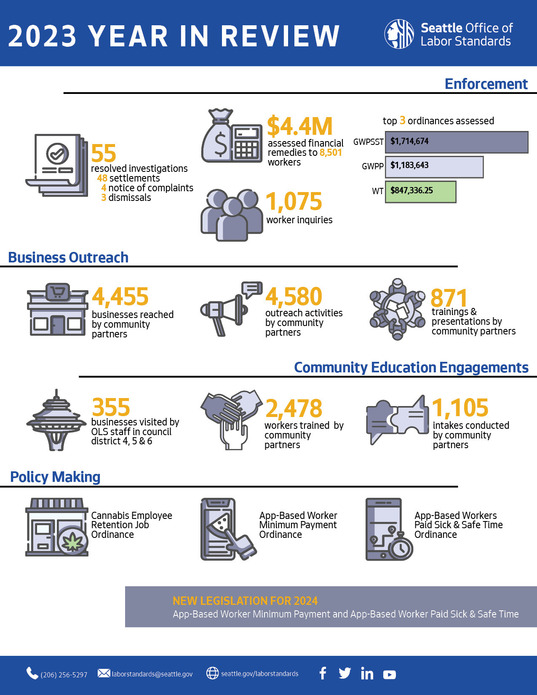
Received 1,075 worker inquiries
-
Investigated 55 cases resulting in 48 settlements, 4 notice of complaints and 3 dismissals with the transportation and food service sectors among the top industries.
-
Recovered $4,490,973 in financial remedies assessed to 8,501 workers.
-
Top three ordinances in terms of financial recovery:
-
Gig Worker Paid Sick and Safe Time - $1,714,674
-
Gig Worker Premium Pay - $1,183,643
-
Wage Theft - $847,336.25
Business Outreach
Business Outreach and Education Fund (BOEF) community partners:
-
Reached approximately 4,455 businesses during the year. The top industry outreach targeted food and drinking establishments, and retail.
-
Conducted 4,580 “outreach activities” which include activities like community events and meetings, door-to-door and business canvassing, tabling, and follow up visits.
-
Conducted 871 total trainings and presentations.
Community Outreach and Education
OLS Outreach Team members and Community Outreach and Education Fund (COEF) partners:
-
OLS staff visited 355 businesses in Council Districts 4,5, and 6.
-
Community partners trained 2,478 workers.
-
1,105 worker intakes conducted by community partners.
In November 2023, the department selected ten community-based organizations, to receive $2,959,503 in funding over two fiscal years (2024-2025) to provide outreach, education, and support to low-wage workers.
Policy Making
OLS Policy Team conducted rule making and shareholder meetings for three new labor standards:
-
Cannabis Employee Job Retention Ordinance
-
App-Based Worker Minimum Payment Ordinance
-
App-Based Worker Paid Sick and Safe Time Ordinance
New Legislation for 2024
New and expanded app-based /gig worker rights:
-
App-Based Worker Minimum Payment Ordinance
-
Effective January 13, 2024, the ordinance applies to certain app-based workers (also referred to as gig workers) and provides for several rights and protections for covered workers.
-
Key rights include:
-
Minimum Payment: Right to minimum pay based on the time worked and miles traveled for each offer.
-
Transparency: Right to upfront disclosures of offer-information and right to receipt and payment records.
-
Flexibility: Right to access the network platform without limitations (except for health and safety limitations), right to not be penalized for limiting availability or refusing offers, and the right to cancel an offer with cause.
-
App-Based Worker Paid Sick and Safe Time (PSST) Ordinance
-
Beginning on January 13, 2024, this law applies to all app-based workers who work at a network company that hires more than 250 workers.
-
Key rights include:
-
The right to take PSST under certain circumstances:
-
To care for themselves or a family member for a physical or mental health condition, including a doctor's appointment.
-
To care for themselves, a family member, or a household member for reasons related to domestic violence, sexual assault, or stalking.
-
When their family member's school or place of care has been closed.
-
If the company reduces, suspends, or discontinues operations for health or safety related reasons.
We look forward to new opportunities for OLS to continue leading the nation in upholding worker protections. At the same time, we remain committed to helping businesses comply with the city’s labor laws, while staying true to our mission of advancing labor standards through thoughtful community and business engagement, strategic enforcement, and innovative policy development, all with a commitment to race and social justice.
Steven Marchese
Director, Office of Labor Standards
|
|
|