|
|
 |
|
A program of the City of Seattle, Trees for Seattle is committed to growing and maintaining a healthy, awe-inspiring urban forest. |
Seattle’s trees provide numerous environmental benefits, including cooling and air purification, making them significant to the city’s overall ecological health. Tree pests are a threat to Seattle’s rich urban forest, and ultimately a threat to our wellbeing. Invasive pests, such as the Bronze birch borer and Winter moth can weaken trees, leading to widespread decline and mortality.
When we have a dominant tree species planted along our streets and in parks, pests that love that tree could quickly cause a lot of damage. When U.S. cities were lined with American Elm trees, Dutch Elm Disease took a devastating toll, wiping out millions of these majestic trees and transforming urban landscapes. While progress has been made in managing Dutch Elm Disease, its legacy remains a cautionary tale about the vulnerability of monocultures.
Seattle has many maples, cherries, and plum trees, but we must maintain a diversity of tree species to mitigate the impact of tree pests. Diversity creates a natural defense system against widespread infestations. Each tree has its own strengths and weaknesses, increasing resiliency and making it harder for pests to spread and cause problems, thus ensuring Seattle’s urban forest stays green and vibrant. “Diversity is the key to fighting adversity”.
|
|
|
|
To answer this question, we turned to Environmental Team Lead Christy Carr from Seattle Department of Construction and Inspections.
Seattle’s new tree regulations have been in effect since July 2023. There are many changes and additions to the regulations affecting trees on private property. Be sure you are familiar with these regulations so you know if a tree may be removed.
Seattle’s tree protection regulations categorize trees into 4 different tier groups.
-
Tier 1 Trees -- all Heritage Trees
-
Tier 2 Trees -- 24” or greater DSH (Diameter at Standard Height is measured 4.5’ from ground), tree groves and trees designated by Director’s Rule 7-2023
-
Tier 3 Trees -- 12” or greater DSH but less than 24” DSH
-
Tier 4 Trees -- 6” or greater DSH but less than 12” DSH
These are regulated trees. In most cases you will need approval for tree removal from Seattle Department of Construction and Inspections (SDCI).
There is some limited tree removal allowed on developed property without SDCI review and approval:
-
Neighborhood Residential, Residential Small Lot, Lowrise, Midrise, Neighborhood Commercial, Commercial, and Seattle Mixed Use zones: Removal of no more than two Tier 4 trees in any 3-year period
-
All other zones: Removal of no more than three Tier 3 and Tier 4 (combined) trees in any 1-year period
The tree regulations also include many tree removal request types for specific conditions such as hazard tree removal, removal of any invasive tree, or due to an insect, pest, or pathogen infestation. These all require approval from SDCI and may require replacement trees. For more information about the types of removal request types and how to apply for an approval to remove a tree, please see SDCI’s Tip 242B Tree Removal on Private Property or contact SDCI staff at sdci-tree@seattle.gov
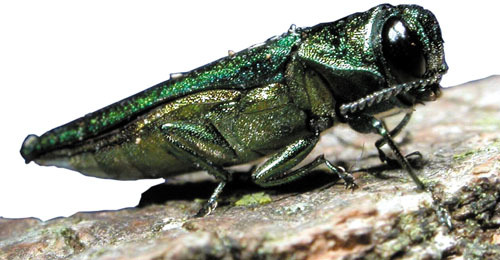 |
The Emerald Ash Borer is an invasive insect native to Asia that has had devastating effects on ash trees. Since its discovery in Michigan in 2002, likely through the transportation of infested wooden materials, the Emerald Ash Borer has spread across the continent killing hundreds of millions of urban and rural ash trees.
These shiny metallic green beetles leave D-shaped exit holes when they emerge from the bark of ash trees, however it is their larvae that do the real damage. The larvae tunnel and feed under the bark, disrupting the tree’s life support. The feeding impacts the trees’ ability to transport nutrients and water, resulting in crown dieback and bark splitting, eventually killing the tree. When Emerald Ash Borer arrive in an area, they are known to cause the death of over 90% of ash tree populations. Trees infested with Emerald Ash Borer typically die within 2-4 years.
USDA’s Animal and Plant Health Inspection Service, Forest Service, and Agricultural Research Service are working together to fight against this pest, aiming to keep ash trees a part of the landscape. To find out more about efforts being made to control the spread of the Emerald Ash Borer, visit USDA’s website.
|
|
|
In late February, the tree service provider registration application for the Seattle Department of Transportation (SDOT) and Seattle Department of Construction and Inspections (SDCI) are being combined into a single application. Once the combined application is launched, property owners can view the complete list of all registered service providers. Check out this page to learn more.
Delridge Neighborhood Tree Care Event at SW Juneau St
Neighbors and Longfellow Creek supporters are joining Dirt Corps and Trees for Seattle in removing weeds and keeping the forest happy along Longfellow Creek! This Tree Care Event is your chance to meet fellow forest volunteers and help support this beautiful section of the Longfellow Creek Trail!
All skill levels are welcome! Please wear clothing that can get dirty, including long sleeves, long pants, and closed-toed shoes. We'll be working rain or shine, so everyone is encouraged to bring rain gear if the weather forecast says chance of rain. We'll be providing the tools, snacks, and water. Bring work gloves if you have them, and we'll have some folks can borrow as well. We hope you'll join us! Please register here.
Meadowbrook Pond Tree Care Event
Saturday, February 24th
10AM - 1PM
Meet at the end of 36 Ave NE near the address 10700 36th Ave NE, and we'll walk into the park to our worksite together.
Seattle Tree Stewards and Dirt Corps are hosting a February Tree Care Event at Meadowbrook Pond! Volunteers are invited to join us in continuing vegetation management (removing aggressive weeds) at multiple locations throughout Meadowbrook Pond. Our work will focus on clearing ivy and blackberry so other plants can thrive, and help keep the paths clear so folks can enjoy their travels around the Pond. We'll meet at the 36th Ave NE entrance, and walk to our worksite together from there. All skill levels are welcome! Please wear clothing that can get dirty, including long sleeves, long pants, and closed-toed shoes. We'll be working rain or shine, so everyone is encouraged to bring rain gear if the weather forecast says chance of rain. We'll be providing the tools, snacks, and water. Bring work gloves if you have them, and we'll have some folks can borrow as well. We hope you'll join us! Please register here.
The Green Seattle Partnership is a collaboration between the City of Seattle, community groups and non-profits, businesses, schools, and thousands of volunteers working together to restore and actively maintain the City's forested parklands. Check out their website and their calendar of volunteer events and signup to support Seattle's forested natural areas.
Events & Volunteer Opportunities
|
|
|
|
|