City Attorney Davison Newsletter: First Quarter News
The first few months of my time as Seattle's new City Attorney has been an incredible opportunity to learn more about the challenges facing Seattle, and get to know the amazing individuals that make up the City Attorney's Office.
Throughout the transition time and during my first few months in office, I was able to meet every single attorney, paralegal, and support staffer across both the criminal and legal divisions. These meetings and introductions have been so important to me, as I have been able to learn so much by listening to people who have been devoting themselves to the important work of this office.
As of today, I am pleased to announce that I have finished hiring my entire executive team. Criminal Chief Natalie Walton-Anderson’s first day was March 1st, and today is the first day of our new Civil Division Chief Tom Kuffel. I can’t even tell you how excited I am to work with both of these incredible leaders and look forward to what we will be able to accomplish together for the people of Seattle. I encourage you to read more about Natalie and Tom on my newsfeed. We are also actively filling vacancies at both the criminal and civil divisions and hope to be fully staffed in the coming months.
The past few months have also been full of new announcements, neighborhood tours and conversations. As I have mentioned before, we are committed to clearing the backlog of nearly 5,000 criminal cases that has grown over the last few years that have been completed by the Seattle Police Department (SPD) and are still waiting for review. First, I announced a new close in time filing deadline for incoming cases in February to ensure that we are not compounding the problem by adding more cases to the back of the list. This is the first step of many as we work to improve public safety in Seattle and to ensure that victims are heard.
I also announced a new High Utilizer Initiative in March that will help us identify individuals responsible for a disproportionate amount of criminal activity in our City to dramatically reduce their public safety impacts. Through this focused effort, my office will coordinate closely with the Seattle Police Department, the King County Prosecutor’s Office, and the King County Jail to disrupt these cycles of crime. By aiming to disrupt criminal activity, it will provide the opportunity to intervene in individual’s lives, advocating for both accountability and behavioral health and substance use interventions to help stop the cycle of addiction, crime, and human suffering we are seeing on our streets.
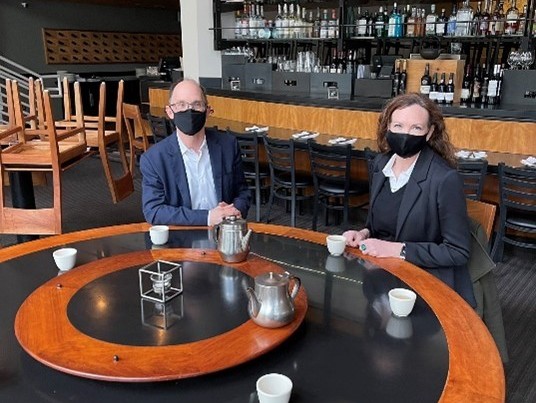 |
I have also made it a priority to get out into the community to hear directly from the people of Seattle about their public safety concerns. This means visiting businesses to speak with owners, employees, and customers. I want to have discussions about the issues facing Seattle and neighborhoods across the city. In the past three months, I have visited the University District, Ballard, Belltown, Chinatown/International District, and Little Saigon, among others. I hope to visit more neighborhoods and connect with the residents and workers of Seattle.
I remain committed to rebuilding our City’s accountability system and ensuring everyone can feel safe in the City that they call home. Our city will see our efforts over time, and until then I can promise that I will be accountable to all the residents, employees, and business owners of Seattle.
To hear the latest updates, connect with my office on Facebook and Twitter.
Stay Safe and Healthy,
Ann
City Attorney Ann Davison announced the launch of a new High Utilizer Initiative. The program will identify individuals responsible for repeat criminal activity across the City of Seattle and aims to dramatically reduce their public safety impacts. To ensure these individuals have access to critical social safety programs, the City Attorney’s Office will prioritize the cases of High Utilizers and work in coordination with public safety partners and service providers.
The High Utilizer Initiative has identified 118 individuals who have been responsible for over 2,400 criminal cases over the past five years. Each of these individuals has twelve or more referrals from the Seattle Police Department (SPD) to the City Attorney’s Office in the past 5 years and at least one case referred in the past 8 months. Most of the charges in cases referred to the City Attorney’s Office involving High Utilizers were theft (1,019 charges), trespassing (589 charges), assault (409 charges), or weapons violations (101 charges). (Some cases involve multiple charges). Because people with a high number of domestic violence or DUI cases are already the subject of additional attention, they are not included in this initiative.
City Attorney Ann Davison announced an immediate change to filing cases in the City Attorney’s Office. Effective February 7, a filing decision will be made in all incoming cases within five business days. This change will stop adding to the case backlog which has grown over the past three years and is the most effective way to immediately tackle crime in Seattle.
Before this action, new cases were sent to the end of the line until they could be acted on accordingly. The Seattle City Attorney’s Office (CAO) Criminal Division has a case backlog of approximately 5,000 cases which can mean up to a two year long waiting period for victims. The current backlog is the largest the City Attorney’s Office has ever experienced.
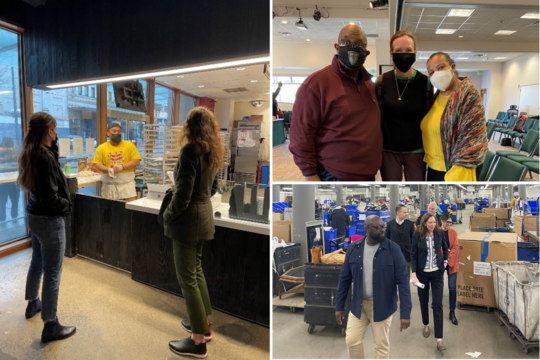 Earlier this year, City Attorney Davison visited Piroshky Bakery and Wild Ginger. Both businesses are located on Seattle’s 3rd Avenue. She spent time with the owners to talk about public safety, and how it affects their businesses. Both business owners spoke about how they are concerned for the safety of their employees and customers. The increase in criminal activity has required cutting hours to keep workers safe.
City Attorney Davison also met with Pastor Harvey Drake and Victoria Beach in February. It was a chance to connect and share valuable perspectives.
In March, the City Attorney met with Goodwill Seattle to learn more about the challenges facing the nonprofit's Dearborn location, and hear about the incredible work that they have been doing in the community for decades.
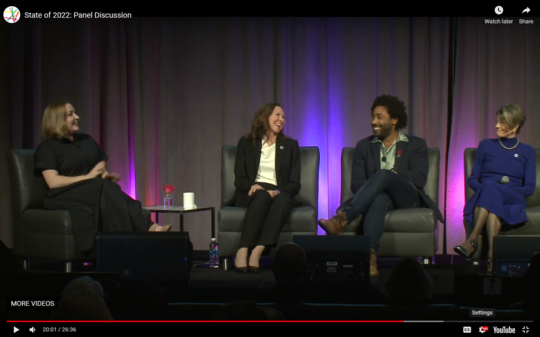 Click to watch the full video
In March, City Attorney Davison joined Councilmember Sarah Nelson and CEO of the King County Regional Homelessness Authority Marc Dones for a panel discussion at the Downtown Seattle Association’s State of Downtown event. Moderated by Brandi Kruse, this discussion touched on topics of public safety and homelessness downtown and the role that elected leaders can play in solving some of our region’s most pressing challenges. You can watch the full panel and read more about the state of downtown here.
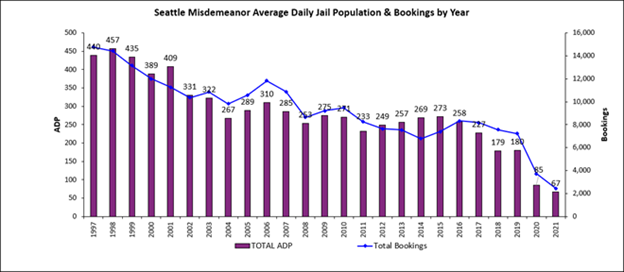 For more context on the challenges facing small business owners in Seattle, Seattle's misdemeanor incarceration rate is at an all-time record low. One of the reported reasons for the lower average daily population (ADP) at the jail in 2020 and 2021 was the public health-related decision to increase social distancing inside the facility during the COVID pandemic.
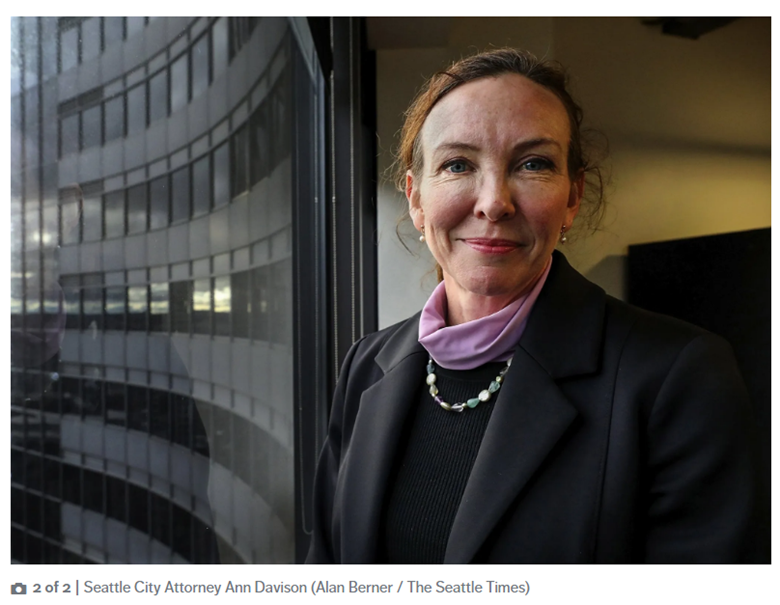 By Sarah Grace Taylor
Restaurant owner Olga Sagan often walks home from one of her two restaurants in downtown Seattle.
“When I’m leaving this location, this would be the quick way to where I live,” Sagan explained on the walk Thursday. “But I don’t walk down that part of Pike.”
“That” part of Pike is a stretch between Third and Second avenues. It has a few ground-level businesses such as a pharmacy and a Thai restaurant, but there’s also frequently graffitied boarded up storefronts, recurring litter and a steady crowd of people sitting or lying on the sidewalk.
Sagan, owner of Piroshky Piroshky, demonstrated her route to and from work recently to newly elected Seattle City Attorney Ann Davison, who wants to prosecute misdemeanors more often and more quickly, in an attempt to aid businesses and public safety.
Sagan’s alternative route, which involves a longer stretch of Third to get to Pine, adding about a block to her commute, has similar, even denser crowds. There’s more trash and more boarded windows, but there also is more security, lighting and businesses.
“It feels safer, but still, it’s always drug use and people shouting at you whichever way you walk,” Sagan said.
“And that’s why we close at 3 p.m. now. I don’t want my employees here or leaving here after dark,” Sagan explained, noting a string of break-ins, drug sales, harassment, indecent exposure and similar episodes in and around her business at the Market at Century Square.
While her landlord has contracted private security, since the Third Avenue location opened in 2019, Sagan says conditions have gotten worse and — along with the pandemic — have caused her sales to plummet from $3,500 per day to $300-$400.
“And businesses can’t operate unless someone does something about crime,” she said, calling for stricter law enforcement.
Davison says that’s exactly what she wants to do.
“That’s why I’m doing these tours with businesses,” said Davison, who took office in January and has visited downtown businesses to seek owners’ input. “I need to understand how I can use my office to help businesses and communities.”
|