|
|
 A draft of the Seattle Hazard Mitigation Plan (2021-2026) is now available for review and public comment! OEM is accepting public comments until January 29th. You can provide feedback through this survey form, or email any comments to HazardMitigationPlanUpdate@seattle.gov.
Every five years, the City of Seattle Office of Emergency Management (OEM) updates the Hazard Mitigation Plan (HMP). This HMP helps us minimize risks to people, property, and the environment from natural and man-made disasters.
Learn more about the HMP and the update process by visiting our Hazard Mitigation Plan Update page. We value your feedback and hope you take time to review the plan and the other project documents.
|
|
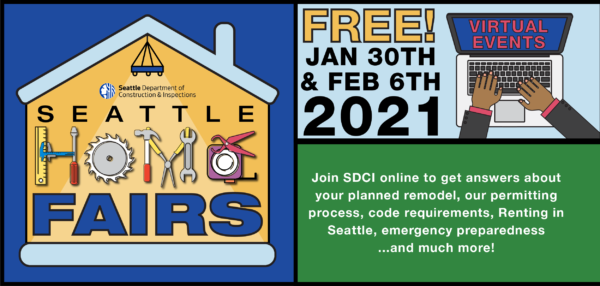 Is your home up-to-date with the latest earthquake safety retrofits? Is your property prone to landslides? The Seattle Department of Construction and Inspections (SDCI) is here to help!
SDCI is hosting the Seattle Home Fairs on January 30 and February 6. This year we’re going virtual with a series of presentations and Q&A sessions. These free events are a great opportunity for Seattle residents to talk to our staff and get answers to questions about a wide range of topics, including:
- Landslide prevention
- Earthquake retrofits
- Rental housing rules
- Getting a permit
- Inspection requirements
- Code requirements
- Tree regulations
- And more!
Sessions will be held online on the following dates and times:
January 30
10:00 a.m. – 3:00 p.m.
February 6
10:00 a.m. – 3:00 p.m.
For more information and to RSVP, go to buildingconnections.seattle.gov/2020/12/31/join-us-for-our-seattle-home-fairs
Was your New Years Resolution to be more prepared for emergencies? Then join us for a FREE training session conducted online. The training can be tailored to your group by a live trainer via a variety of online platforms. All our training is currently offered online only due to COVID-19.
Neighborhood groups, businesses, community based organizations, and others interested in learning more about area hazards and how they can prepare should request a virtual training with the Training Request Form.
OEM offers a variety of emergency preparedness courses, including:
|
 Neighborhood Preparedness (SNAP: Seattle Neighborhoods Actively Prepare)
|
 Disaster Preparedness: The Basics
|
|
 Workplace and Business Preparedness
|
 Emergency Planning for Child Care Providers Workshop
|
|
|

Helen Murphy is a retired epidemiologist and former Family Practice Nurse Practitioner with the US Public Health Service. She worked internationally for twenty years with a variety of NGOs and UN agencies, primarily in emergency relief in politically sensitive refugee camps that at times were under military bombardment.
Her epidemiological research involved developing a home technology to prevent dehydration among Afghan refugee children and spent a number of years studying and preventing the health effects of pesticides among Southeast Asian farmers. She also completed a short tour of duty with the USAID Office of Foreign Disaster Assistance. On returning to the US and before retiring, she ended her working career in occupational health. She was outreach director in an agricultural health and safety research center within the School of Public Health at the University of Washington.
She enjoys volunteering for OEM because she can use her multi-cultural training background and disaster management experience. After so many years out of the country, it is now important for her to serve her city of Seattle and get to know its community groups. EOM has proved the most inclusive organization with whom she has ever volunteered because it offers superb educational seminars. It also highly values their volunteers making them feel part of their team. She has been impressed how EOM allows the volunteers to introduce new training methods and cross-pollinate innovations with each other.
The training is fun to deliver and well accepted by community groups. The biggest hit includes the end-of-session ‘Disaster Jeopardy’ game and the 2- bucket emergency sanitation system complete with pool-noodle-adapted comfortable seats. Her personal favorite disaster preparedness tool is a lantern constructed from an empty plastic gallon water bottle and head lamp which, when turned inward and on, provides excellent lighting. More recently, Helen has been overwhelmed by the enthusiastic acceptance of the SeattleAlert system when handing out information posters and cards for the program to local businesses.
Although 2020 was a challenge, it has allowed one to be grateful for surviving the pandemic, tightening one’s bonds with friends and family, albeit remotely, and the opportunity to build resilience.
OEM thanks Helen and all our volunteers for their contributions to a safer Seattle! To learn more about volunteering with OEM, visit http://www.seattle.gov/emergency-management/about-us/volunteer
|
|
|
|
COVID-19 Vaccine Information
We are currently in Phase I of Washington’s COVID-19 Vaccine distribution plan. This infographic details the tiers or subphases of Phase I.
COVID-19 Testing Information
There are several free testing sites currently operating in Seattle:
- The City of Seattle, King County, and UW Medicine are now offering free COVID-19 testing for people who live, work, or regularly visit Seattle. Drive-through and walk-up testing is available. You must first register online or over the phone. While testing is free, if you have medical insurance, please bring your insurance card or proof of insurance. To learn more about these sites, please visit the City of Seattle COVID-19 Free Testing page
-
Public Health – Seattle & King County is regularly updating their list of free testing sites located all over King County, which also includes community health centers and UW Mobile Clinics. Language and mobility access varies by location. Learn more at Public Health – Seattle King County’s website.
|
|
|
|