|
|


I hope you are healthy and as well as one can be in what has surely been one of the more challenging years we have faced. Change has been a theme this year. HSD staff and our community partners have continued to lead the front-line response to COVID-19, pivoting programs and rising to the many challenges to help those most in need. I am deeply proud of the work we have accomplished together during this crisis.
My work throughout 2020 has been on borrowed time. I delayed an earlier announced departure this spring in order to help the City and our partners respond to COVID, develop HSD’s 2021 budget, and ensure the governance structure of the regional homelessness authority was launched and positioned to hire a CEO. While we continue the work to reduce the impact of COVID-19, I will leave the department in January. This was not an easy decision for me to make—especially given how much the department is holding at this time—but with these priorities accomplished and in good hands, it is time for me to step away.
For more than seven years, I have had the privilege of working alongside you. Together we have accomplished a number of critical projects that have strengthened Seattle’s social safety net and the City’s commitment to advancing equity. Initiatives that come to mind include the dramatic increase in funding to our community-based partners, increased services in shelter and housing for people experiencing homelessness, improving our business practices to be audit-ready, amplifying awareness and funding in support of gender-based violence survivors, continuing our progress for accountability for results and racial equity, the launch of Age Friendly Seattle and the King County Regional Homelessness Authority, and building a sustained response to COVID-19. These few examples only scratch the surface of the work we’ve done together and I look forward to taking more time to celebrate these experiences with you all in the weeks ahead.
This department has strong leadership at all levels, and clearly defined results that each of you contribute to. With the continued support of the Mayor’s Office, this transition will not interrupt the amazing, life-saving work underway. I am heartened by the vision and leadership that Mayor Durkan offers our City. During this transition, the Mayor has named Helen Howell to serve as the interim director while the process to find a permanent replacement begins. Many of us know Helen well from her work at Building Changes and King County and I am excited that she is bringing her wealth of expertise to HSD. You will hear more from Helen in next month’s Lifelines.
My tenure at the City and my partnerships with each of you have affected me enormously, and I will be forever grateful for what I have learned from you and for the opportunity to have worked alongside each of you.
Happy holidays and be well! --Jason
|
|
|
 In November 2019, HSD partnered with The Vida Agency (TVA) to develop a bi-lingual, community informed and designed public awareness and counter-marketing campaign funded by the City of Seattle Sweetened Beverage Tax. Centered on Black, Latinx, and indigenous youth and young adults, the campaign focuses on highlighting the predatory practices of sugar-sweetened beverage (SSB) sellers, offering healthy alternatives to SSBs, and promoting a positive message. The resulting campaign, “Be Ready. Be Hydrated.” launched in July 2020.
|
|
Indoor social gathering restrictions extended through January 4—read updated information.
Here’s what we know: Gathering with people we don't live with—even close friends and family—may spread COVID-19. The more people we interact with at a gathering and the longer that interaction lasts, the higher the risk of becoming infected.
The safest action for everyone is to avoid gatherings, even outdoors, and find different ways to celebrate this season.
Multilingual Content
|
|
|
HSD Goes Virtual for Its Annual Employee Recognition Awards

The MAX Awards, a shortened term for “maximum achievement,” are presented annually to HSD employees whose performance and efforts have made a noticeable difference to their colleagues, the Department and/or the clients and communities we serve.
Reflecting this year’s theme of “Resilience,” the nominations for our annual awards covered the breadth of hard work HSD staff engaged in for 2020 – especially in response to COVID-19. The winning individuals and teams highlighted below were nominated by their colleagues in the following categories this year:
While the co-hosts could only "present" plaques on screen this year, this annual all-staff meeting was a critical moment to remind all of us why we are doing this work, and to pause and reflect on the work happening around us. This is much harder to do in the current environment where so many employees are working from home or only heading into the offices on limited schedules. Recognizing that loss of work culture, the awards also found a few moments to have fun, featuring a funny hat competition and ugly holiday sweater contest. We also paused for a few moments to recognize the tremendous losses so many of us have suffered personally this year, as well as amongst our community partners and clients. Our department also lost a well-known and long time employee, Dwight Mizoguchi, who was previously recognized as a Racial Equity Hero for his work over the years.
Along with some live music, an amazing keynote by Dr. Amarah Khan, Director of the City's Office of the Ombud, and a fun poll on holiday interests, over 230 employees engaged in a reminder of who we are and why we love and support each other. Next Year may we be in person again!
|
 |
New Homeless Shelter Opens in SODO
Back in October, HSD and King County’s Department of Community and Human Services (DCHS) announced a new 24/7, enhanced deintensification shelter opening in Seattle’s SODO neighborhood. This new shelter will offer supportive services, housing navigation, and meets public health standards to protect clients and workers against the spread of COVID-19.
A big THANK YOU to King County TV for recording a video showing the inside of the new shelter and highlighting some of the enhancements made to improve our congregate shelter settings for individuals needing a place to stay as well as preparing us to respond better to future health emergencies.
The shelter began operations last month with the goal of achieving full occupancy by the first quarter of 2021. Our provider will move four existing programs—some of which were basic/overnight only shelters—into a new 24/7 shelter with supportive services and hygiene access. Programs being moved are the existing City of Seattle shelter programs at City Hall and Fisher Pavilion (which was a de-intensifying site for the City Hall program), and King County funded programs at 4th and Jefferson Street and the King County Administration Building. These moves also allow for Fisher Pavilion and City Hall to be available again as severe winter weather shelters.
DCHS also plans to relocate its sobering and recovery support program from its temporary location nearby at the Recovery Café into a section of the SODO site at some point in 2021.
The shelter has a high quality air filtration system, physical space, and hygiene access to handle both wildfire smoke and COVID-19. In September, the facility was temporarily used as a wildfire smoke shelter and served between 80-100 people 24 hours a day.
This new shelter was funded through a combination of Federal and local emergency resources. King County’s lease on the building is for three years.
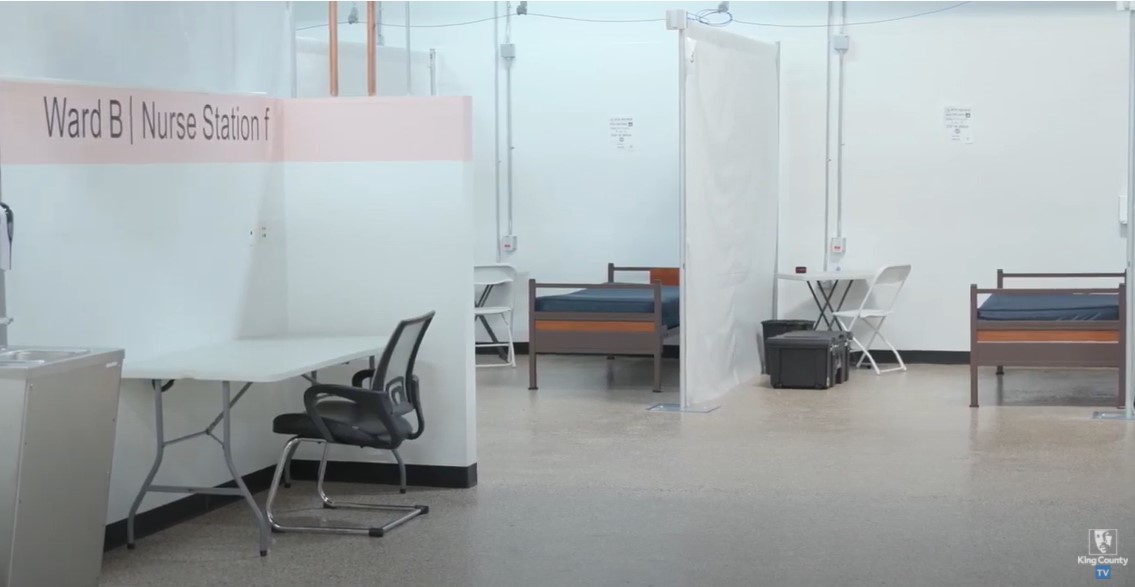 Click above to view King County TV's video on YouTube!
On AgeWise King County: ADS Ramps Up Efforts to Promote Social Connectivity
When the COVID-19 pandemic broke out earlier this year, many health and wellness programs and social activities were cancelled or suspended. Providers quickly stepped up to move programming online, to institute phone-based wellness checks, and to provide other creative means of maintaining social connectivity. Early on, Aging and Disability Services (ADS) planning staff reached out to partners to identify and promote new social connectivity strategies. In addition to ongoing support of senior centers and meal providers, ADS has implemented several projects this year in support of social connectivity.
Jon Morrison Winters, a senior planner in HSD’s ADS division, wrote more about some of the challenges he and his colleagues faced and how they responded with new event ideas and new methods for maintaining social connectivity with the clients we serve. Click here to read Jon’s article.
|
On Public Health Insider: Where is Covid-19 Transmitted in King County? Report Shows Most Common Exposure Settings Are Homes, Workplaces, Community and Social Gatherings
The dramatic recent increase in COVID-19 cases in King County reflects a wide range of activities and settings where people may be getting exposed to the SARS-CoV-2 virus, the virus that causes COVID-19. Instead of a few “hotspots,” COVID-19 risk is dispersed across homes, businesses, and other places where people gather. Currently, with a case-rate above 380 cases per 100,000 residents – more than five times what it was in early October – the virus is widespread in King County. It’s fair to assume at this time that exposure can happen anywhere you are around other people, especially indoors.
A new report on outbreaks and exposure settings from Public Health—Seattle & King County describes settings where people may have become infected and finds the most common reported sources of potential exposure in recent weeks are in households, in a variety of community or social activities and gatherings, and in workplaces. Examples of community and social activities include get-togethers with family and friends, birthday parties, house or dinner parties, larger celebrations such as weddings, activities at a place of worship or visiting food service establishments. These activities, as well as out of state travel, have increased over the course of the pandemic while cases associated with long-term care and other healthcare facilities have decreased.
There are differences in potential sources of exposure by race and ethnicity, geography and age. In some of our most-impacted communities, particularly in south King County, workplaces are more frequently reported as a potential exposure setting. This reflects that in some communities, people have fewer options to limit their exposure, like the option of working from home or isolating from others inside the home if they become ill. When people who can limit their social exposure do so, they’re supporting essential workers and others who may not have a choice. More info on exposures by race/ethnicity and geography.
What We're Reading -- Publicola: Domestic Violence Intervention Project Experiments with Restorative Justice for A Stigmatized Group
The notion of providing treatment for domestic abusers isn’t new, but Seattle’s DVIP is driving a revival of the practice. In 2013, the Washington State Institute for Public Policy (WSIPP) published a report criticizing domestic violence treatment programs as ineffective and expensive, but their conclusions were based on treatment programs that followed a one-size-fits-all intake and counseling model developed in the 1980s and favored in Washington state at that time.
The report marked a low point for domestic violence treatment in Washington. Tonya Dotson, a probation manager with the Municipal Court who specializes in domestic violence, told PubliCola that the report effectively brought the court’s domestic violence treatment referrals to a halt. At the same time, nonprofits in the Seattle area closed their domestic violence treatment services because of lack of support, referrals and funding.
When DVIP emerged five years later as a joint effort between the city, King County, and several local nonprofits interested in proving the value of treatment for domestic abusers, it was designed to address many of WSIPP’s critiques. For example, Judge Eisenberg says, the new program includes elements like in-court progress reviews and varied approaches to treatment.
Read more about how our region's ecosystem for treating domestic violence abusers has changed over time.
On the Human Interests blog: City of Seattle Reminds Residents and Businesses of Resources Available for COVID-19 Relief, Announces $1.7M in funding to support BIPOC Led Organizations Impacted by the Pandemic

Since the COVID-19 pandemic began, the City of Seattle has worked quickly to launch COVID-19 relief programs including rent relief, expanding shelter and services for people experiencing homelessness, grocery vouchers for working families, direct cash assistance for immigrants and refugees, and financial assistance to small businesses. Residents and businesses can find a list of existing COVID-19 relief resources and policies on this website.
Following the recent announcement of $6 million in Equitable Development Initiative funding for site acquisition, capacity building, and capital improvements for community organizations fighting displacement, the Office of Planning and Community Development will provide an additional $1.7 million in funding to support BIPOC-led organizations that have been impacted by the pandemic. Awards of up to $50,000 will go out to 36 organizations to support community-based responses to the pandemic. You can find the full list of recipients here.
There are a series of key programs that are currently available and open to help residents and businesses, including rental assistance, the Small Business Stabilization Fund, Utility Discount Program (UDP), a grocery voucher program, and food assistance.
Click here to read more about these key programs and even more ways that the City is supporting residents during this health care crisis.
|

These two funding processes closed on November 23, 2020. Applications are under reviews and funding announcements will be made shortly.
Visit the joint funding process web page for more information on these two RFQs and to review materials. Please contact Lisa Gustaveson, Strategic Advisor at lisa.gustaveson@seattle.gov or (206) 482-4573 with any questions.
2021 Notice of Funding Availability (NOFA)
HSD is pleased to issue its 2021 Notice of Funding Availability (NOFA) related to the following investments:
- Area Specific - Georgetown, South Park, Delridge - Food Bank Services RFP
- Supporting Youth and Young Adults for Success RFP
This notice provides an overview of HSD's impending funding opportunities for 2021 with a brief description of the service areas for each opportunity, anticipated funding amounts, release dates, and contract start dates. Once finalized, HSD will issue detailed funding opportunities for each investment on our Funding Opportunities page.
|
|
|
 The Seattle Human Services Department (HSD) connects people with resources and solutions during times of need so we can all live, learn, work, and take part in strong, healthy communities.
HSD is one of the largest contributors to Seattle's safety net, investing over $170 million in contracts to nearly 150 community-based organizations and programs that support Seattle neighbors and communities each year. About 400 staff further the department’s role as a funder, convener, and direct service provider to achieve positive results. HSD invests in innovative strategies and effective programs and services that promote racial equity, support basic needs in our communities, and foster connection through collaborative approaches to address six key impact areas:
Preparing Youth for Success
Supporting Affordability and Livability
Addressing Homelessness
Promoting Public Health
Supporting Safe Communities
Promoting Healthy Aging
|
|
|
|
|