|
...The Seattle Department of Transportation (SDOT) Urban Forestry team is still working hard to protect street trees during this time. Street Tree Permits are required to plant, prune, or remove a tree in the public right-of-way. You can now apply for a permit online. For more information about street trees and when a permit is required, visit the SDOT Urban Forestry website.
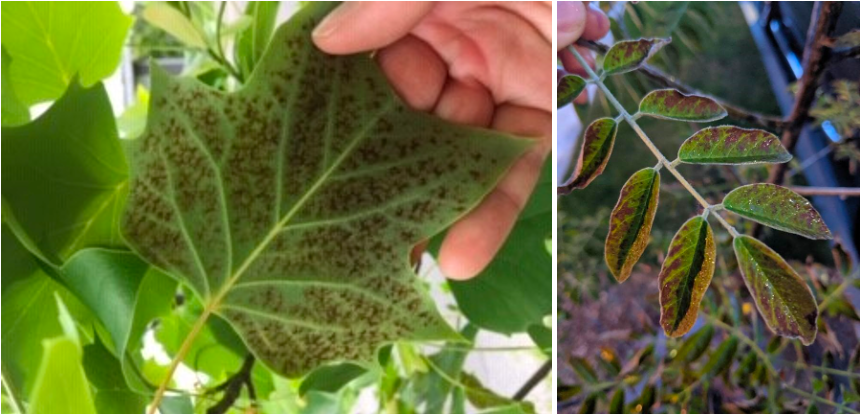 Have you noticed a strange discoloration on leaves lately? Some local trees are showing signs of ozone damage. Even though certain air pollutants, like particulate matter, have decreased during Stay Home, Stay Healthy measures, harmful concentrations of ground-level ozone remain. Unlike the naturally-occurring atmospheric ozone that helps to protect us from the sun’s ultraviolet rays, ground-level ozone is formed when automobile emissions and other industrial pollutants create a chemical reaction when exposed to sunlight and heat. This effect is worsened by climate change, with extreme heat events becoming more frequent. Ozone damage shows up on trees as purplish-brown speckling on the tops of deciduous leaves, and yellow mottling on the needles of conifers. While ozone damage alone typically won’t kill a tree, it’s another source of stress that, when combined with other factors like pests or drought, can greatly compromise a tree’s health.
The urban forest plays a critical role in reducing ground-level ozone. Shade provided by the tree canopy blocks sunlight and keeps temperatures cool, which is particularly important along busy streets and parking lots where ozone is most likely to form. We can help minimize ozone pollution by planting, caring for, and preserving Seattle’s trees. Check out our website and explore the Urban Forestry Online Storymap to learn more.
Healthy Trees, Healthy City: Social Benefits of a Robust Urban Forest (Online Webinar)
When: Thursday, June 4th, 6pm – 7:30pm
Where: Online (via Zoom Webinar)
Register: Fill out this form
A link to access the Zoom Webinar will be provided via email before the start of the event
We often talk about the aesthetic and ecological value of our urban forest, but did you know there are incredible social, mental and physical health benefits of trees in our city as well? Join us in an interactive online workshop where Dr. Kathy Wolf will introduce us to the inspiring social science research currently at the forefront of urban forestry. Learn about the role trees can play in improving the health and well-being of our communities, particularly as we cope with the COVID-19 pandemic.
Instructor Dr. Kathy Wolf is a research social scientist at the University of Washington's College of the Environment. She investigates people's perceptions and behaviors in regard to urban landscapes. Her work is based on the principles of environmental psychology and explores the human dimensions of open space, urban forestry, and natural resources.
Questions? Contact us at TreeAmbassador@seattle.gov
All in-person Trees for Seattle Events are cancelled until further notice
Everyone's health and safety is always our number one priority. Due to the emergence of novel coronavirus (COVID-19), all in-person Trees for Seattle events are cancelled until further notice. We will resume hosting volunteer opportunities and other tree-related events when the guidance from health officials supports public gatherings again. In the meantime, keep an eye on our website for virtual ways to stay engaged and updates on this year's Trees for Neighborhoods program.
|