|
Welcome to Clean Air Quarterly, a newsletter from the Ports of Seattle, Tacoma, and The Northwest Seaport Alliance (NWSA) sharing clean air and climate efforts across our gateway. Each issue showcases recent projects and milestones, features a staff member or partner making a difference in our gateway, and highlights upcoming opportunities for engaging with the ports, including bus tours, commission meetings, webinars, and events!
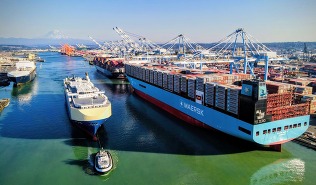
As a part of our shared commitment to advance the Northwest Ports Clean Air Strategy, the three ports each adopted specific action plans to advance their efforts towards a zero-emission future. As we enter the second half of the decade, both the NWSA and the Port of Tacoma are renewing their efforts through updated five-year Clean Air Implementation Plans (CAIPs).
In January, the Managing Members adopted a NWSA CAIP for 2026 through 2030, building on progress made over the last five-year period (2021-2025). Some key actions include completing shore power installation at major international container terminals in Seattle and Tacoma, deploying zero-emission trucks across the NWSA gateway, and launching a cargo-handling equipment (CHE) zero-emission technology demonstration program. NWSA will also continue advocating for funding at the state and federal level and deepening its community engagement efforts. Development of the plan included extensive collaboration with industry, community, and government partners to ensure stakeholder priorities were reflected. The plan will be made available on the NWSA website in the coming weeks.
The NWSA’s action followed the Port of Tacoma Commission’s adoption of its new CAIP in November, providing a blueprint for clean air efforts through 2030. Over the last five years, the Port made progress by electrifying its vehicle and CHE fleet and incorporating sustainable design into the new Maritime Center. The updated CAIP builds on these efforts to reduce emissions under the Port’s direct control and includes new actions to address emissions at the Tacoma Grain Terminal. The new plan can be read here.
|
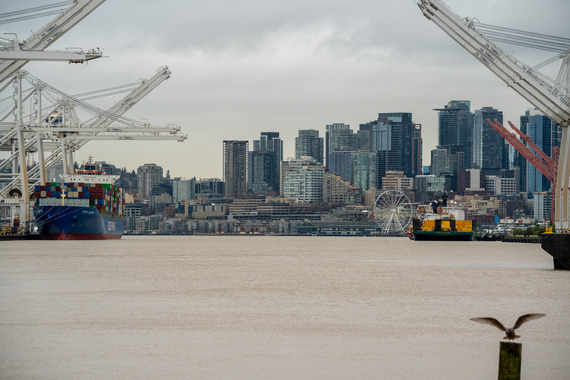
The Port of Seattle is seeking a Community Capacity Building Consultant to design and implement a crucial Community Liaison Program for our Powering Maritime Innovation project. This project is funded through an EPA Clean Ports Grant awarded last year.
Working with Port and NWSA staff and Duwamish Valley Community Partners, the Consultant will help establish a foundation for collaborative and inclusive engagement across the Duwamish Valley and broader South King County area. The resulting Community Liaisons will play a key role in providing multilingual public education and awareness on the pathway to zero-emissions cargo operations.
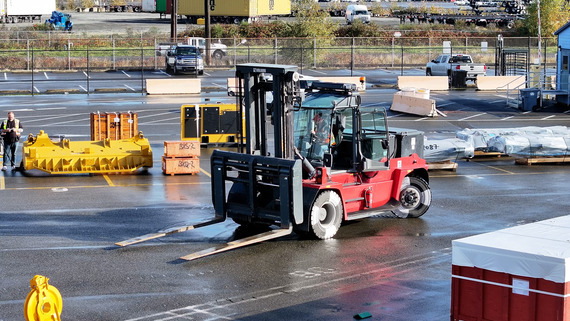
At the East Blair One (EB-1) Terminal in Tacoma, the NWSA is accelerating its transition to zero-emission operations as part of its goal to eliminate emissions under its direct control by 2040.
In November, NWSA purchased a new electric forklift capable of lifting up to 36,000 pounds and operating for eight to ten hours before recharging, replacing diesel-powered equipment at the terminal. This is the first of several electric forklifts planned for EB-1. NWSA has received a total of $2.6 million in funding from the Washington State Department of Transportation (WSDOT) Port Electrification Grant program to purchase at least three additional zero-emission forklifts and associated charging infrastructure for the terminal.
The NWSA is also electrifying its light-duty and passenger vehicle fleet at EB-1. In late 2025, the Port was awarded $80,000 from the Department of Ecology’s Charge Where You Are grant program to install Level II vehicle chargers supporting up to twelve electric vehicles in the port’s fleet.
These deployments are part of a broader zero-emission transition effort. Through a Clean Ports Planning Grant from the U.S. Environmental Protection Agency, the NWSA is developing a zero-emission terminal plans for both EB-1 and Washington United Terminal (WUT). This effort will develop roadmaps for how to transition all on-terminal assets, including cargo-handling equipment and fleet vehicles, to zero-emission by 2050 or sooner.
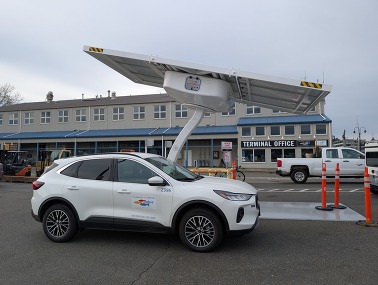
Two new solar-powered BEAM charging units were delivered last week to support the Port of Seattle’s Maritime Division fleet charging. One unit will be installed at Fishermen’s Terminal (FT) and the other at the Marine Maintenance North Office (MMNO). These units will support charging of Port electric vehicles until permanent infrastructure is in place. If needed, they can be easily relocated in case of natural disasters or emergencies to provide natural on-demand power. The future is bright!
|
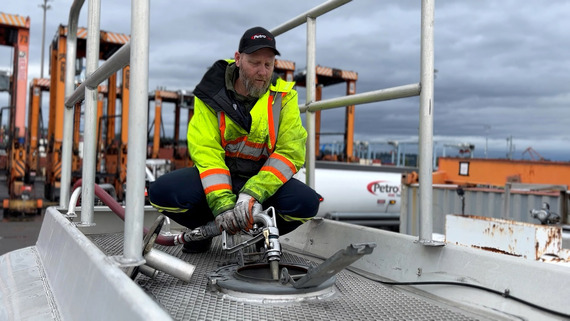
Recently, Lineage Logistics, a key supply chain partner to NWSA that plays a critical role in the movement and storage of goods across our gateway, made the switch to renewable diesel to fuel its drayage fleet. Renewable diesel (RD) is a drop-in fuel that provides immediate emission reductions compared to conventional diesel, and availability continues to grow statewide thanks to policies such as the Washington State Clean Fuels Standard. Learn more about Lineage Logistics’ renewable diesel use and other sustainability efforts here.
In addition to the Ports own fleets, other recent adopters of renewable diesel include Husky Terminal and SSA Marine, which operates Terminal 5 and Terminal 18.
Tell us about Clean & Prosperous and your mission
Clean & Prosperous is a nonprofit, nonpartisan organization driving practical strategies that reduce carbon emissions and support economic growth in Washington state. We advance smart clean energy solutions that grow Washington’s economy, improve public health, and create a more resilient future.
How is Clean and Prosperous working to advance zero-emission heavy-duty trucking in the Puget Sound?
We have been working for years to advance zero-emission medium- and heavy-duty (MHD) vehicles in Washington state! It is a central element of our work to decarbonize transportation and improve air quality across Washington.
In 2021, after the passage of the Climate Commitment Act and the Clean Fuel Standard, Clean & Prosperous led our first study mission to California to learn about the implementation of their own cap-and-invest program. On that study mission, we learned about California’s nation-leading effort to decarbonize medium- and heavy-duty vehicles, so we returned the next year to go on a deeper-dive about that program specifically. Inspired by that study mission, and with the understanding of the significant impact diesel emissions have on Washington’s air quality and environment, we launched our Medium- and Heavy-Duty working group to advance a similar program here in Washington.
Working alongside climate, labor, and business partners, we successfully encouraged the Legislature to make a point-of-sale voucher program like California’s a priority. That program - called WAZIP - will launch later in 2026.
What type of challenges have you encountered with the transition to electric vehicles, particularly in the heavy-duty sector?
First, it is clear that businesses in Washington state want to make this transition. In terms of challenges, it is a difficult time to be in this industry. There is a reduction in freight demand, the expiration of federal incentives, and uncertainty around how things like tariffs can impact a business’s bottom line.
The upfront costs of medium- and heavy-duty zero-emission vehicles are significant, particularly around Class 8 vehicles. Businesses need vouchers, and they need vouchers at a level that will make a meaningful impact on vehicle prices.
We also know that lack of charging infrastructure is a huge barrier, along with uncertainty around new technologies and a lack of understanding or experience on how to integrate electric vehicles into an organization’s operations. Fortunately, the infrastructure is being built right now. It is just a matter of making sure that people know that infrastructure exists, that more is coming, and connecting people with the information they need to make the best choice for their business.
The higher insurance costs for the heavy-duty end of the electric vehicle spectrum can also be a deterrent for some. We expect, however, that as more vehicles hit the road and the technology is more proven, insurance costs will come down.
Please tell us about your work with the Washington Zero-Emission Vehicle Incentive Program and the Breaking Barriers Collaborative.
Launching statewide in 2026, the Washington Zero-Emission Incentive Program (WAZIP) will help bring more zero-emission trucks to Washington’s roads by offering financial incentives to support the transition to battery-electric or fuel commercial vehicles. Our MHD Working Group, made up of stakeholders including manufacturers, dealers, and fleet operators, helped pave the way for WAZIP and informed program development.
We are thrilled to have helped secure $126 million in Climate Commitment Act funding for WAZIP, and to serve as a program subcontractor providing technical assistance and facilitating outreach and engagement to vehicle manufacturers and dealers.
Clean & Prosperous is also a founding member of the Breaking Barriers Collaborative, which supports school districts and fleet operators in accelerating their transition to electric vehicles and provides the knowledge, resources, and networks to develop a cost-effective electrification action plan. We continue to serve on their steering committee to help guide strategy, facilitate industry connections, and support outreach and marketing.
Any other highlights or goals that you would like to share?
Electrifying our transportation sector is undoubtedly going to increase our load growth in Washington state. Net-Zero Northwest is predicting Washington’s electricity demand to grow by 77% by 2045 due to increased load - and that does not include data centers.
A 2025 report from Oregon Public Broadcasting and ProPublica found that Washington was dead last in the country in renewable growth. If we do not have the clean energy needed to power our electrification efforts, so much of the work we are doing on incentives and charging infrastructure will be in serious trouble.
That is why Clean & Prosperous partnered with Greenline Insights on the new Build Sustainable High Impact Infrastructure Together report. The report evaluates more than 250 individual clean energy projects and found that - over the next 10 years - Washington’s clean energy pipeline could result in 24 gigawatts of new electricity generating capacity, $149 billion in economic output, and more than 580,000 jobs.
These projects represent a substantial buildout pipeline and a large set of investments ready to advance if development pathways become more efficient and predictable.
|
|