 |
|
Currently there are no teacher trainings on the calendar.
|
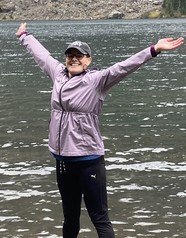
About Crystal Moore
Crystal Moore lives in Snohomish with her husband Vince and two daughters (Kaydence, 11, and Londyn, 8). She has been teaching in the Everett School District for 16 years. Having taught grades K-3, she has decided that 1st grade is her favorite and would love to stay there until she retires. When she can find some free time, she loves to fuse glass.
Tracy Godat, FEPPP Executive Director, sat down and asked Crystal some questions about her teaching experience and here’s what she had to say.
TG: Since you are an elementary school educator – What is your method for putting personal finance into the classroom?
CM: That is tricky. I am still figuring it out – but I really like incorporating the Teaching Economics With Children’s Literature I received from FEPPP trainings. I like to make sure I hit on what money is, why it is important and how we use it every day. Also, why we have jobs, goal setting and how they all work together. I introduce entrepreneurship as well. When I learned that kids are very young when their spending habits are set, it really stuck with me that this is important.
To continue reading the article please go to feppp.org.
|
The 2022 Washington State Legislature passed 2SSB 5720 requiring districts to adopt one or more financial education goals by March 1, 2023. FEPPP has developed a nonexhaustive menu of model goals. The final bill report can be found on the Washington State Legislature website(link is external).
Goals for Expanding Financial Education Instruction. Each school district, charter school, and state-tribal compact school, by March 1, 2023, shall adopt one or more goals for expanding financial education instruction to students in their district. Examples of goals that school districts may adopt include:
- increasing the number of financial education courses available to students in grades 9 through 12;
- increasing the number of grades, schools, or both that provide students with instruction in, or access to instruction in, financial education; and
- expanding the amount of financial education professional development training available to certificated staff.
Financial education materials, like most public school curriculums, are written by and for the largest market segment – the middle class. Studies evaluating the effectiveness of financial education programs repeatedly conclude that there is a need for materials that are relevant for students from low-income households. This work is designed to help educators make their financial education classes more inclusive by recognizing the differences in perspective and experience of all students. Identifying and adjusting for these differences can be the difference between a lesson that resonates with all students and one that leaves a quarter of your class unchanged in any meaningful way. If our experiences and our curriculums don’t reflect the world of our students, how do we ignite student interest? This is the question we hope to address in this booklet. We hope that this booklet will provide a fresh perspective and give you permission to explore new methods for your classroom focused on inclusivity for all students, expanding their world to include multiple perspectives. Our goal is to share with you where there is potential for improvement in our standard curriculums, and how we work to fix them. This is just the beginning of this conversation.

 |
Join us ONLINE or IN-PERSON at 1570 Irving St. SW. Tumwater, WA 98512.
- Budgeting workshop - teaches how to set financial goals and create a budgeting plan.
- Credit & Debt workshop - details how to build and improve your credit history and make a debt payoff plan.
- Consumer Cautions workshop - teaches techniques to start budgeting conversations with your family and avoid identity theft.
Workshop A: “Financial Wellness 101 - Part A: Budgeting”:
Learn the steps towards financial wellness. This workshop will discuss financial basics such as setting financial goals and creating a budgeting plan. Bring your questions and get ready to put the information into practice.
Workshop B: “Financial Wellness 101 – Part B: Credit & Debt”:
Learn the steps towards financial wellness. This workshop will discuss financial basics such as understanding your credit score, building & improving your credit history, and making debt pay off plans. Bring your questions and get ready to put the information into practice.
Workshop C: “Financial Wellness 101 – Part C: Consumer Cautions”:
Learn the steps towards financial wellness. This workshop will involve such topics as budgeting conversations with partners and/or family, comparing employment packages, and identity theft prevention & awareness. Bring your questions and get ready to put the information into practice.
December
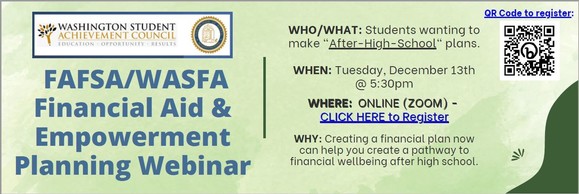 FAFSA/WASFA Financial Aid & Empowerment Planning Webinar
Tuesday, December 13th at 5:30 pm
Christina Winstead of the Washington Student Achievement Council and John McKenney of the Office of the State Treasurer have partnered to provide a webinar covering: creating a monthly financial/budgeting plan and how to apply for postsecondary funding with the FAFSA and the WASFA.
Setting up a realistic financial empowerment plan or budget and completing the FAFSA & WASFA application can be a confusing process. But with some help and a plan, it can be an easier to accomplish. Please join us as we delve into both topics to get you started on a financial path of success. Register today and we look forward to seeing you online soon!
 |
New research shows college and financial aid improve long-term economic outlook for low-income Washington students
Many of the most economically disadvantaged recipients of need-based financial aid surpass their parents financially within three years of college graduation, a new report from the Washington Student Achievement Council (WSAC) finds. There is consistent evidence that education contributes to economic equalization.
WSAC’s report, Intergenerational Economic Mobility of Need-Based Financial Aid Recipients in Washington: Evidence from Three Years After Postsecondary Graduation, provides detailed analysis. Learn more and view the report.
Contact
Katie Tallman, Communications Director 360-252-9997 or media@wsac.wa.gov
|
Get help applying for financial aid
Do you need money for college or career training? Do you have questions about financial aid? There are people and programs available to help:
- The 12th Year Campaign and partners are hosting virtual financial aid info and filing events to help students and families learn more and apply for aid.
- The Washington State Student Loan Education Site helps families better understand education costs and considerations.
-
OtterBot is a free texting service that sends financial aid info and reminders to high school seniors and juniors who signed up for the College Bound Scholarship. Get started by texting "Hi Otter" to 360-928-7281.
- Connect with the financial aid office at any colleges you’re considering. Your high school counselor can also answer questions and direct you to more resources.
Financial aid applications are now available for the 2023-24 school year that begins next fall. Learn more, get support, and apply for financial aid at wsac.wa.gov/apply.
 Join us for our professional learning series, Transformative SEL for Educators: Connecting Healthy SELves to Healthy Communities!
PESB is hosting this virtual interactive social emotional learning (SEL) series all about developing your own SEL capacity throughout the school year. Research has shown that teachers who developed their own SEL skills not only improved their own well-being, but also improved the social, emotional and academic development of their students. Through this series, you will cultivate your identity as an educator, as well as reaffirm your purpose. The series will help you strengthen your community through self growth, inquiry, and lived experiences.
While you may choose to attend any or all of these interactive sessions, they do build on each other, so attending the entire series is encouraged. This series is open to all educators, including ESAs, teachers, paraeducators, administrators and classified staff. Free clock hours are provided for each session through OSPI.
Series Calendar
Register for each professional learning series below.
|