|
As we welcome students back to our schools and continue virtual learning, using effective and equitable instructional practices remains paramount.
Mathematically Productive Instructional Routines (MPIRs) offer quick strategies to engage students in meaningful conversations and use of the Standards for Mathematical Practice. In each newsletter this year we will highlight an MPIR with recommendations for how to use it in a blended or distance learning setting.
Notice and Wonder

To learn more about the Notice and Wonder routine please visit the Notice and Wonder page on Learning Space.
|
Articles and blogs to check out for more information about Notice and Wonder:
Ever Wonder What They'd Notice
By Annie Fetter
Annie Fetter (@MFAnnie) gives a talk on April 15, 2011, called “Ever Wonder What They’d Notice?” at the Ignite talks hosted by Key Curriculum Press during the 2011 NCTM Annual Conference in Indianapolis, IN.
Notice and Wonder
By NCTM
Resources and Teaching Aids to help bring Notice and Wonder to your classroom. (Targeted towards Elementary)
The Power of Noticing and Wondering
By Greta Anderson
Greta talks about the magic of using Notice and Wonder in the classroom.
Strategies for Using Notice and Wonder in a Virtual Setting
Asynchronous and Synchronous:
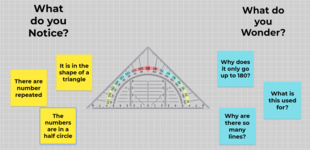
Jamboard- Create a Jamboard and have students use the sticky notes to record that they Notice and Wonder.
Example of a Notice & Wonder on Jamboard.
Desmos- Students can engage in the Notice and Wonder either asynchronously or synchronously. Teachers can track student progress and view responses. Make an activity from scratch or start with one that has already been published and personalize it.
What's Going on in This Graph?
Desmos has collaborated with the New York Times Learning Network and the American Statistical Association to help students experience the power of statistical literacy in the world around them in a feature called What’s Going on in This Graph?
Google Slides- Create a google slide that can be shared with students. Students can complete the activity either on their own and submit, or it can be completed with a group of students.
Peardeck/Nearpod- Put a slide in a Peardeck/Nearpod so that all kids can respond with text/drawing and then share.
Use Chat- Have students type their Notice or Wonder in the chat but have them wait to press enter until you announce so no one gets robbed of thinking or wait time. This strategy is often called Chat Waterfall.
Flipgrid- Students can explain their thinking by creating a video and can comment on each other’s reasoning. Or the teacher can show a few of the videos during a live session and have a class discussion about the different strategies featured.
Mentimeter/Slido- Have students submit their Notice and Wonder. This allows all voices to be heard and the app collects and compiles student responses.
Breakout rooms- Send students to breakout rooms of 3-4 to allow time for students to discuss their reasoning together. Use any of the tools above as a means for students to interact and discuss.
Resources for Notice and Wonder
Locations to check out for Notice and Wonder resources:
Fellows
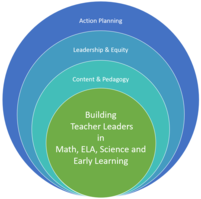
The Washington State Fellows’ Network is a grassroots program supported by a partnership between OSPI and the Association of Educational Service Districts (AESD). This three-year program is designed to build teacher leaders in Mathematics, Science, ELA and Early Learning through ongoing professional learning and collaboration. Although Fellows have traditionally met four times each year within their region, in 2020-21 math fellows met virtually to develop relationships across the state.
Applications for 2021-22 Fellows will open in early May and can be found on the Fellows’ page on OSPI’s website.
|
From the Superintendent: Students Will Not Take State Tests This Spring
OLYMPIA — April 14, 2021 — After submitting accountability and state assessment waiver applications to the U.S. Department of Education (Department) in March, it is clear that the needs of the students of the State of Washington cannot be achieved through the current design of the Department’s waiver process. Washington has been granted an accountability waiver, but thus far has not received the flexibility students, families, and educators need for spring assessments.
I have made the determination that Washington state will not be administering the Smarter Balanced Assessments or the Washington Comprehensive Assessment of Science this spring. Instead, our assessment window for the 2020–21 school year will be in the fall — a timeline consistent with guidance provided by the Department to satisfy federal testing requirements...
For more details and to view the full statement: Students Will Not Take State Tests This Spring.
Fact Sheet: Fall 2021 State Assessment Plan
Learn & Plan with PBS
PBS member stations in Washington are partnering with the Office of the Superintendent of Public Instruction to support educators as you continue to teach in challenging circumstances.
“PBS LearningMedia resources has a wealth of video and primary source materials that are paired with high quality lesson plans. Through PBSLM, teachers have the chance to discover local and national resources and innovative ways to use them in the classroom.” ~Susan Gerard, Secondary Social Studies Coordinator, Spokane Public Schools
Learn, interact with other teachers, and build lesson plans during “Learn & Plan with PBS” sessions with staff from Washington PBS member stations. Earn one clock hour for each session you attend, plus an additional two clock hours if you create a lesson plan using a PBS resource. Sessions are April 26th and May 24th from 4 – 5 pm. Register HERE.
Here are 5 steps to help you start incorporating PBS educational materials into your teaching:
- Review this printable flyer that highlights the features of PBS LearningMedia to support teaching & learning.
- Watch this 30-second video that provides an overview of the educational benefits of PBS LearningMedia.
- Create a PBS LearningMedia account for access to free content, tools to build quizzes, puzzles, storyboards and to connect with Google Classroom, Schoology, and other learning management systems.
- View video tutorials (under 5-minutes each) to learn how to get the most from PBS LearningMedia resources.
- Browse the current Teacher Planning Kit (for PreK–12) for ready resources on PBS LearningMedia tied to themes and content relevant to what you’re teaching in your classroom. A recorded webinar about the current kit and the full collection of kits can be found here.
If you have questions or would like to connect with staff from one of the PBS member stations in Washington, please fill out this form or contact Cathryn Burby, cburby@kcts9.org.
Supporting Summer Learning Through PBL Planning Grant
OSPI is offering short-term planning grants for Spring 2021. Funds will support planning and resources to design summer Project Based Learning (PBL) experiences that focus on a relevant community issue or problem.
The goal of this grant is to plan for a summer PBL experience focused on a complex question, problem, or challenge that will enhance student learning and meaningfully integrate standards-aligned content.
Planning Grant Walkthrough
April 26, 2021
4:00 pm–4:30 pm
Register to attend webinar
Recording will be available after event
Proposals due: May 6, 2021 (4:00PM)
Application Questions and Scoring Rubric
This grant is only for planning the summer opportunity and has an end date of 6/30/21.
OER Project Grant
OSPI’s K–12 OER Project Grant targets the development of openly licensed instructional materials that educators may freely adapt and share. This project targets content areas currently lacking in standards-aligned OER and/or designed for delivery in a blended or hybrid learning environment.
This competitive grant opportunity for 2021–2022 will open on May 1st in iGrants.
-
Review the grant announcement that has all the information about the opportunity and plan your submission
-
See the work other grantees have done
-
Register for the Project Grant Walkthrough on May 4 at 3:30 pm
|
OSPI OER Project Grantee Showcase
Join the 2020-2021 OER Project grantees for a look at their newly developed resources - available now on the Washington OER Hub.
May 5, 2021
3:30 pm– 4:30 pm
Register on pdEnroller
One clock hour provided for online attendance
Zoom link sent to participants prior to event
What to Expect
- Explore resources developed by Washington OER Project grantees in financial education, health and fitness, science, social studies, STEM, and world languages
- Discuss strategies for effective implementation
- Learn how to adapt grantee resources to meet district needs
Exploring Math Through Stories
Great stories are a wonderful way to get young people of all ages excited and interested in mathematics. The annual book prize, Mathical: Books for Kids from Tots to Teens, recognizes the most inspiring math-related fiction and nonfiction books that bring the wonder of math to life.
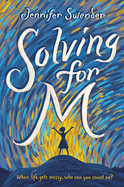
Solving for M (2020 Mathical Award Winner)
Written by Jennifer Swender
3rd through 6th grade
When Mika starts fifth grade at the middle school, her neat life gets messy. Separated from old friends and starting new classes, Mika is far from her comfort zone. And math class is the most confusing of all, especially when her teacher Mr. Vann assigns math journals. Art in math? Who’s ever heard of such a thing? But when challenges arise at home, Mika realizes there are no easy answers. Maybe, with some help from friends, family, and one unique teacher, a math journal can help her work out problems, and not just the math ones.
Key Math Concepts
- Math-Life connection
- Problem Solving
- Girls in Math
Reading Guide
Want to enjoy Mathical books with the children around you? Feeling uncertain about guiding them through the book?
Visit the authors website to access educational resources for Solving for M.
Copyright © 2020 All Rights Reserved. Mathematical Sciences Research Institute.
|
Bridge to College Summer Institute

Registration now open for the 2021-22 school year
The Bridge to College Math Virtual Summer Institute will have two format options.
1. Virtual Summer Institutes:
- New Bridge Teachers: August 3 & 5, 2021
- Returning Bridge Teachers: August 4, 2021
- A combination of virtual and asynchronous learning.
2. Online Self-Paced Course:
- Available in New and Returning Teacher formats
- Opens mid-August and must be completed by August 31, 2021.
- A completely asynchronous version
• The New Teacher Summer Institute is mandatory for new teachers and prepares teachers to begin teaching the course with additional professional learning throughout the school year.
• The Returning Teacher Summer Institute is available to returning teachers; it is required for those who have not yet completed their required professional learning and optional for all others.
• All virtual sessions include asynchronous follow-up work.
To Register: Districts register for the course at BtC. Registration information for teachers will follow.
|
Additional Information about the course can be found at bridgetocollegecourses.org and OSPI or contact OSPI Director of Mathematics, Arlene Crum at arlene.crum@k12.wa.us or 360-789-7143.
Modeling Our World with Mathematics Summer Institute

We are excited to announce that the Modeling Our World with Mathematics (MOWWM) Summer Institute is now open for registration.
The Modeling Our World with Mathematics (MOWWM) Summer Institute is a free training designed to provide teachers with the familiarity and support to implement the full course and its accompanying assessments in the 2021-22 school year. Teacher familiar with the course will also have the opportunity to engage with updated materials.
Details
The Summer Institute will have two optional formats:
1. Virtual Summer Institute:
- New MOWWM Teachers: August 10 & 12, 2021
- Returning MOWWM Teachers: August 12, 2021
- A combination of virtual and asynchronous learning.
2. Self-Paced Course:
- Available Late August, 2021
- Available in New and Returning Teacher formats
- A completely asynchronous version
• Teachers who are new to MOWWM complete prework and attend both days of the training
• Teachers who have previously taught MOWWM attend only the second day
• All virtual sessions include asynchronous follow-up work
|
Additional Information about the course can be found on the OSPI website or contact OSPI K-12 Mathematics Specialist, Jennifer Cronquist at jennifer.cronquist@k12.wa.us.
WAMC Virtual Spring In-service
Friday, May 7, 2021 7:00 - 3:00
Sharing of virtual math lesson plans and labs derived from our Spring and Fall In-service and our week long Summer Conference.
Includes six (6) STEM Clock Hours
Click here to learn more and register
|