|
Do you have Styrofoam or Electronic Waste you need to dispose of? Bring it out to our collection event!
WHEN Saturday June 8th 10AM - 12PM
WHERE Lynnwood Operations and Maintenance Center
20525 60th Ave W, Lynnwood, WA 98036
Check the website here for list of accepted material and more information.
Recycling Collection Events sponsored by the Washington State Department of Ecology.
Did you know that our state recently began a new initiative to help Washingtonians "Use Food Well?" The campaign focuses on waste reduction in terms of unused food. Did you know that food waste costs the average family $1,500 per year? Or that Washington State generated 1 million TONS of food waste in 2021?
This new initiative has tips for meal planning, and using commonly wasted ingredients in recipes. Additionally there are resources for donating unused food, composting, and much more! Please check out their website here!
There are a lot of new bills coming down that will have a positive impact on waste reduction, especially in connection to removing organics from the garbage stream, and making those organic waste streams clean and usable. Check out this information the Washington State Department of Ecology.
In March 2024, the Washington State Legislature passed Organics Management Law 2.0 (OML 2.0), including changes to the compostable product labeling standards (“Plastic Product Degradability,” chapter 70A.455 RCW). Below is a summary of key updates that go into effect June 6, 2024.
This bill changes the original Organics Management Law (OML 1.0) passed in 2022, and both will help reach our statewide climate and waste reduction goals. OML 1.0 included labeling standards for compostable products in an effort to support facilities that accept these materials and ease consumer confusion. Consumer confusion adds to contamination, which makes composting more difficult and expensive.
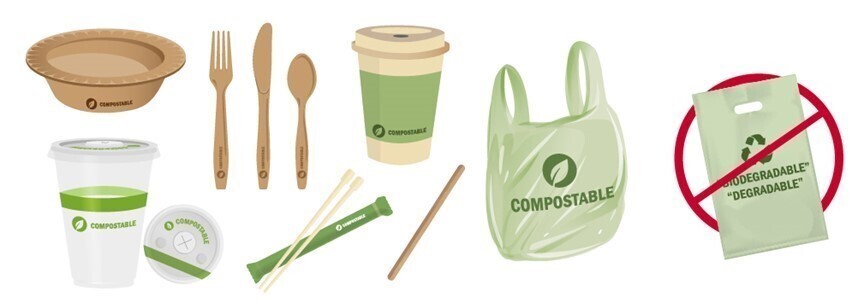 Expanding the definition and standards for product compostability
-
Exempt: Products made from wood are considered compostable and do not need to be labeled in accordance with the labeling rules.
- Products made from more than 98% fiber with no plastic or wax additives or coatings are also considered compostable and do not require specific labeling.
- These products do not need to be listed on a producer’s declaration of compliance.
-
Film bags, other film products, and food service products: These still must be tested and certified to ASTM standards D6400 or D6868 by a third-party.
-
Other products (compostable packing peanuts, cellulose tape, PLA insulated mailers, etc.): These can be certified to a similar scientific standard for composting in industrial settings (ex. ASTM D8410, ISO 17088, and EN 13432).
-
What about home compostable? All compostable products in Washington must be certified by a third-party that the product meets the scientific standards for composting in industrial settings.
- Starting in June 2024, a product may include the claim “home compostable” if the producer has scientific evidence to support their claim, and the product has still been certified for composting in an industrial setting. A product cannot be labeled as “Home Compostable only."
Fighting contamination from produce stickers and plastic film bags
With the goal of diverting organic materials away from the landfill and recovering their nutrients and energy, it is important that organic management facilities can make a marketable product. Contamination from plastics and other non-accepted materials is expensive to the facility and customers. Reducing contaminants, including microplastics, is one of the biggest challenges for organic management facilities, but OML 2.0 adds support.
New Produce Sticker Study: Produce stickers are common and visible contaminants in compost. Together, Ecology and the Washington State Department of Agriculture (WSDA) will study produce sticker technologies, including non-plastic or stickers that meet scientific standards for compostability. The report is due to the Legislature by September 2025.
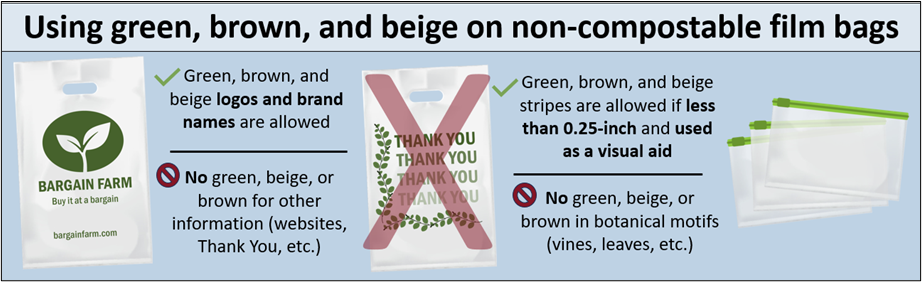
Green, Beige and Brown on Film Bags: In OML 1.0, non-compostable film bags were prohibited from using specific color schemes (green, beige, and brown). Organics Management Law 2.0 gives clarity. Film bags that are not certified for industrial composting can use color schemes (green, beige, and brown) in the following ways:
-
Can use green, beige, or brown in lettering and logos used solely for brand identity reasons; botanical themes are allowed if part of the brand or logo.
-
Can not use green, beige, or brown for botanical motifs like leaves and vines, if they are not part of the brand or logo.
-
Can use green, beige, or brown in stripes smaller than 0.25-inch and used as visual aids, such as the top of a resealable plastic bag (i.e. “sandwich bag”).
 For more information you can check out the links in the text, or visit the Washington State Department of Ecology's website here.
Do you have any ideas or suggestions about how to make this newsletter better? Are you involved in or know of any recycling events in our area? Please send an email to pwrequest@lynnwoodwa.gov and reference the Recycling Newsletter.
The City of Lynnwood's Waste Reduction education program, including this newsletter, is funded in part by the Washington State Department of Ecology.
|