
Legislative Commentary -- March 15, 2013
Sen. Mark Schoesler sent this bulletin at 03/15/2013 05:50 PM PDT
March 15, 2013
Dear Friends,
The Majority Coalition Caucus, which assumed leadership of the Senate on the first day of this legislative session, faced its most serious test this month. The basic question was: Could we deliver on our promises to put jobs and education first (along with the budget – I’ll get to that) in a way that put policy ahead of politics? I’m pleased to say the answer is yes. Please keep reading for more information about how that is, and some notable legislation we approved.
The workload was a tad bit lighter this week – after Wednesday’s deadline for voting, that is – which allowed me more time to meet with people from the 9th Legislative District and surrounding areas. The visitor list included officials from the Ritzville-Lind and Pasco school districts, the CEO of Inland Empire Paper, Pullman residents associated with the Early Childhood Education and Assistance Program, Franklin County’s coroner, officials from Pioneer Telephone in LaCrosse, and Pasco residents with the Latino Civic Alliance here for today’s Latino Legislative Day. Around noon today I slipped over to the governor’s mansion, where the Colton High girls’ basketball team was being honored (it picked up a fifth consecutive 1-B state title earlier this month). I met with the new director of the Department of Labor and Industries, took part in more talks with Governor Inslee (they’re becoming pretty regular) and had another enjoyable meeting with President Floyd of WSU.
After spending the past two weekends in Olympia I’m looking forward to spending this Saturday not in my legislative office but on the farm and around town. There are nine weeks down and six to go in the legislative session, which makes this a great time to recharge the batteries, spend some time with the family -- including granddaughter Macy Mae, who just passed the two-month-old mark – and let Ruger the hound lope around on home soil.
* * *
The obvious news hook from this week of the 2013 session was supplied by the Wednesday “cutoff” for each house of the Legislature to act on its own bills, with the exception of legislation that is budget-related.
As is typically the case, the number of bills awaiting consideration far exceeded the amount of time left before that day’s 5 p.m. deadline to cast votes. In the Senate our Majority Coalition Caucus had some difficult decisions to make about which measures would receive a vote and which would have to be sidelined until 2014.
During an interview with the state’s non-profit public-affairs network, TVW, an MCC member who is chairman of a committee was asked about the bills that were “dying” on cutoff day. He correctly pointed out that the process ought to be viewed as a sort of filter. Bills that are ready to become law (or are at least close) make it through, while measures that need more work before they’ll win a majority of votes do not.
Senate’s bipartisan majority continues to deliver on new way of governing
The Senate passed 267 measures by the March 13 deadline. While that’s more than were approved by this point in the previous 105-day session, in 2011, it’s worth remembering that many pieces of legislation are “good little bills.” That’s the light-hearted description legislators tend to hang on measures that would make useful but minor adjustments to state law.
|
||
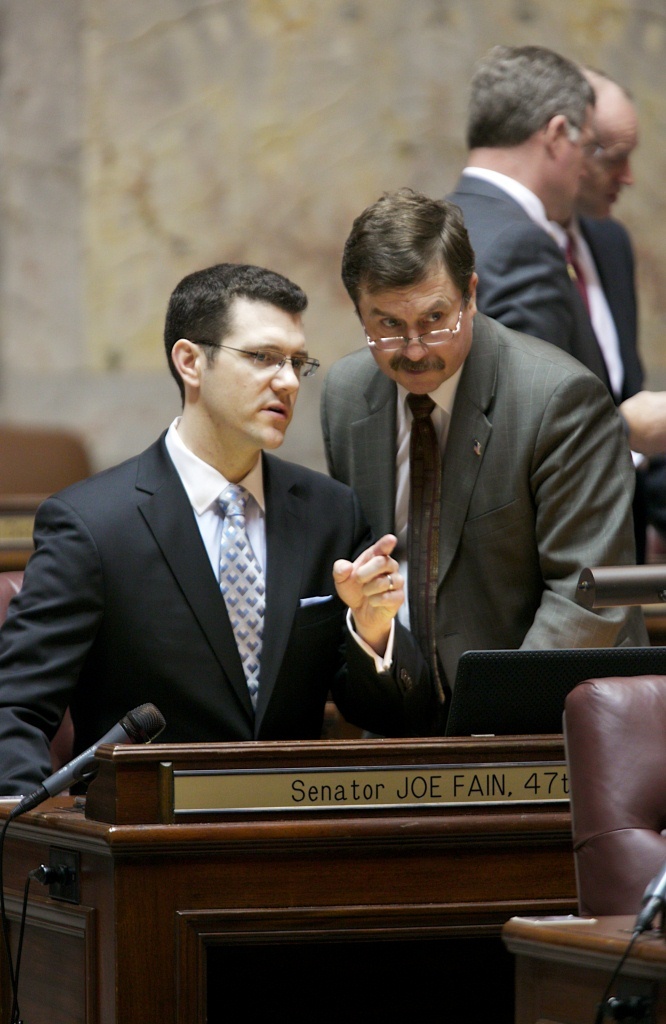
| After I was elected Senate Republican leader in November the leadership role I'd held since 2006 -- floor leader -- was filled by Sen. Joe Fain of Auburn, one of our newer Majority Coalition Caucus members. The position is responsible for coordinating our activities on the floor of the Senate chamber, which means the two of us had a lot of decisions to make lately about which bills to bring forward and when. | ||
An example of this is Senate Bill 5083, adopted Wednesday, which basically adds special-election yard signs to the law allowing primary and general-election yard signs to be displayed in spite of any homeowner-association covenants to the contrary.
The best way to assess the work done by the Senate so far is to look not at the quantity but the quality of the legislation we’ve passed – meaning bills that could have big benefits for our state.
Our bipartisan coalition has three priorities – encourage job creation, provide for a world-class education system and develop a sustainable state budget. From that standpoint we’re 2-for-2 on jobs and education with the budget about to move into the spotlight. Also, we’ve succeeded in putting policy ahead of politics, as nearly 33 percent of the legislation coming out of the Senate was introduced by the Senate minority party. That’s not something the majority typically points out, but in this case the level of consideration our side gave minority-caucus bills reflects our shared belief that good ideas are not Democratic or Republican, and no one party has a monopoly on talent, creative ideas, and workable solutions.
Pro-jobs agenda
retakes center stage
As promised, the reforms we passed in February to the state-run industrial-insurance monopoly better known as “workers’ compensation” were just the first wave of our coalition’s effort to give employers the hope they need to stay in business and grow.
We kicked off this past week by passing 10 more measures that would make Washington a friendlier place to do business. These are mostly aimed at reducing the administrative costs employers incur just trying to contend with state and local regulations.
Our effort to shield employers who are located outside of but do business inside Seattle drew plenty of attention and a pretty close vote (for more about that issue see this opinion piece in Washington Focus). However, there was no shortage of strong bipartisan votes for other bills on our pro-jobs agenda, such as Senate Bill 5680. That measure would create a single web portal for things such as business licensing, permits and inspections – a big help to small businesses that don’t have the time to run around from one agency website or office to another. It passed with a unanimous vote, which begs the question: Was the previous majority simply unable to think of reforms such as these?
Next in the spotlight: our pursuit of a sustainable state operating budget
Every other year the Legislature has to adopt a trio of two-year budgets: one to cover the operations of most state agencies; one to pay for capital projects, such as the construction of public buildings; and one to pay for transportation projects. Each takes effect on July 1 of the year in which is it adopted.
While the transportation budget tends to get more attention when vehicle-related tax increases are proposed – this year being an example – the budget that typically has the most visibility is the state operating budget. I’ve served for many years on the committees that develop the operating budget and spent the past two years as part of the Senate Republican budget-negotiating team, so I understand the situation inside and out.
Our bipartisan coalition came into this session committed to crafting a state operating budget for 2013-15 that lives within the state’s means. Those “means” are expected to be more plentiful: the fourth of the 2012 quarterly state revenue forecasts predicted the state would take in $32.56 billion in collections for 2013-15 from taxes and other revenue sources. That’s quite a jump from the $30.47 billion in revenue anticipated for the two-year budget cycle we’re in now. Who wouldn’t like to have nearly 7 percent more to spend?
Unfortunately, between the rising cost of maintaining state services at today’s levels and the additional demands for K-12 education funding (tied to the McCleary court ruling of January 2012 – see this report in Washington State Wire for more detail) even a revenue increase of almost 7 percent isn’t enough. When the session began we expected the gap between spending commitments and anticipated revenue would be close to $1 billion, and that divide widened this week due to some miscalculating by the governor’s budget office.
The first of the quarterly revenue forecasts for 2013 will be issued this Wednesday. We already know it could show a dip from November, due to the payroll tax cut that expired as part of the federal “fiscal cliff” response at the end of 2012. Either way, budget writers typically plug that revenue prediction into the set of figures they’ve already been compiling and release a proposed operating budget soon thereafter. So it’s fair to expect that by the end of March the budget discussion will be in full swing here at the Capitol.
Senate passes my bill to let people learn the who, what and why of state fees
It’s easier to hold government accountable when its actions are more transparent. That’s the thinking behind the bill I introduced that would use online technology to make the fees imposed by state agencies in our state a whole lot more transparent and easier to follow.
The inventory of fees called for in Senate Bill 5751, which passed in the Senate on Wednesday, would let people see exactly who is collecting the fee, the purpose of the fee, the current amount of the fee, the amount of the fee over the previous five years, and the statutory authority for the fee. Several years ago the state budget office had put together an online database of fees, but it’s become outdated; this bill would require that one-stop shop to be maintained and updated regularly.
My bill to make state-run insurance rules consistent wins Senate approval
A lot of legislation is inspired by the experiences legislators have in real life, and here’s another to add to that list. Small corporations, such as family farms, have to opt in to pay workers’ compensation premiums to the Department of Labor and Industries – but opt out from the unemployment-insurance premiums collected by the state Employment Security Department. This inconsistency can be confusing, and it becomes a problem when someone either doesn’t realize or forgets to opt out of the UI system – and next thing they know, they’re getting socked for back payments plus penalties!
My accountant noticed this was happening to some of his other customers and mentioned it to me. I introduced Senate Bill 5227, which passed in the Senate earlier this month, to make it so the UI system is also an opt-in decision, just like the workers’ comp system, which should eliminate the unhappy surprises others have had to suffer through already.
It’s almost unbelievable to me that anyone in the Senate would oppose this idea, but I’m guessing the 11 senators who did simply don’t want to see the state lose out on revenue, even if it’s obtained through an inconsistency in the rules.
Cellular-device legislation aimed at holding state agencies more accountable
Among the principles that brought our Majority Coalition Caucus together is a shared interest in making state government more efficient and holding agencies accountable. An example of our progress in that area is Wednesday’s passage of Senate Bill 5381, aimed at the management and use of state-issued cellular devices. It would continue implementing recommendations from a 2011 state audit that found agencies were wasting money by issuing devices that went unused or underused.
Of course there are state workers who need to have cellular devices to do their jobs and will use them properly. However, taxpayers shouldn’t be paying for state workers to carry around devices that aren’t being used for the public good – and that audit uncovered many concerns, including the fact that the state paid more than a half-million dollars for more than 2,000 cell phones that weren’t used once in an entire year.
SB 5381 would permit agencies to issue cellular devices to employees whose jobs require fieldwork or travel where land lines are inaccessible or inefficient; immediate or on-call availability; or real-time communication, including e-mail. Agencies also would be able to issue cellular devices to other workers if requirements are defined and the need documented. The state audit also found agencies could save by changing to prepaid phone plans, so the bill also would require the state’s chief information officer to come up with a cellular management and use policy, and direct agencies to evaluate the use of prepaid services and devices.
 |
|
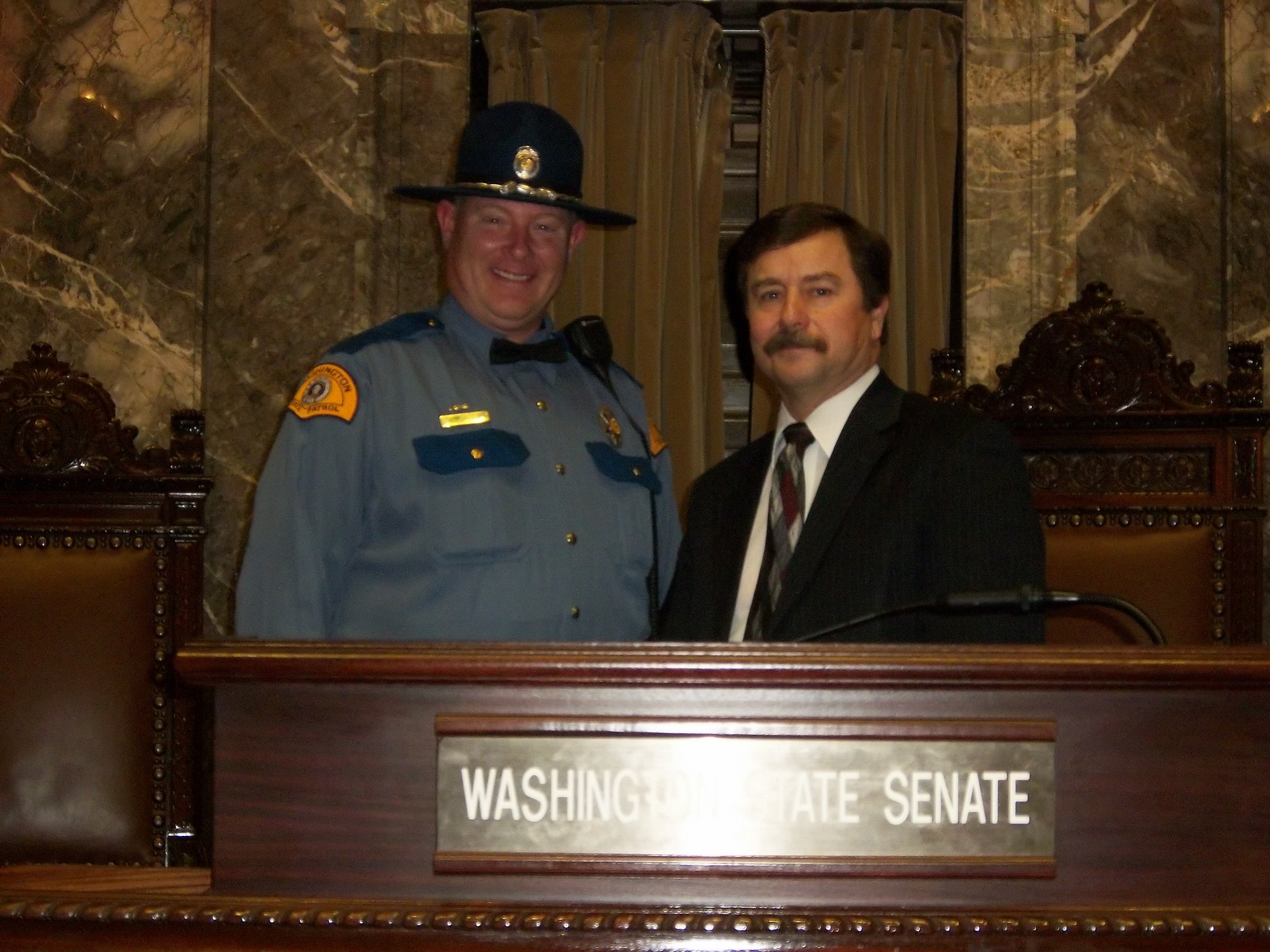
| I always welcome visits from law-enforcement officers and from folks back home, so wouldn't it be twice as good when it's a law-enforcement officer who is also from back home? This is Washington State Patrol Trooper Courtney Shawley, from Uniontown in Whitman County. | |
Senate attempts to get ahead of criminals by targeting ‘flash robberies’
If you’re familiar with the “flash mobs” that have gained in popularity and internet fame lately, then be warned that there’s a darker side: “flash robberies,” born when some individuals began utilizing electronic communication devices to organize mass thefts from retail stores.
It’s a new sort of crime that is seen more often on the east coast, but just recently there have been several incidents in Portland, on our state’s doorstep. That promoted the Senate to make a pre-emptive move this week by adopting Senate Bill 5178. It would allow a person to be charged with organized retail theft if he or she is involved in a theft that’s coordinated through electronic communication, involves at least six accomplices are involved and steals property with a cumulative value of at least $500.
This is more than simple shoplifting by several individuals at the same time; SB 5178 sends a message to thieves of this kind who might be eyeing Washington as a potential target.
How dependent is Olympia on federal money? Bill anticipates possible cuts
Our state is becoming dangerously dependent on federal matching funds, with nearly 25 percent of the state operating budget made up of federal funding.
It’s a concern at budget-writing time because reducing appropriations might mean a loss of federal money. At the same time, as our discussions about Medicaid expansion have pointed out, the federal government’s promises to upholding its funding commitments aren’t something we can take to the bank, so to speak.
Given all that it makes sense to direct state agencies to provide an inventory of how they use federal dollars and create contingency plans for possible reductions. Senate Bill 5804, an idea from our bipartisan coalition’s top two budget-writers, is aimed at preparing our state for the day when the federal government finally deals with its more than $16.5 trillion worth of debt.
State budget analysts are still trying to figure out exactly how much federal “sequestration” cuts will affect the state budget. They’ve calculated about $83 million dollars in funding cuts so far; had this kind of bill been in place prior to sequestration, the agencies that will be affected would have had ample warning.
* * *
I welcome your comments about anything in this newsletter and your questions about what I’m doing on behalf in the state Senate. Please call, e-mail or write using the contact information below.
Legislative E-mail: Schoesler.Mark@leg.wa.gov
Legislative Phone: (360) 786-7620
Toll-Free: 1 (800) 562-6000
Olympia Address: 305 Legislative Building
P.O. Box 40409
Olympia WA 98504-0409