|
April 7, 2026
Dear Friends and Neighbors,
While I was still at the Capitol someone asked whether, as a fruit grower, I’m an optimist like so many others in our state’s agricultural sector. My answer was yes – but looking back on what came out of this year’s legislative session, which ended March 12, it isn't easy to be optimistic about where our state is heading.
Start with the new state income tax. Washington has done fine without one for more than 90 years, yet the supporters went ahead and pushed it through in just six weeks. Even worse, they wrote the bill in a way that prevents the people from challenging the tax through a voter referendum, as our state constitution allows.
Also, Olympia's spending is still way out of control. The updated operating budget, passed with one of the session's final votes, pushes spending over the $80 billion mark. For comparison, the budget in place during my first session in Olympia (2019) was $45.2 billion. That’s a whopping 77% spending increase in seven years, when population growth during that span has been less than 15%, based on statistics kept by the state budget office.
There were bright spots from this 60-day session, of course. Several of the bills I introduced or co-sponsored will become law, and I was glad to secure money in the updated capital budget for important community/infrastructure projects in our district. Details are below, along with information about some of the more notable legislation from the session.
I'm happy to be back home. This is a particularly beautiful time of year in the 12th District, and besides, there's a lot of work to be done in the orchard. Just remember I’m your senator all the time, not just when we’re in Olympia, so say hello if you see me out and about.
As always, please reach out whenever you have questions or need help dealing with a state agency. My email is keith.goehner@leg.wa.gov and my Senate office phone number is 360-786-7622.
Sincerely,
 Keith Goehner, 12th Legislative District
Washington State Senate
 From Monroe to Manson and beyond... capital budget aids local communities
The state's capital budget is historically the smallest of the three state budgets -- but it is also known for producing some very visible results.
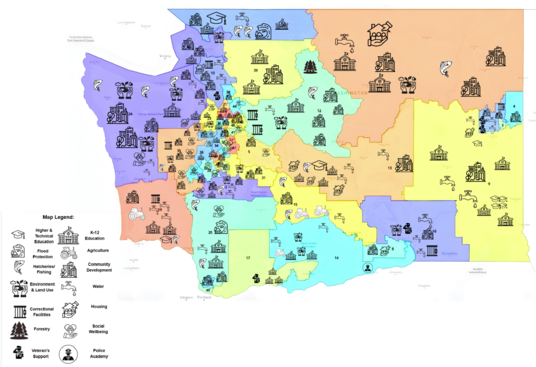
Out of the $890 million appropriated in this year's supplemental capital budget, our 12th District delegation secured $32 million in projects. As I put it in the statement we issued after the final vote, this is truly a budget for all of our district, with investments from one end (like $141,000 for the Sultan Main Street lighting project) to the other (such as $100,000 for improvements to the Manson Grange). Those and more are depicted in the map above, which offers a sense of how the capital budget is good for all of Washington.
Also on the list for our communities:
- Monroe Correctional Complex, domestic water and HVAC systems: $13.8 million
- Skykomish school construction: $6 million
- Echo Glen secure facility improvements: $1.7 million
- Snoqualmie Valley Food Bank: $1.28 million
- Monitor Park Farmworker Housing: $1 million
- Middle Fork Snoqualmie land transfer: $900,000
- Performing Arts Center infrastructure: $716,000
- Lake Chelan Senior Center structure improvements: $548,000
- Old Swim Hole revitalization project: $393,000
- Snoqualmie Tribal Police Station: $360,000
- Chelan River Heights, affordable housing project: $258,000
- CAFE: Community Multi-Service Community Center: $258,000
- Chelan-Douglas Community Action Council Commercial Kitchen: $252,000
- Wenatchee Crail Cottages: $248,000
- BSG gymnasium restroom project: $113,000
- Riverside Park picnic shelter: $40,000
- Chelan Library improvement project: $21,000
 |
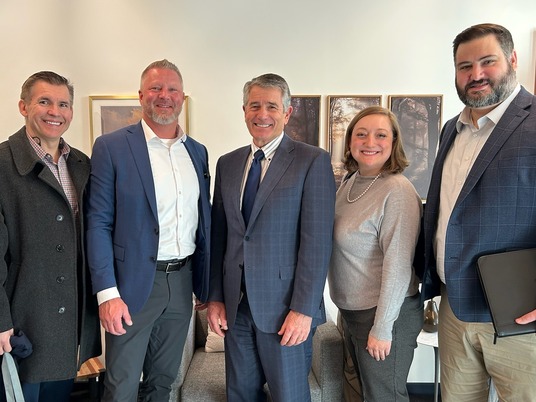 As a member of the Senate Housing Committee I am particularly interested in the opinions and concerns of those in our state's construction sector. My visit this past month with representatives of the Central Washington Home Builders Association was very informative.
More taxes and fees won't make living in Washington more affordable
The previous year's legislative session was the most expensive in state history, producing a $12.3 billion package of new and higher state and local taxes in response to a budget shortfall that was realistically around $7 billion.
I had opposed that plan and instead sponsored a conservative but unsuccessful approach that also eliminated the budget gap, but without increasing any tax or cutting anyone off of services.
Rather than recognize how Washington has become unaffordable, and give taxpayers a break this year, the majority side in Olympia went a tax-and-spend route yet again. Here's the list of taxes that are new for 2026, not counting the income tax.
-
SB 5949 (Sen. June Robinson, D-Everett): Insurance-carrier tax
-
SB 6228 (Sen. Noel Frame, D-Seattle): Will increase health-care costs by raising cost of doing business for many pharmacies
-
SB 6231 (Sen. Frame): Increases costs for replacing data-center equipment
-
SB 6248 (Sen. Derek Stanford, D-Bothell): Travel-insurance tax
-
HB 1796 (Rep. Lisa Callan, D-Issaquah): Allows schools to take on more debt without public vote
-
HB 1983 (Rep. Steve Tharinger, D-Port Townsend): Redefines “timberland” for real estate excise tax purposes
-
HB 2089 (Rep. Shaun Scott, D-Seattle): Tax on loan interest
-
HB 2385 (Rep. Nicole Macri, D-Seattle): Tax to expand Medicaid access
-
HB 2442 (Rep. April Berg, D-Mill Creek): Local-government tax authority
-
HB 2487 (Rep. Macri): Tax on insurance carriers
-
HB 2521 (Rep. Timm Ormsby, D-Spokane): Firearms background-check fees
-
HB 2681 ((Rep. Ormsby): Cannabis-license fees
It's also troubling that the amount of money appropriated in the new operating budget to our K-12 schools represents less than 43% of state spending. I don't say that to suggest the schools are getting shortchanged -- the issue is priorities, because spending on programs and services not related to basic education is continuing to shoot up far faster than the investment in K-12. This isn't consistent with how providing for education is state government's paramount duty under our state constitution.
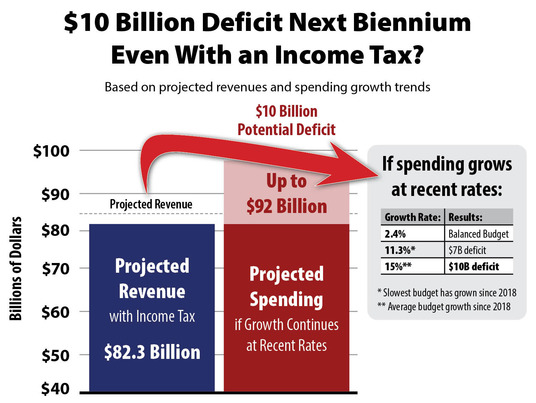
What's more concerning is how this new budget puts our state on track for an enormous shortfall in the very near future. See the chart below for how that could happen.
After eight sessions as a legislator I’m able to compare what I see in Olympia with what I saw in Wenatchee during my terms as a Chelan County commissioner. The obvious difference between the two levels of government is a lack of spending restraint at our state capitol.
This year the budget choices are being portrayed as though they were forced by spending reforms put in motion at the federal level. That just isn’t accurate -- state spending has grown an average of 15% from one cycle to the next for most of the past decade, regardless of what's happening in Washington, D.C.
Notable for the wrong reasons: new anti-sheriff law, income tax and more
Between the Senate and House of Representatives, more than 1,200 bills were introduced during our 60 days in Olympia. Because the Legislature works in two-year terms, bills introduced in 2025 also could be brought forward for consideration in 2026 -- and many were, such as my Senate Bill 5467. It was passed by the Senate in 2025 but not the House; this session, after quickly flying through the Senate again, it won unanimous approval from the House, and will become law.
In all, 276 bills were passed by both chambers and sent to the governor. That's around 22% of the total introduced this year, which is probably a pretty normal percentage. Besides, it shouldn't be easy for legislation to become law.
Having said that, here are some of the bills passed this session that are notable for being controversial. All were introduced for 2026, and more than a few seem to be partisan reactions to fears about the federal government. I didn't support any of these, as they conflict with the majority of the emails and phone calls I've received from 12th District residents:
-
SB 5855 (Sen. Javier Valdez, D-Seattle): Prohibits local, state, and federal law-enforcement officers from wearing masks while interacting with the public, with certain exceptions.
-
SB 5892 (Sen. Marcus Riccelli, D-Spokane): Prohibits county elections offices from publishing voter-registration records; those must be divulged only to the Secretary of State. Violations may be charged as a Class C felony.
-
SB 5925 (Sen. Drew Hansen, D-Bainbridge Island): Large expansion of state attorney general's power to demand documents from businesses, law-enforcement agencies, school districts, other entities covered by laws related to wage laws, jail standards, and Keep Washington Working Act compliance.
-
SB 5917 (Sen. Jessica Bateman, D-Olympia): Allows distribution of state-purchased stockpile of chemical-abortion drugs (mifepristone and misoprostol) free of charge.
-
SB 5974 (Sen. John Lovick, D-Mill Creek): Anti-sheriff. Allow the state Criminal Justice Training Commission, an unelected board appointed by the governor, to decertify sheriffs, which has the effect of removing them from office. This goes against the principle of local control and may also put sheriffs in a conflicting position while enforcing state law. However, they are also sworn to uphold the Washington State Constitution and the United States Constitution, both of which preempt state law.
-
SB 6081 (Sen. Jamie Pedersen, D-Seattle): Involves privacy, including the unauthorized disclosure of sex-designation information and historic sex-designation changes in official government records.
-
SB 6182 (Sen. Bateman): Tax on insurance plans to make up for $8 million cut in funding to Planned Parenthood made by Democrats in 2025. All health-insurance plans must pay 82 cents for every covered life the first year and 16.5 cents each year per covered life thereafter.
-
SB 6246 (Sen. Vandana Slatter, D-Bellevue): Adds additional regulatory requirements to “Emissions-intensive, trade-exposed” (EITE) facilities that have been required to lower their emissions on a schedule set by the Climate Commitment Act.
The income-tax bill (SB 6346, also introduced by Sen. Pedersen) stands out from the rest for many reasons.
It's been a very unpopular idea for many decades, with voters saying no 10 times since 1933, when the state Supreme Court threw out the only other income tax ever approved. Also, Olympia doesn't need the additional $3.2 billion this tax is expected to bring in annually when collections begin in 2029. The problem is too much spending, not a lack of revenue.
Supporters are marketing it as a tax on millionaires because the first $1 million of taxable income will be exempt from the 9.9% tax. Married couples don't get a $1 million deduction each, however, so that's misleading and unfair. Also, that deduction should be viewed as temporary -- in future years, legislators may reduce or eliminate it with a simple change to just one sentence. For proof, just look at the income tax on capital gains; collection began in 2023 and by 2025 the tax had already been increased.
When signing the income-tax bill March 30, the governor repeated the claim that it will pay for free breakfast and lunch for all K-12 students in our state. The trouble is, SB 6346 makes a commitment to early learning (5% of the expected revenue) but nothing similar for free meals. Most of the money generated by the income tax would go into the general fund, which means it can be used for most anything.
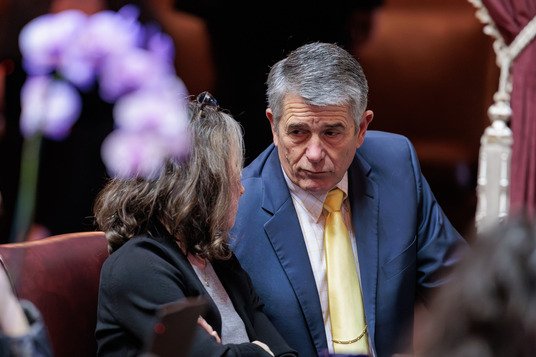 The closing days of a session bring an extra layer of bipartisan work, as committee leaders in the Senate confer across party lines about changes the House made to legislation that came through our committees. That's what had me visiting with Sen. Jessica Bateman, D-Olympia and chair of the Senate Housing Committee, a few days before we adjourned for the year.
Session ends without action on citizen initiatives, so they go to the ballot
Early during this legislative session, Secretary of State Steve Hobbs certified two initiatives to the Legislature. One deals with the controversial issue of boys competing in girls’ sports in school. The other focuses on parental rights in regard to students in schools.
Legislators have three options with initiatives to the Legislature: 1) adopt the initiative as written, in which case it becomes law; 2) refuse to pass it, which would result in the measure automatically being placed on the statewide ballot in November; 3) propose and approve an alternative initiative, in which case both the original initiative and the alternative would both appear together on the ballot.
Democratic leaders in the House and Senate decided against taking action on either measure – including no public hearing on either. On Feb. 3, responding to the many citizens who expressed a desire to speak to lawmakers, Senate Republican members held a listening session at the Capitol on the two initiatives. House Republican members also held a listening session that same day.
Because the Legislature did not take action on the two initiatives, they will appear on the statewide ballot this fall.
Looking for a podcast about your state government? Check out The Elephant in the Dome -- click here or on the image to visit and subscribe! And for even more content about the 2026 legislative session, sign up to receive The Weekly Roundup by clicking here or on the image below.
|
|
 |
|