Dear Friends and Neighbors,
The 2026 legislative session has officially come to an end. After 60 days in Olympia, it was one of the more intense — and exhausting — sessions in recent memory.
Like every session, some positive things happened. But several major decisions made by the majority will have long-term consequences for Washington taxpayers — most notably dramatically expanding the state’s operating budget and approving a brand-new state income tax.
Let’s start with the budget.
The $80 billion operating budget
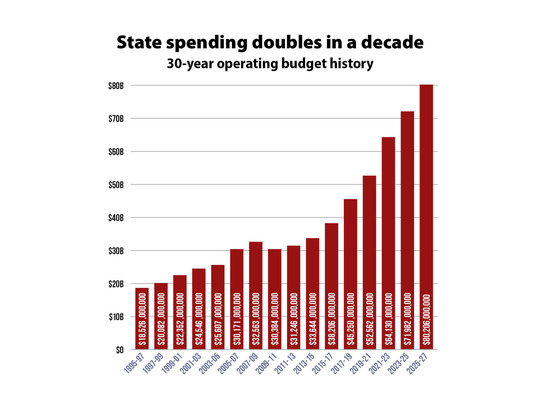 The Legislature has now approved the 2025–27 supplemental operating budget, Engrossed Substitute Senate Bill 5998, making adjustments to the two-year spending plan adopted last year.
In a previous update during the session, I shared how dramatically Washington’s operating budget has grown over time. As the chart above shows, the budget has climbed from about $18.5 billion in the mid-1990s to more than $80 billion today — more than tripling over roughly three decades.
With the supplemental budget now approved, that trend continues. Simply put, state government costs have been rising faster than the incomes of the families who ultimately pay for it.
Why does that matter?
Because government spending cannot keep increasing faster than revenue indefinitely. When that happens, lawmakers eventually come back to taxpayers looking for more money. In many cases, today’s budget increases become tomorrow’s tax increases — including the income tax approved this session and discussed further below.
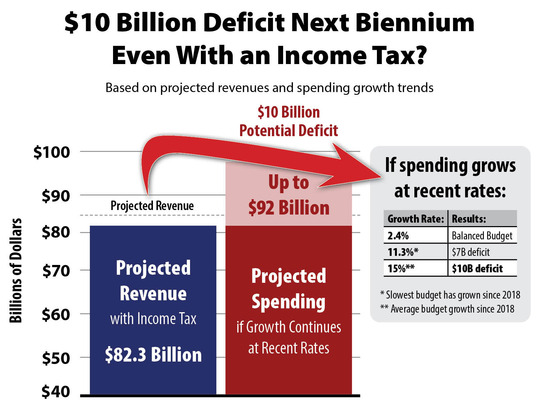 The chart above highlights another concern. Even with the newly approved income tax projected to generate 3.2 billion in additional revenue, current spending trends could still leave the state facing a significant deficit in the next budget cycle.
Based on projected revenues of about $82.3 billion, spending could reach roughly $92 billion if it continues growing at recent rates. That would leave the state facing a potential budget shortfall of up to $10 billion.
Worse yet, to balance the budget this year, the majority relied heavily on one-time maneuvers. These include draining billions from reserves, tapping the rainy-day fund, shifting money intended for other purposes, and assuming hundreds of millions of dollars in appropriated spending will somehow never be spent.
In other words, the budget is being held together with temporary fixes while spending continues to grow. Eventually, the math catches up — and when it does, taxpayers are the ones who will get handed the bill.
A new state income tax
 The other major development this session was the Legislature’s approval of a state income tax. You've probably heard it described in the media as a “millionaire tax.” That label is misleading. This is an income tax, something that Washington voters and courts have repeatedly rejected for more than 90 years.
Under the legislation, the state will impose a 9.9 percent tax on certain income above $1 million beginning in 2028, with the state expecting to collect roughly $3.2 billion annually.
Supporters insist it will only affect “millionaires.” But if that were truly the case, the majority could have accepted a simple amendment permanently prohibiting the tax from expanding to everyone else. They rejected it — a clear sign the door is open for it to expand to you and me in the future.
They also included language in the bill that blocks a public referendum, meaning voters cannot easily challenge the tax at the ballot box. For a policy change this significant, especially one Washington voters have rejected at least 10 different times, you would think the public would be allowed to weigh in directly.
Apparently, the majority did not want to take that risk.
I strongly opposed this bill because it undermines one of Washington’s most important competitive advantages: being one of the few states without an income tax. Businesses and innovators have long chosen Washington in part because of that policy. Once that door is opened, history shows it rarely stays limited.
For communities like ours in the Tri-Cities, which are working hard to grow industries such as advanced nuclear energy, agricultural innovation, artificial intelligence, and other emerging technologies, policies like this send the wrong signal. Instead of encouraging investment here at home, they risk pushing entrepreneurs, innovators, and job creators to other states.
My bills signed into law
 While much of the session was dominated by debates over taxes, spending, and the state budget, there were also opportunities to advance practical legislation that will make a real difference for Washingtonians, families, and students. I was pleased to see two of my bills clear the Legislature with strong bipartisan support and be signed into law.
Helping students access financial aid
One of those measures, Substitute Senate Bill 5841, will make it easier for high school students to navigate the financial aid process after graduation.
Washington requires every student to complete a High School and Beyond Plan before graduating. My bill improves that system by integrating information from the Free Application for Federal Student Aid (FAFSA) and the Washington Application for State Financial Aid (WASFA) directly into the online platform used by students, families, and school counselors.
Washington consistently ranks near the bottom nationally in FAFSA completion rates. By making the process clearer and easier to follow, we can help more students access the financial aid already available for college, trade schools, apprenticeships, or other career training.
My bill passed the Senate unanimously and received overwhelming bipartisan support in the House before being sent to the governor for signature.
Protecting Washingtonians from AI “deepfakes”
My second bill approved this session, Substitute Senate Bill 5886, updates Washington’s personality rights law to address a rapidly growing problem in the digital age: AI-generated impersonations, often referred to as “deepfakes.”
Technology now makes it possible to create highly realistic audio and video that appear to show a real person saying or doing something they never actually said or did. These forged digital likenesses can be used to deceive people, damage reputations, or exploit someone’s image or voice without permission.
This law strengthens protections by making it clear that using a person’s forged digital likeness without their consent violates their personality rights. It allows courts to stop the misuse and increases penalties for those who create or distribute these deceptive digital impersonations.
The bill passed the Senate unanimously and cleared the House with strong bipartisan support before being signed into law on Monday, March 16.
Working for you!
Stay tuned — in my next update, I’ll walk through the finalized transportation and capital budgets and highlight projects affecting our region.
While the 2026 legislative session has come to a close, my work representing you continues year-round on the issues that matter most to our community.
If you ever have questions, concerns, or ideas about legislation or state government, please don’t hesitate to reach out. Hearing directly from you helps guide the work I do on your behalf.
You can also stay informed between updates by following the Senate Republican Caucus on Facebook, X, YouTube. and Instagram, or by visiting my legislative webpage for the latest news and updates from Olympia.
It is truly an honor to serve the people of the 8th Legislative District.
Thank you for the opportunity to represent you.
Senator Matt Boehnke
8th Legislative District
|