Dear Friends and Neighbors,
Thank you to everyone who joined me for our town hall on Saturday, Feb. 21 at Columbia Basin College. I truly appreciate those who took time out of their weekend to come talk about what’s happening in Olympia and how it affects our community.
We had a strong turnout and, as always, thoughtful and direct questions. That’s exactly how it should be.
We discussed a wide range of issues, from the proposed income tax and the state budget, to public safety legislation, transportation funding, and education policy. Many of you asked about affordability and whether state government is living within its means. Others raised concerns about local control, the role of law enforcement, and how decisions made in Olympia impact families and small businesses here in the Tri-Cities.
I also heard questions about infrastructure investments, water projects, and how we ensure our region continues to grow responsibly while protecting agriculture and public safety. Those conversations matter. They directly inform how I approach debates on the Senate floor and in committee.
Senate proposed operating budget: A spending problem, not a revenue problem
Throughout this short legislative session, much of the work in Olympia has centered on supplemental budgets. In even-numbered years like this one, we do not write a brand-new two-year budget. Instead, we make adjustments to the existing 2025–27 spending plan to reflect updated revenue forecasts, new costs, and shifting priorities.
Washington operates on three primary budgets: the operating budget, the transportation budget, and the capital budget. The operating budget funds the day-to-day functions of state government: schools, public safety, health care, and social services. It receives the most attention and, this year, has generated the most controversy.
 This week, the Senate approved the supplemental operating budget. I was a firm NO vote.
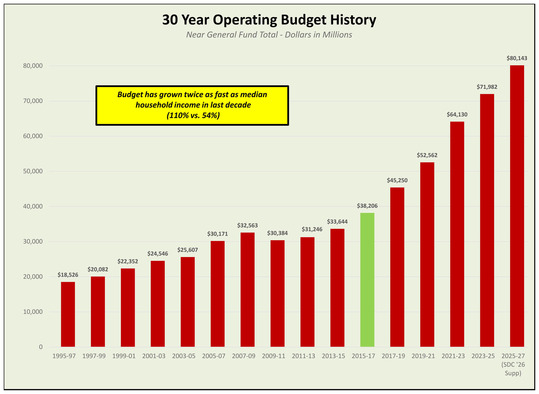
As shown in the chart above, Washington’s operating budget now exceeds $80 billion for the first time in state history. Over the past decade alone, state spending has grown by roughly 110 percent. During that same period, median household income in Washington has increased by about 54 percent.
The trend is clear: state government has grown at roughly twice the pace of family income. That’s not sustainable.
Rather than tightening the belt in response to a projected shortfall, the majority chose to increase spending again. The proposal relies heavily on one-time money — draining reserves, transferring funds from other accounts, and assuming large sums of appropriated money that will not actually be spent. That is not long-term reform. It is a temporary patch.
We should be focusing on core priorities, education, public safety, and essential services, while improving efficiency and accountability. Instead, this budget continues a pattern of expanding spending without addressing the underlying cost drivers.
Washington does not have a revenue problem. It has a spending problem. Families in the 8th District live within their means. State government should do the same.
Senate proposed transportation budget: Fix what we already have
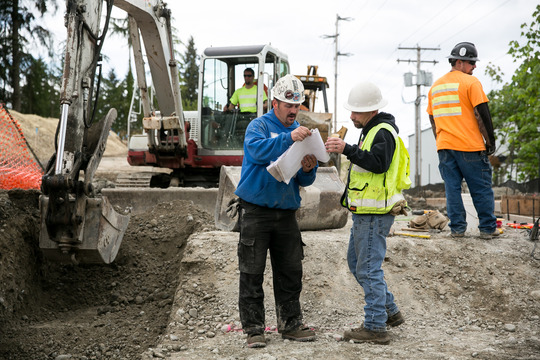 While the operating budget has been contentious, the transportation budget has followed a different path.
The Senate’s supplemental transportation budget is a bipartisan proposal centered on preservation and maintenance — fixing what we already have before expanding further.
Our highways and bridges are aging, and we face a significant backlog of maintenance needs. The Senate plan invests an additional $1.7 billion over six years into preservation and infrastructure repair, without increasing the gas tax. It leverages previously authorized bonding capacity to address urgent needs.
The proposal also includes funding to repair damage from last December’s flooding — $15 million for state highways and $45 million for local roads — along with investments in ferry maintenance and electrification, Columbia River dredging, and Washington State Patrol trooper training to help address staffing shortages.
Maintenance may not grab headlines, but keeping roads safe and infrastructure functional is one of government’s core responsibilities.
I voted YES on the transportation budget because it focuses on preservation, infrastructure, and core transportation needs without raising taxes. The Senate-approved budget now moves to the House for further consideration and final negotiations before a final version is adopted.
Senate proposed capital budget: Investing in our region
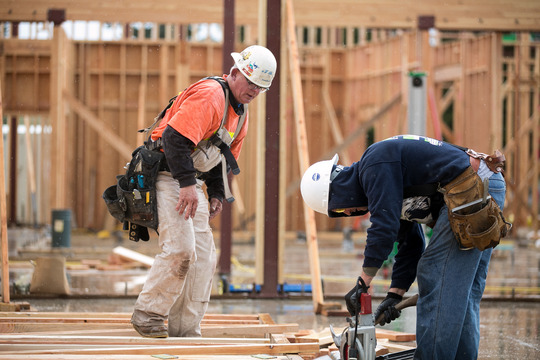 The capital budget is where we invest in the future.
Unlike the operating budget, which funds day-to-day government services, the capital budget focuses on bricks-and-mortar priorities — schools, water systems, public safety facilities, housing, and other community infrastructure that will serve families for decades to come. It is primarily funded through bonds and dedicated accounts, and because it centers on long-term investments, it tends to bring lawmakers together across party lines.
The 2026 Senate supplemental capital budget invests $723 million statewide and builds on last year’s bipartisan $7.5 billion capital budget. These are real dollars going into real projects — the kind that strengthen communities and support long-term economic growth.
Many of these investments directly impact our region. Not every project listed below sits entirely within the 8th District, but our communities are interconnected. We work closely with our neighbors in the 14th, 15th, and 16th districts to support investments that strengthen the entire Tri-Cities and Yakima Valley region.
I voted YES on the capital budget because it prioritizes critical infrastructure and brings meaningful resources back home.
Here are several projects in the Senate’s proposed capital budget that I worked to secure and supported:
8th Legislative District
- West Richland Homeownership — $1.52 million
- Kennewick Activity Center Asbestos Abatement — $93,000
16th Legislative District
- Richland Transitional Veterans Home — $150,000
- Pasco Reimann Expansion Engineering Master Plan — $258,000
- Twin Bridges Road Tire Pile Cleanup — $3.2 million
- Kennewick Irrigation District Main Canal Lining — $3.647 million
- Mill Creek Passage (3rd to Colville) — $1 million
- Touchet River Mile 42 — $500,000
15th Legislative District
- Fire Station 52 Parking Lot Safety Upgrade — $155,000
- Naches Hatchery Raceway Refurbishment — $93,000
- Lower Naches Grange #296 Refurbishment — $40,000
- Roza Canal Floor Replacement and Sealing — $4.475 million
- WSDA Plant Services Lab, Prosser — $2.186 million
14th Legislative District
- Columbia Grange 87 Improvements — $74,000
- Roof Replacement for Agricultural Livestock Barns — $150,000
- Pasco Regional Police Academy Improvements — $1.002 million
- Glenwood School Construction — $6 million
- Mabton School Planning — $43,000
- Yakama Nation Trust Land Transfer (Tract C East) — $4.4 million
Total Tri-Cities and Yakima Valley Projects: $32.734 million
You can review the complete proposed project list here. Be sure to select the appropriate district.
Please note: As with the transportation budget, these are highlights and the process is not yet complete. Negotiations with the House are still underway, and the final capital budget must be reconciled and approved before session ends. I will continue working with my colleagues to help move these investments across the finish line.
Staying engaged and making your voice heard
As we move through the last few days of session, your input matters more than ever. Whether it’s legislation moving through the Senate or issues impacting our local community, I encourage you to stay involved.
If you’d like to share your thoughts on pending legislation or other state matters, you can always contact my office directly. Hearing from you helps me represent the 8th District more effectively.
You can also stay informed between updates by following the Senate Republican Caucus on Facebook, X, YouTube. and Instagram.
It is truly an honor to serve the people of the 8th Legislative District.
Senator Matt Boehnke
8th Legislative District
|