Dear Friends and Neighbors,
First, I want to thank the families and community members who joined us last Monday night in Kennewick for the town hall on the proposed less restrictive alternative (LRA) placement. I was encouraged by the strong turnout and deeply appreciate everyone who took the time to show up, ask questions, and share personal concerns.
When public safety is involved, clarity matters — so let me speak plainly with you.
The proposed placement of an LRA home in Kennewick has raised serious and legitimate questions, and I share those concerns. These placements do not belong in residential neighborhoods, especially near schools and places where children and families live their daily lives.
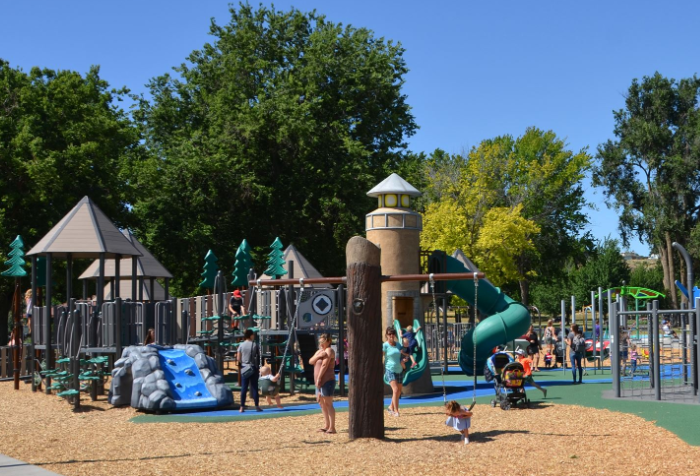
SVP placements and the public safety gaps we can’t ignore
Unfortunately, in recent years, Washington has increasingly moved people out of total confinement and into community-based housing. These are homes placed in ordinary neighborhoods, sometimes near schools and child care facilities, where individuals with a history of violent sexual crimes are allowed to live under court-ordered supervision.
That is deeply troubling.
Investigative reporting by The Seattle Times has shown why. The state has quietly accelerated releases from McNeil Island without adequate tracking, consistent oversight, or independent accountability. The state does not routinely monitor outcomes after release, and audits of the system are rare.
The Times found that roughly one in four people released from McNeil Island were later arrested for new crimes, and one in seven reoffended in a serious way, many involving sexual violence. Even placements that were supposed to be “supervised” have generated hundreds of violations over the past decade, including tampering with monitoring devices, curfew violations, and prohibited contact.
When these individuals are placed into neighborhoods, the risk is no longer theoretical — it’s local and real.
Parents should not have to wonder who is living near their child’s school. Neighborhoods should not learn about placements after decisions are already made. And communities should not be expected to absorb risk created by a system that has failed to prove it can manage that risk safely.
VIDEO: Watch my recent legislative update on the Kennewick LRA proposal and why community safety must come first.

Pushing back: Stronger Laws, Clearer Limits, Safer Neighborhoods
Here’s what I’ve been doing legislatively to push back against these placements. You may have seen my joint press release with Sen. Nikki Torres, but I want to focus here on the work I’m leading to address these issues.
Senate Bill 6301 — Strengthens supervision requirements for LRAs, including enhanced electronic monitoring, enforceable safety conditions, fair-share placement standards, and a requirement that supervising Department of Corrections officers be located within 50 miles of the placement.
Senate Bill 6317 — Requires advance notification to local law enforcement, county officials, and area legislators before a property is finalized for use as an LRA.
Senate Bill 6334 — Prohibits LRA placements from abutting residences with minors and strengthens proximity restrictions around schools and child care facilities.
Senate Bill 6336 — Prohibits LRA placements in areas with a high concentration of children, based on verified adult-to-child ratios.
Senate Bill 6337 — Bars placements within 500 feet of, or within sight lines of, schools, child care centers, and other youth-focused facilities.
Senate Bill 6338 — Requires courts to formally consider and respond to recommendations from local prosecutors before approving an LRA placement.
Senate Bill 6339 — Requires LRA residences to be owned and operated by the same individuals responsible for treatment and monitoring.
Senate Bill 6340 — Expands distance requirements around schools, parks, and recreational facilities to one-half mile.
Call to action
I strongly encourage you to contact members of the Senate Human Services Committee and ask them to schedule public hearings on these bills. Public hearings allow community members to testify, share concerns, and formally place their experiences on the legislative record. Your engagement helps move this process forward.
Two citizen-led initiatives: Voters spoke. The Legislature has not.
And now, I'd like to share a quick update on two voter-driven initiatives now before the Legislature.
One initiative focuses on strengthening communication between parents and schools (IL26-001). The other addresses fairness in girls’ sports (IL26-638). Both qualified for legislative consideration after receiving hundreds of thousands of signatures from Washingtonians across the state.
At this point, the majority party is refusing to hold public hearings or move these initiatives forward in the Legislature. Under state law, lawmakers still have the option to adopt the initiatives, refer them to voters, or propose alternatives. If the Legislature does not act, the initiatives will appear on the November ballot.
In the meantime, you still have a direct way to weigh in. You can make your voice heard by submitting written comments online. Those comments become part of the official legislative record, and legislators do read them. Just choose one of the links below and click the button that says “Send a comment to your legislators.” An example is shown below.
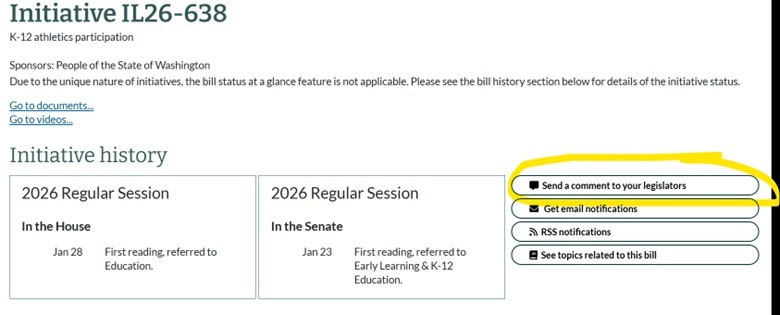 You can also sign in as PRO or CON on each initiative.Click or scan the QR code below:
Scan this code or click on it to sign in PRO or CON for the initiatives.
Looking Ahead
In my next update, I’ll share where key bills stand as we move closer to the finish line — policy committee cutoff is February 4, with the House-of-origin cutoff on February 17. (Yes, the legislative calendar waits for no one.)
Thank you again for your continued engagement and advocacy. Please don’t hesitate to reach out to my office if you have questions or need assistance.
It’s an honor to serve you.
Senator Matt Boehnke
8th Legislative District
|