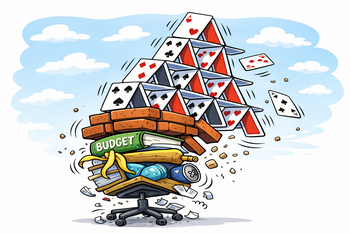
 The Senate budget has been described as a "house of cards" built on a shaky foundation.
Senate Democrats passed their $80 billion operating budget Friday -- a budget that relies on:
- The hope that $801 million in appropriated money WON'T actually get spent
-
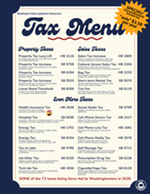
$114 million in higher taxes, on top of the record $12.3 billion in state and local tax increases last year
- One-time money: Drains unrestricted reserves by $2.4 billion; takes $750 million from rainy-day fund; transfers $395 million in capital gains revenue from the capital budget to the operating budget; raids $375 million from Public Works Fund
The Senate proposal is also based on a projected growth in the state budget of only 2.2%, even though Democrats have increased the budget an average of 15% per biennium in the past decade. It's unlikely that the majority will restrict future spending to fit within that 2.2%.
Worst of all, this budget proposal is tied to an unconstitutional income tax (SB 6346).
No Republican senators voted for this irresponsible proposal -- which, like a house of cards, is built on a shaky foundation.
Once both chambers pass their budget proposals, negotiations between House and Senate Democrats will result in a compromise version that will be put to a final vote before it goes to the governor for a signature.
The Senate also passed two bipartisan supplemental budget proposals -- the $723 million capital budget and the $1.5 billion transportation budget.
Read more about the budgets.
 Earlier this week, Democrat leaders met with reporters and were asked about the record numbers of people who signed in CON against the income tax when it came before committees in the Senate and House. The numbers made SB 6346 it the most unpopular bill in state history -- even if you remove duplicate signatures.
Watch for yourself. The Democrats’ responses were telling.
"We don't pay attention to people who sign in, but not to testify."
"We don't think everyone who is signing in support or opposition is reading the bill so I think you gotta take it for what it's worth."
"It's not like we're making decisions not to pass a bill because of a sign-in."
"They're not helping us make decisions."
Next, consider that Democrats proposed two bills this year to hinder the people's constitutional right to initiative (SB 5973/5382), and they have attacked the initiative process with past legislation as well.
Other maneuvers undermining transparency include banning the tax "advisory votes" on the ballot -- votes required by the 2007 passage of Initiative 960 that didn't overturn taxes but were an important way to let people know about the taxes and say if they approved or not.
Democrats are even building this lack of transparency into legislation. Senate Bill 6119 proposes a new tax on tires yet forbids sellers from telling the buyer about the tax or putting it on the receipt.
 Early in this session the Senate Republican bill (Senate Bill 5071) to add fentanyl to the child endangerment act passed with strong bipartisan support in the Senate for the fourth consecutive year. For the fourth time, it was assigned to the House Community Safety Committee.
And for the fourth time, the chair of that committee refused to let its members vote on the bill -- killing any chance the legislation has this year of becoming law.
Why would anyone oppose adding one of the most deadly, addictive and widely used drugs to the existing statute protecting kids from drug-related fatalities and near fatalities?
Good question.
Sen. John Braun, R-Centralia, took past criticism of the bill to heart and changed it so that a first-time offense wouldn't result in jail time -- it would provide drug treatment and parenting support.
But the chair of the House Community Safety committee still refused to allow a vote on the bill.
Other bills aimed at protecting children from fentanyl exposure also died this session, thanks to House Democrats.
House Bill 1125 would have allowed judges to resentence convicted felons to an exceptional sentence below the standard range if it “serves the interest of justice.”
House Bill 1178 would have eliminated sentencing enhancements for certain illegal drug violations committed in protected zones and for involving a minor in a criminal street gang-related felony.
How many more children will be exposed to fentanyl and suffer accidental overdoses? How many more parents trapped in fentanyl addiction won't face any consequences for endangering their children?
The continued opposition in the House to enacting this policy is shameful. And future child fatalities or near-fatalities from fentanyl exposure will be on them.
If you someone forwarded you this newsletter, you can subscribe to receive it directly.
|