Before the facility: Why hazardous waste collection matters
Household hazardous waste collection programs grew out of a national problem; hazardous waste was everywhere, but there was no place to safely dispose of leftover products.
After World War II, synthetic chemicals (like organochlorine pesticides) were widely used in agriculture, industry, and everyday products. Chemicals became normalized and put in paints, batteries, pesticides, cleaners, automotive supplies, and more. Simply put, they were everywhere.
By the 1970s, communities across the U.S. began advocating for clean air, clean water, and other environmental and public health protections. Thus, the Environmental Protection Agency (EPA) was created in 1970. Within two years, Congress passed several landmark environmental laws including the National Environmental Policy Act (1970), the Clean Air Act (amended 1970), the Clean Water Act (1972), and the Consumer Product Safety Act (1972). Around the same time, organochlorine pesticides like DDT were banned, leaving large stockpiles on farms across the U.S.
In 1976, Congress passed the first law setting rules for managing hazardous waste—the Resource Conservation and Recovery Act (RCRA)—but it excluded household products. This meant residents’ only option was to dispose of chemicals in landfills not designed for handling hazardous waste or on their own property, where they contaminated soil and groundwater.
Recognizing this growing problem, local governments across the country began looking for solutions. Until the early 1980s, there wasn’t a term to describe this waste. Then in 1982, Dave Galvin of Seattle coined the term “household hazardous waste,” as part of a grant from the EPA. Galvin’s work, along with other independent work from various local agencies, helped shape early strategies for managing leftover household chemicals. One strategy was hosting one-day special collection events.
How hazardous waste collection started in Kitsap County
Eventually, household hazardous waste collection events made their way to Kitsap County. The first event in Kitsap was hosted by a regional organization and Washington Department of Ecology in 1988. This first event drew in 539 vehicles.
In the following years, the Kitsap County Solid Waste Division began to host annual collection events. We also launched a public education campaign teaching residents what household hazardous waste is and how to identify it. This public education campaign is similar to what we tell residents today: Hazardous waste is any product that contains harmful chemicals. You can identify this waste by looking for warning labels with words like danger, caution, flammable, warning, toxic, poison, or combustible.
In 1991, we piloted a drop-off event for small businesses, which was the first program of its kind in Washington State. This later inspired our small quantity generator program, through which we accept hazardous waste from qualifying businesses and organizations.
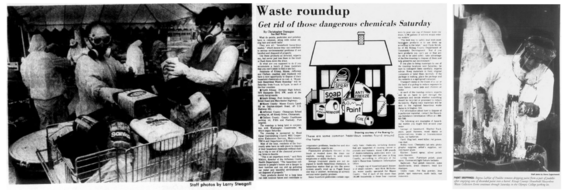 Left image: The first collection event in Kitsap County, with two workers sorting a basket of household chemicals (1988). Middle image: An article advertising the first hazardous waste collection event in Kitsap County (1988). Right image: A worker using paddles to scrape out leftover paint into a bucket at the last collection event before the facility opened (1995). Newspaper clippings courtesy of the Kitsap Sun archive.
As these collection events became more popular, public interest grew. The events were the perfect short-term solution for handling Kitsap’s household hazardous waste. Then, in October 1991, the Bremerton-Kitsap County Board of Health (now Kitsap Public Health District) banned the disposal of household hazardous waste in the garbage, down the drain, and into the environment (Ordinance 10-1991, Solid Waste Regulations).
With a ban in place, county leaders started planning for a long-term solution: a permanent facility. After several years of community meetings and site selection, the county chose a location in 1995 for the first household hazardous waste facility in Kitsap. The South Kitsap Household Hazardous Waste Collection Facility opened a year later on April 18, 1996. It cost just under $600,000 (in 1996 dollars) to build and collected 73 tons of household hazardous waste from 2,000 residents in its first year.
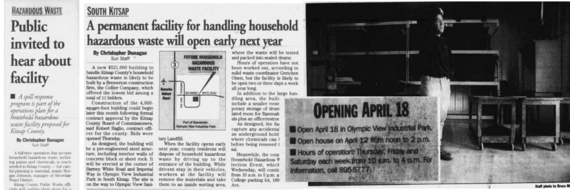 First image: Newspaper clipping inviting the public to hear about the proposed Household Hazardous Waste Collection Facility (1993). Second image: Newspaper clipping announcing when the facility will open (1995). Third image: Newspaper clipping announcing the opening of the new facility on April 18, 1996. Fourth image: The first facility manager standing inside of the brand new Household Hazardous Waste Collection Facility (1996). Newspaper clippings courtesy of the Kitsap Sun archive.
30 years later
Since its opening in 1996, Kitsap County’s household hazardous waste collection program has served 204,779 customers and collected more than 15 million pounds of hazardous waste. The program has grown to include more services, such as collection of latex paint for recycling through the PaintCare program. The program has also become a model in Washington State for effective hazardous waste management, winning awards in 2010 and 2021 from the North American Hazardous Materials Management Association.
We continue to provide free hazardous waste disposal to residents and low-cost disposal to qualifying businesses and organizations. We’ve also expanded our program to include a second facility to better serve the North Kitsap community. The North Kitsap Household Hazardous Waste Facility is expected to open later this year.
As we look forward to opening our second facility, we’re excited to celebrate the environmental safeguards and history of the existing South Kitsap Household Hazardous Waste facility. Learn more about the facility and what we accept on our household hazardous waste webpage.
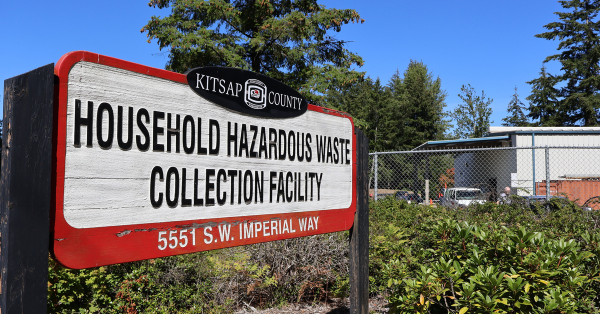
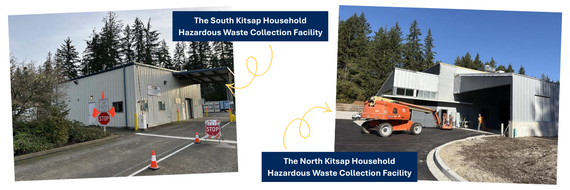 Left image: The South Kitsap Household Hazardous Waste Collection Facility. The facility is celebrating thirty years this April. Right image: The new North Kitsap Household Hazardous Waste Collection Facility that is expected to open later this year.
|