|
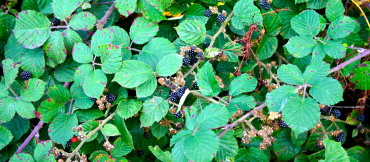
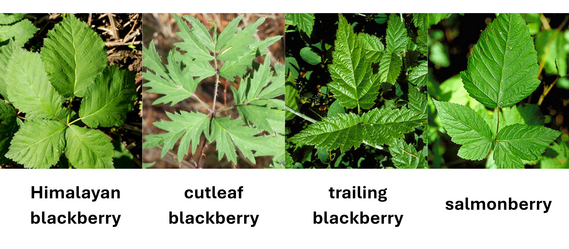
Himalayan blackberry (Rubus armeniacus) and evergreen or cutleaf blackberry (Rubus laciniatus) are non-native invasive shrubs. Both form dense, thorny thickets that spread aggressively by rooting canes (stems) and seeds, outcompeting native vegetation, preventing tree regeneration, and blocking wildlife movement.
It’s important to distinguish these invasive blackberries from our native blackberry. The native trailing blackberry (Rubus ursinus) is a delicate, low-growing vine with smaller, slender canes and three small leaflets. It produces smaller but very flavorful berries, and unlike the invasive species, it does not form impenetrable thickets. Another native plant that can be mistaken for invasive blackberry is salmonberry (Rubus spectabilis), a tall, upright shrub with pink flowers and orange-to-red berries instead of black ones. Its canes are sparsely thorny or thornless, and its distinctive three-part leaves differ from the large, tough leaves of Himalayan and evergreen blackberry. Recognizing these differences helps us protect native species while targeting invasive blackberry for removal.
 Invasive blackberries spread by birds, animals, and disturbance. They dominate sunny and disturbed sites at low elevations throughout Kitsap County. Once established, it forms impenetrable stands that are difficult to maneuver and restore. Because invasive blackberries are so widespread, control is not legally required in Kitsap County, but it is highly encouraged to prevent spread into new areas. Long-term management is necessary, as plants resprout vigorously. Start in lightly infested areas and work toward heavier infestations.
Blackberry Control Tips:
- Manual: Repeated mowing, cutting, or goat grazing in spring and fall months will eventually exhaust the plants. Cutting and then digging out root crowns is an effective method.
- Chemical: Herbicides, such as triclopyr or glyphosate, can be applied to foliage or freshly cut stems of actively growing plants. The best timing is late summer to fall when native vegetation is dormant. Always follow label instructions, wear protective clothing, and avoid spraying near waterways unless using state-approved aquatic herbicides under permit.
-
Disposal: Stems and roots can resprout if they touch the ground. Pile them on tarps, logs, or brush piles so they dry out, or dispose of at a transfer station. Do not compost, as most home systems will not kill seeds.
Source: King County Noxious Weed Control Program. Best Management Practices – Cutleaf Blackberry (Rubus laciniatus) and Best Management Practices – Himalayan Blackberry (Rubus armeniacus).
UPCOMING COMMUNITY EVENTS
Bainbridge Island Land Trust - Native Plant Sale
Saturday, October 4th, Member Sale 9 - 10am, Public Sale 10am - 1pm
Join BILT to explore a wide selection of native plants and connect with fellow plant enthusiasts! More information here.
Shore Friendly Kitsap - Contractor Workshop
Thursday, October 16th, 8:30am - 4:00pm
Shore Friendly Kitsap is hosting a FREE workshop for landscape professionals, arborists, drainage specialists, excavation services, and contractors working on marine shoreline properties. More information and registration here.
GPC - Traditional Foods: Ethnobotany Walk
Saturday, October 18th, 10:00am - 12:00pm
Join Great Peninsula Conservancy for a Walk and Talk along Cowling Creek as they highlight the uses of native plants. More information and registration here.
Kitsap Salmon Tours
Saturday, November 1st, 11:00am - 3:00pm
Join this free event at 8 different stream sites across the county to explore all things salmon with biologists, local environmental organizations, and trained docents.
More information and locations here.
VOLUNTEER OPPORTUNITIES
Kitsap Parks - Chico Salmon Park Work Party
Saturday, October 4th, 9:00am - 12:00pm
This is the last work party before the Kitsap Salmon Tours, putting final touches on trails and removing unwanted vegetation. If you have any questions, contact Aaron Bartleson at abartles@kitsap.gov. Location here.
Kitsap Parks - Newberry Hill Heritage Park Work Party
Every Wednesday, 9:00 - 11:00am
Location changes weekly. For up-to-date information, please contact
Natural Resource Coordinator, Aaron Bartleson at abartles@kitsap.gov.
GPC - Clear Creek Trail Work Party
Saturday, October 11th, 9:00am - 12:00pm
If interested in joining Great Peninsula Conservancy’s work party, please register here.
GPC - Creekside Guide Training
Saturday October 11th, 12:00 - 1:30pm
Join Great Peninsula Conservancy at the Clear Creek Interpretive Center in this training session to become a Creekside Guide. More information and registration here.
GPC & KCD - ORCA Recovery Day Dogfish Creek Restoration
Friday October 17th, 2:00 - 4:00pm
Come help restore vital salmon habitat by planting native vegetation, in partnership with Great Peninsula Conservancy and Kitsap Conservation District.
More information and registration here.
Kitsap Parks - Newberry Hill Heritage Park Work Party
Saturday, October 18th, 10:00am - 12:00pm
If you are interested in joining this work party, please contact
Natural Resource Coordinator, Aaron Bartleson at abartles@kitsap.gov.
GPC - Planting Maintenance at Tahuya River Preserve
Saturday, October 25th, 10:00am - 12:30pm
If interested in joining Great Peninsula Conservancy’s work party, please register here.
Weed Warriors - Weed Pull at Bloedel Reserve
Saturday, October 25th, 1:00 - 3:00pm
If you are interested in joining this weed pull, more information and registration here.
To learn more about our program, please visit our website: www.kcowa.us/noxiousweeds
|