|
Proposed Changes to Sewer Rates
Washington State law, RCW 36.94.140 requires sewer rates to be set to produce revenues sufficient to cover the costs of maintenance and operations, bond obligations, repayment of loans, and other costs necessary to properly run the county’s sewer systems.
The proposed five-year rate plan for 2026-2030 provides a cost-of-service based approach ensuring sewer rates are as fair and equitable as possible across all customer classes. This includes customers connected to sewer and contractors using Central Kitsap Treatment Plant for liquid hauled waste disposal (septage and grease). Adjustments to hauled waste rates will allow for a fairer distribution of costs, mitigating the impact on connected customers.
This model aligns revenue generation with actual system use and service impacts, helping to responsibly fund operations while preparing the utility for future capital investments.
The Sewer Utility will present a rate adoption resolution to the Kitsap County Board of Commissioners by October, which will enable the Utility to continue delivering on the capital plan that supports reliable and sustainable sewer service countywide. Sewer customers may review the detailed rate plan and provide comments. More information is available at kcowa.us/sewer.
Proposed 5-Year Rate Plan for Kitsap County Sewer Customers:
|
Customer Class
|
2026
|
2027
|
2028
|
2029
|
2030
|
|
Residential
|
$109.72
|
$115.48
|
$121.55
|
$127.93
|
$134.64
|
|
Multi Family
|
$89.53
|
$96.47
|
$103.94
|
$112.00
|
$120.68
|
|
Commercial
|
$0.16
|
$0.16
|
$0.17
|
$0.18
|
$0.19
|
|
Restaurant
|
$0.26
|
$0.29
|
$0.31
|
$0.35
|
$0.38
|
Residential and multi-family are monthly charges per unit. Commercial and Restaurant are per cubic foot of water usage.
|
|
|
Does Kitsap County offer any discounts on sewer fees?
A senior/low-income discount is given to customers that meet the Assessor’s criteria for the Senior/Disabled Exemption on property taxes. The current discount on sewer accounts is 25%. If you qualify for this exemption, please contact Utility Billing at 360.337.7127 to request the discount.
Not sure if you qualify? Visit Kitsap.gov/assessor for more information.
|
|
 Don’t Flush Contact Lenses
According to the CDC, approximately 45 million Americans wear contact lenses. If you are one of them, you’ve probably heard about the dangers of leaving contacts in too long. But did you know the importance of proper disposal? If you flush them, you contribute to the microplastic pollution in our waterways.
A study at Arizona State University found 15 to 20 percent of people that wear contacts dispose of used lenses down the sink drain or by flushing them down the toilet. The tiny pieces of plastic end up at our wastewater treatment plants.
At the treatment plant, contact lenses can break into tiny shards small enough to get through the treatment process and ultimately end up in Puget Sound. These plastics sink to the bottom of the ocean where they are mistaken for food and ingested by fish and other animals. Finally, the plastic can make it back to humans as part of the food chain and expose us to pollutants absorbed by the plastics along the way.
Next time you throw out your used contact lenses, remember to use the trash can and not the drain.
|
 Inside Wastewater Treatment
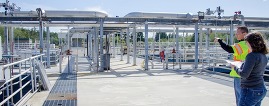
Most of us don’t think about where our wastewater goes once it leaves our homes and businesses. But wastewater treatment plant operators think about this every day. It is their job to control the treatment process, make sure our plants are properly maintained, meet environmental regulations, and protect Puget Sound.
Wastewater treatment plant operators in Kitsap County must be certified by the Washington State Department of Ecology. The Sewer Utility employs operators at all levels from Trainee to the highest certification at Group IV. Operators are required to complete continuing education to stay certified or obtain certification for an advanced level.
Who would want to treat wastewater? People that choose this career tend to be detail-oriented with good mechanical skills and an interest in math, science, and technology. Experience can be gained through on-the-job training, internships or even volunteering. Once these skills are obtained, there is a lot of longevity in a career in wastewater treatment.
As long-term employees begin to retire and our communities continue to grow, there are more opportunities for careers in wastewater treatment. If you are interested in a career or just want to know more about the treatment process, schedule a tour of your local treatment plant. Visit kcowa.us/lessons for more information.
|
|
 |
|
Don't be a pain in the drain
Don’t let items such as grease or wipes go down drains. Avoid using the toilet as a trash can. Only flush human waste
and toilet paper to avoid clogged pipes. Only flush the 4 P’s - poop, pee, puke, and toilet paper.
|
|
|
KITSAP COUNTY PUBLIC WORKS | KITSAP.GOV | KITSAP1: 360.337.5777 |
|
|
|