|
August 2025
Weed Aware - August Weed of the Month:
Knotweed Species - Himilayan, Japanese, Giant and Bohemian (Persicaria wallichii, Polygonum cuspidatum, Polygonum sachalinense, Polygonum x bohemicum)
Invasive knotweeds: Himilayan, Japanese, Giant and Bohemian are aggressive, non-native perennial plants that pose significant ecological and infrastructural threats in Kitsap County. Originally introduced in the late 1800s as ornamentals and for erosion control, these species have become prolific invaders of riparian zones, roadsides, wetlands, and unmanaged lands.
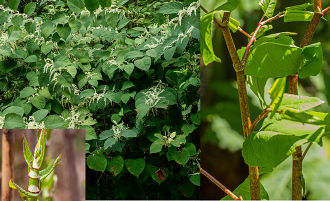
Knotweeds are clump-forming perennials that can reach 4 to 12 feet in height. Their hollow, bamboo-like stems and large, alternate leaves (varying by species) give them a distinctive appearance. They reproduce via both seeds and vegetatively, but their primary mode of spread is through extensive rhizome systems. These underground structures can reach depths of over 7 feet and extend more than 23 feet laterally, making them exceptionally difficult to eradicate. Even small fragments of roots or stems can regenerate new plants, particularly in moist environments.
The environmental impact of knotweed is severe. It displaces native vegetation, degrades riparian habitats critical for fish and wildlife, lowers water quality, and alters river nutrient cycles. Its aggressive growth can clog waterways, promote erosion, and interfere with infrastructure by damaging pavement and blocking road visibility. Additionally, knotweed compromises drainage and septic systems, making it a costly nuisance in both urban and rural landscapes.
Bohemian knotweed is a hybrid of Japanese and Giant knotweed, further complicating identification and management. Despite their ornamental origins, all knotweed species are now classified as Class B noxious weeds in Kitsap County to mitigate their spread and ecological harm. Landowners are required to control Himalayan and giant knotweeds and highly encouraged to control Japanese and Bohemian knotweeds.
Effective knotweed management demands a long-term, integrated approach that targets the resilient rhizome network. Integrated Pest Management (IPM) is the preferred strategy, blending manual, mechanical, and chemical controls tailored to site conditions and available resources.
For small infestations, manual digging or cutting (conducted repeatedly over several years) can weaken the root system. However, root fragments must be carefully disposed of to avoid re-infestation. Covering with heavy-duty black plastic or geo-textile fabric for at least five seasons can suppress regrowth in isolated patches.
Herbicide application is often necessary for larger infestations. The most effective treatments occur between July and October using systemic herbicides like glyphosate or imazapyr. Methods include foliar spraying, wick wiping, and hollow stem injection. Stem injection is highly effective and minimizes environmental drift but is labor-intensive. Chemical controls must comply with local regulations, especially in aquatic or riparian areas.
Preventing spread is critical! Never transport or discard knotweed fragments in waterways or moist soils. Early detection and upstream control are essential to prevent downstream reinfestation. Coordinated landscape-scale projects involving landowners, volunteers, and local agencies improve outcomes. Regardless of method, persistence and annual monitoring are necessary for long-term suppression or eradication of knotweed populations.
Source: King County Noxious Weed Control Program. (July 2015). Best Management Practices – Invasive Knotweeds: Bohemian Knotweed, Japanese Knotweed, Giant Knotweed, Himalayan Knotweed (Polygonum bohemicum, P. cuspidatum, P. sachalinense, P. polystachyum). Retrieved from www.kingcounty.gov/weeds
|