|
As spring gives way to summer, the recent heat giving us an early preview, the Shore Friendly team has been out enjoying the sunshine and occasional rain shower. From native plants and beach walks to classroom inspiration and salmon habitat, here's what we’ve been up to:
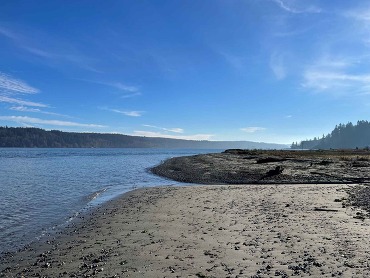 Anderson Point Park
A Day at Anderson Point Park
We couldn’t have asked for a more beautiful day to explore Anderson Point Park! Shore Friendly Kitsap recently hosted a shoreline walk where a small but enthusiastic group joined us to explore a natural beach and learn about the vital connections between upland areas, erosion, sediment movement, and shoreline ecology. One of the top highlights was learning how bulkheads can interrupt natural sediment supply, leaving beaches starved of the materials they need to stay healthy. Participants also enjoyed discussions about native vegetation, invasive species management, and practical tips for making their own shorelines more Shore Friendly—all while soaking in the beauty of Puget Sound!
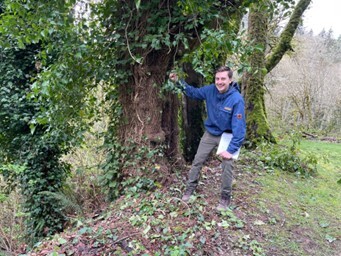 A Message from Kitsap County's Noxious Weed Program Coordinator
The lush, green growth of Spring is in full swing! Unfortunately, that means invasive and noxious weeds are also on the move. Noxious weeds can be highly destructive to native habitat and often outcompete native flora, making them very difficult to control. Prevention and early detection are the most effective ways to combat noxious weed infestations. Installing native plants in bare or disturbed areas can help prevent noxious weeds from getting started. We recommend familiarizing yourself with common invasives found along shorelines of the Puget Sound, walking your property regularly to monitor for new infestations, and acting quickly when an invasive is spotted. We are currently offering free noxious weed disposal all Kitsap County solid waste facilities as well as Bainbridge Disposal through October 31, or until funds are exhausted.
Some noxious shoreline invaders include:
- English ivy
- Himalayan blackberry
- Knotweeds – Bohemian and Japanese
- Perennial pepperweed
- Spartina (Common cordgrass) - This is a rare and extremely aggressive Class A noxious weed. Please contact our office if you suspect you might have Spartina.
If you need help identifying a suspected invasive species or would like to discuss control options, please submit an inquiry here or on the Noxious Weed Control Program webpage: kcowa.us/noxiousweeds.
-Jade Jarvis, Noxious Weed Program Coordinator
Over 60 Homeowners Reached Out For Geotechnical Site Assessments!
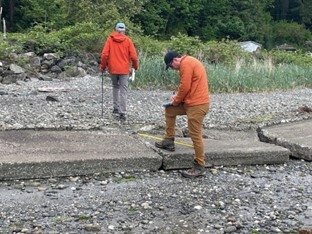 We had an amazing response to our recent postcard mailer—over 60 shoreline homeowners reached out for a free Shore Friendly site assessment! We’re thrilled by the enthusiasm and are currently working on getting everyone scheduled. Right now, we aren’t offering any more geotechnical site assessments. We only had a limited number to give out because they cost the program money to provide. But don’t worry! You can still sign up for a free general Shore Friendly site visit. These visits are a great way to learn about your shoreline, talk about erosion, and explore natural ways to protect your land and Puget Sound. Click here to schedule your visit
Why Shorelines Matter to Salmon
Salmon are amazing travelers—born in freshwater streams, growing up in the ocean, and returning home to their stream to spawn. But before they head out to sea, young salmon rely on nearshore areas as a safe place to grow, feed, and adjust to saltwater.
In Puget Sound, young salmon use the nearshore the most during spring and summer, especially between and July. Some can still be found in shoreline areas through the fall.
Different salmon species use shorelines in different ways. Some stay for a long time, while others pass through quickly. How they use the shore depends on things like their size, when they were born, and where they came from.
Healthy shorelines help salmon by:
- Providing food,
- Offering shelter from predators,
- Helping them adjust from freshwater to saltwater, and
- Guiding them on their way to the ocean.
But when shorelines are damaged—by pollution, buildings, or removing plants—it becomes harder for salmon to survive. That’s why it’s so important to protect and restore these special places.
Sources: Beamer et al., Salmon Use of Nearshore Habitats in Puget Sound (2005)
Juvenile Pacific Salmon in Puget Sound | Encyclopedia of Puget Sound
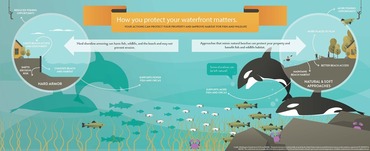 Washington Department of Fish and Wildlife created this graphic to show how natural shorelines in Puget Sound promote a healthy ecosystem which supports fish and orca
|