|
May 2025
Weed Removal & Disposal Tips
Spring and summer are great times to remove invasive and noxious weeds, but proper disposal is key! Many noxious weeds, such as poison hemlock, tansy ragwort, and giant hogweed, remain toxic long after they are pulled. Improper disposal can expose people and animals to harmful toxins and allow these weeds to continue to spread.
-
Always wear protective clothing and eyewear when handling noxious weeds, especially those with toxic sap like giant hogweed.
-
Do not compost or add to yard waste bins. Most home compost piles are not heated high enough to kill seeds or vegetative parts, which can regrow and spread.
-
Best practices for disposal:
- Bag entire plants and dispose of in the trash.
- For large amounts, pile and cover with a tarp to prevent light and moisture until plants are fully dried.
- Never transport weed material loosely! Secure bags and clean tools, clothing, and vehicles after removal.
Free noxious weed disposal is available at facilities throughout Kitsap County. All weeds on our 2025 Noxious Weed List are eligible for disposal.
Click here to view more details on how to participate.
Weed Aware - May Weed of the Month:
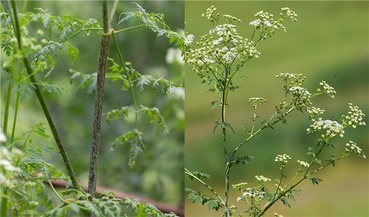
Poison Hemlock (conicum maculatum)
Poison hemlock is prioritized for control in Kitsap County and a Class B Designate weed (control required). Native to Europe and North Africa,
it was introduced to North America as an ornamental plant, and is now widespread and classified as a noxious weed in many western states.
Poison hemlock grows 3-10 feet tall forming dense stands in moist areas like roadsides and stream banks. It reproduces by seed with each plant able to produce over 30,000 seeds that remain viable for years. A key identification trait that distinguishes poison hemlock from lookalike species is its smooth, hairless stem marked with distinctive purple spots.
In spring, it produces umbrella-shaped clusters of small white flowers. The plant follows a two-year cycle: forming a basal rosette the first year, and flowering in the second.
Highly toxic to humans and animals, all parts contain potent alkaloids that can cause respiratory failure or death if ingested. Even skin contact can cause irritation.
Control includes pulling plants by hand (with gloves), mowing in spring and late summer, and applying herbicides like 2,4-D, triclopyr or glyphosate when actively growing. Do not compost--bag and dispose in the trash. Clean tools and clothing after handling.
Source: Sylvan Ramsey Kaufman, & Kaufman, W. (2012). Invasive plants: a guide to identification, impacts, and control of common North American species. (2nd ed.). Stackpole Books.
|