|
The smoke from wildfires happening in Spokane and elsewhere in the state is expected to blow into King County this week.
Please share widely with your networks. Information in more than 20 languages is available at kingcounty.gov/wildfiresmoke. Thank you for your help in keeping yourself and your community safe and healthy this summer.
Public Health - Seattle & King County
|
|
|
|
1. Check smoke forecasts every day.
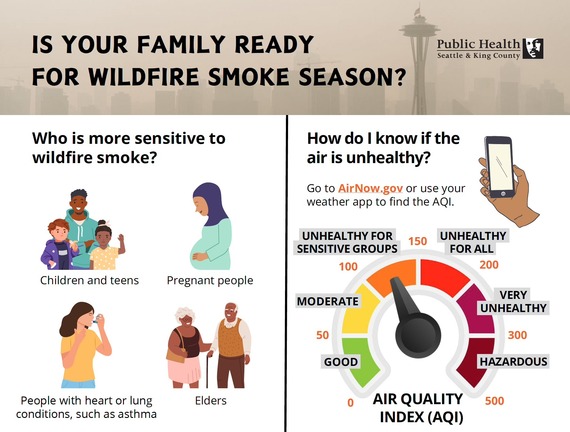
Smoke forecasts use numbers and colors to show the potential harm to our health. The most dangerous levels are shown in red (level 3) and purple/magenta (level 4).
-
Check the local air quality index (AQI) and wildfire smoke forecasts at AirNow.gov (map available at Fire.AirNow.gov).
- Weather apps and local news stations can also provide updates on heat risk and air quality.
2. Move indoors and avoid physical activity outdoors on smoky days.
- When AQI is orange (unhealthy for sensitive groups, 101-150 AQI): people in these groups should stay indoors as much as possible and avoid outdoor physical activity:
- children and teens
- people with asthma, lung or heart disease, diabetes, or have had a heart attack or stroke
- anyone who is pregnant
- anyone older than 65
- people who smoke
- people who have colds, the flu, COVID and other illnesses
- When AQI is red or purple days (unhealthy or very unhealthy/hazardous, 151 AQI and higher):
- Everyone should stay indoors and avoid outside physical activity
- If you can’t avoid going outside on a smoky day, consider using an N95 mask.
3. Keep indoor air as clean as possible on smoky days.
When it’s smoky outside, you need to give your lungs a break indoors.
- Close windows and doors when it’s smoky. But If it’s too hot inside the building, it’s better to open the windows for a short time than to overheat. Listen to your body and how you’re feeling.
- Consider getting a HEPA air purifier and making a clean air room, keeping doors to other rooms closed as much as possible.
- Don't smoke, use candles, or vacuum – these activities pollute indoor air.
- Avoid frying and broiling when cooking indoors.
4. Manage symptoms from smoke exposure.
- Watch for symptoms of wildfire smoke exposure: coughing, headache, sore throat, burning eyes, or wheezing.
- If someone has these symptoms, they should limit time outdoors, avoid vigorous physical activity and stay in an indoor space that has cleaner air.
|
|
Information, including flyers and slides, about how to protect yourself from wildfire smoke is available in over 20 languages at: kingcounty.gov/wildfiresmoke
 |
|
Video: Top 3 tips to beat the wildfire smoke: English |
|
|
 |
|
Facebook |
|
 |
|
Youtube |
|
 |
|
Instagram |
|
|
|
|