February 2026
Programs & News – Oregon & Washington
E-CYCLE WASHINGTON SEEKS LOCAL GOVERNMENT FEEDBACK
As E-Cycle Washington enters its 17th year, local governments are invited to provide feedback on how the program is working in their communities. The annual survey, open through March 1, helps guide future program improvements.
OREGON PACKAGING EPR LAWSUIT UPDATE
On February 6, 2026, the U.S. District Court for the District of Oregon issued two rulings in NAW v. Feldon. The court granted a preliminary injunction preventing enforcement of Oregon’s packaging EPR law against NAW and its members, while other producers remain fully subject to the law. DEQ’s motion to dismiss was partly granted: Equal Protection, Nondelegation, and Unconstitutional Conditions claims were dismissed without prejudice, but Dormant Commerce Clause and Due Process claims will proceed to trial on July 13, 2026. The preliminary injunction remains in effect for NAW members until the court issues its judgment.
LIGHTRECYCLE WASHINGTON TRANSITION
LightRecycle Washington is currently in transition after Product Care Recycling ended operations on December 31, 2025. The program remains required under state law, and the Washington State Department of Ecology is actively working to identify a new stewardship organization and provide guidance to ensure continued collection and recycling of mercury-containing lamps.
Programs & News – Other States
BC EXPANDS CURBSIDE RECYCLING FOR FLEXIBLE PLASTICS
Recycle BC is rolling out curbside collection of flexible plastics and select glass containers in the Regional District of Central Okanagan starting this May. The program also adds dedicated flexible plastic bins for Vancouver apartments and condos later this month. This expansion supports Recycle BC’s goal of reaching a 50% recovery rate for flexible plastics by 2027, a material type that has traditionally required drop-off at depots. The move is part of broader efforts to make recycling more convenient and effective under the province’s EPR framework.
CHEMICAL RECYCLING DEBATE SHAPES STATE POLICY
Chemical recycling is receiving increased scrutiny across the U.S. In California, ongoing court cases examine industry claims about the technology’s effectiveness, while in New York, lawmakers are debating whether it should qualify under the state’s packaging EPR bill.
CALIFORNIA SB 54 IMPLEMENTATION UPDATE
CalRecycle closed an additional 15-day public comment period on February 13, 2026, on revised draft regulations for implementing California’s Plastic Pollution Prevention and Packaging Producer Responsibility Act (SB 54). The updates reflect feedback from the earlier 45-day comment period and October 2025 hearing and include revisions related to program implementation, oversight, enforcement, and compostable product labeling requirements under AB 1201. The agency will now review comments and continue the rulemaking process. CalRecycle also released additional components of the statewide needs assessment, including reports on consumer education and access, reuse and refill systems, source reduction strategies, and the current state of collection, processing, and end markets.
CALIFORNIA REVIEWS APPLICANTS FOR TEXTILE PRO
CalRecycle has received applications from three organizations—Circular Textile Alliance, Landbell USA, and Textile Renewal Alliance—to serve as the producer responsibility organization (PRO) for California’s new textile EPR program, established under the Responsible Textile Recovery Act of 2024 (SB 707). CalRecycle is expected to select a PRO by March 1, 2026. The chosen organization will develop and manage a statewide system to collect, repair, reuse, and recycle apparel and household textiles, with program implementation expected in 2027.
 |
|
CALL2RECYCLE IS NOW THE BATTERY NETWORK
Call2Recycle has rebranded as The Battery Network, reflecting an expanded focus on battery stewardship and collection. The nonprofit operates producer responsibility programs in several states and maintains a nationwide network of voluntary consumer battery collection locations across the U.S.
|
NEW TECH IMPROVES BATTERY SAFETY AND COLLECTION
Advances in battery collection and sorting technologies are helping recyclers and communities meet two growing challenges: preventing fires and handling rising volumes from battery EPR programs. Firesafe bins, improved identification systems, and automated alerts reduce risks from damaged lithium-ion batteries, while faster, more accurate sorting strengthens recovery infrastructure. These upgrades enhance worker safety, lower costs, and support expanding battery collection under evolving EPR policies.
PEW REPORT: U.S. COULD CUT PLASTIC WASTE BY 10-20% by 2040
A new report from the Pew Charitable Trusts shows that the U.S. could substantially reduce plastic packaging waste and pollution by 2040 through a combination of policies, including EPR, reuse systems, deposit return programs, and improved recycling infrastructure. The report finds that adopting these “stacked” strategies could lower waste by around 29% and prevent up to 35% of pollution compared with business as usual.
Legislative Updates
Oregon
-
HB 4144 (Batteries): Passed out of the Ways & Means Committee with amendments on Feb. 25.
-
HB 4030 (Packaging Amendment): Passed out of the House Climate, Energy & Environment Committee and referred to Rules on Feb. 13. Seeks exemptions for certain berry and protein packaging.
Washington
-
HB 1420/SB 6174 (Textiles): House Environment & Energy Committee approved a second substitute of HB 1420 on Jan. 29 and referred to Appropriations, which held a hearing on Feb. 6. The revised version would direct a statewide needs assessment to better understand existing and needed systems for managing textiles and apparel, informing potential future EPR adoption. The Senate version received a hearing in the Senate Committee on Environment, Energy & Technology on Feb. 4. Both bills failed to meet legislative deadlines and will not advance this session.
-
HB 2301 (Paint Amendment): House Appropriations approved a substitute; referred to Rules. Would expand existing paint EPR to include aerosol coatings, coating-related products, and nonindustrial coatings. The bill failed to meet legislative deadlines and will not advance this session.
-
SB 6271/HB 2633 (Mattresses): SB 6271 received a hearing on Feb. 4 in the Senate Committee on Environment, Energy & Technology. Both bills failed to meet legislative deadlines and will not advance this session.
-
HB 2439 (Vapes): House Consumer Protection & Business approved a substitute; referred to Appropriations, which held a hearing Feb. 5. The bill failed to meet legislative deadlines and will not advance this session.
-
HB 1607/SB 5502 (Beverage Containers): HB 1607 heard in House Appropriations Jan. 21; referred to Rules Jan. 30. We understand this bill may be deemed “necessary to implement the budget” and therefore not subject to certain legislative action deadlines.
Events & Webinars
CWMA EPR Programs Webinar Series – Product Care
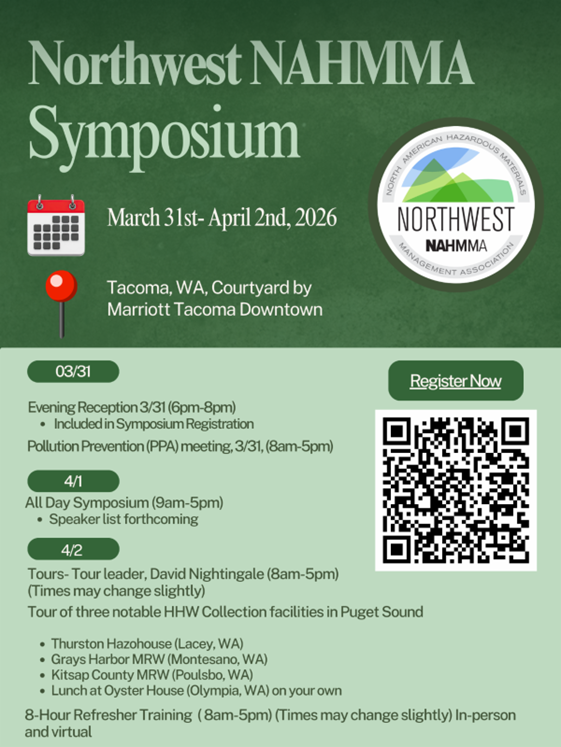
Northwest NAHMMA Symposium 2026
- Tacoma, WA | March 31 – April 2, 2026
AOR 2026 Spring Forum: Non-Packaging EPR Programs
41st Annual SWANA Northwest Regional Symposium
2026 Washington State Recycling Association (WSRA) Conference
Engage with the Northwest Product Stewardship Council (NWPSC). Join as an Associate, Steering Committee, or Community member. Follow @StewardshipNW on X for product stewardship information from Washington, Oregon and elsewhere.
|