December 2025
Programs & News – Oregon & Washington
APPOINT A PRO IN WASHINGTON FOR PACKAGING EPR BEFORE JANUARY 1, 2026
Washington’s EPR law, passed in May 2025, aims to reduce waste, expand equitable recycling access, and shift system costs from local governments to the producers of packaging.
Local governments and other service providers that want to participate in the packaging EPR program – and receive reimbursements - must register as a Service Provider by January 31, 2026. Department of Ecology is expected to launch the service provider registration portal in the first week of January 2026. Service Providers need to provide information about the residential recycling services that they provide, associated costs and tonnage for 2024 and 2025.
Rulemaking will begin in 2026, with full implementation targeted for 2030. You can find additional details on the Recycling Reform Act here.
E-CYCLE WA PARTNERS WITH KING COUNTY SOLID WASTE DIVISION AND SEATTLE PUBLIC UTILITIES ON AN E-WASTE CAMPAIGN
 |
|
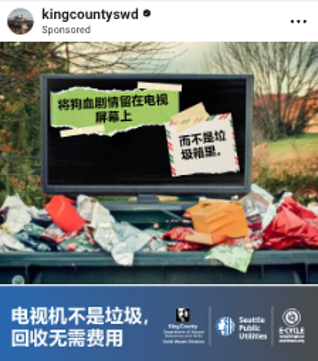
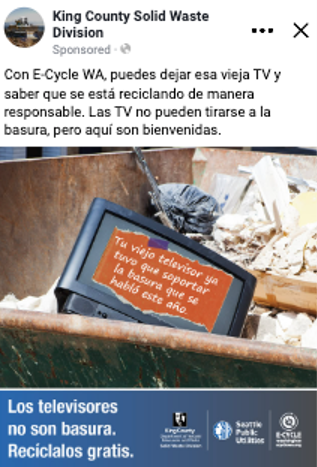
The holiday season is upon us! While this can be joy in the form of Black Friday purchases and gifts, it usually also means more electronics getting thrown out. To ensure residents know how to recycle responsibly, WMMFA (the producer responsibility organization behind E-Cycle Washington) has partnered with King County Solid Waste Division and Seattle Public Utilities on an awareness campaign.
|
|
This is part of WMMFA’s Joint Outreach Project, where local governments, E-Cycle Washington Collection Sites, and others can request partial funding of outreach campaigns that promote recycling of computers, monitors and televisions. The funding has ensured that the campaign has been translated into several different languages and will appear in diverse media used by local communities. E-Cycle WA was Washington’s first EPR program. The program offers residents, schools and school districts, and businesses with fewer than 50 employees to recycle computers, monitors and televisions for free – the costs are covered by the producers.
|
|
 |
PREVIEW OF SOLID WASTE RELATED BILLS IN WASHINGTON
The Washington State Recycling Association (WSRA) held their annual Policy Forum at Federal Way City Hall on Thursday December 11, 2025. Mayor Jim Ferrell of Federal Way welcomed all attendees. State legislators presented solid waste related bills that they will be sponsoring in the upcoming 2026 legislative session and the Department of Ecology gave updates on the implementation of Organics Management Laws and the Recycling Reform Act (EPR for Packaging & Paper Products).
- Rep. Reeves has continued to work on an EPR bill for Textiles with stakeholders (building on HB 1420)
- Rep. Stonier presented a bill that would establish a deposit-return system for beverage containers (also known as Recycling Refund Program or a Bottle Bill)
- Rep. Berry presented a bill that expands the list of products that are subject to post-consumer recycled content (PCRC) requirements
- Rep. Parshley presented a bill that would amend the single-use plastic bag ban
- Sen. Hunt presented an EPR bill for Mattresses (building on HB 1901)
TOUR OF THE RECYCLE WAREHOUSE’S MATTRESS RECYCLING OPERATIONS
The Washington State Recycling Association (WSRA) also organized a tour of The Recycle Warehouse, a non-profit mattress recycling facility in their new Mukilteo facility. Senator Hunt and Representative Hall participated in the tour. They will be sponsoring the EPR bill for Mattresses (building on HB 1901) in the upcoming 2026 legislative session in Washington.
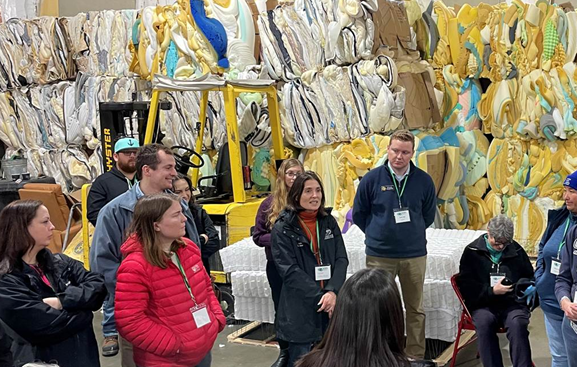 Each year, over 48,000 tons, or more than 1 million mattresses, are sent to landfills in Washington, each one taking up a cubic yard of space. Almost all parts of a mattress can be recycled: metal, foam, wood, and fabrics, but this costs $30-$40 per mattress. As it isn’t easy to get rid of a used mattress, they are often just sent to disposal – or worse – illegally dumped.
The NPWSC has been learning from mattress recycling programs in Connecticut, California and Oregon and meeting regularly with the International Sleeping Products Association (ISPA) and the Mattress Recycling Council (MRC) in the interim to develop an EPR bill for Mattresses. The bill would establish a program that would offer more convenient opportunities to dispose of use mattresses across the state; be able to recover, reuse and recycle mattresses; and create local jobs.
WASHINGTON EVALUATES HEALTH IMPACTS OF PROPOSED TEXTILE EPR LEGISLATION
The Washington State Board of Health, in coordination with the Governor’s Interagency Council on Health Disparities, has completed a Health Impact Review (HIR) of SHB 1420—legislation that would establish a producer responsibility program for textiles in Washington.
The HIR assessed how the proposed law could affect health outcomes, with a focus on equity and environmental justice. Findings indicate that the bill could lead to measurable public health benefits by diverting textiles from landfills and illegal dumping sites, reducing exposure to associated pollutants. The review also notes that by expanding access to reuse and repair systems, SHB 1420 could improve resource access for low-income and rural communities.
Additionally, the report highlights workforce development opportunities tied to local textile recovery infrastructure. Jobs in collection, sorting, repair, and recycling may disproportionately benefit communities already experiencing environmental health disparities. The HIR provides valuable context as policymakers consider SHB 1420 during Washington’s 2026 legislative session. Access the Full Health Impact Review and Executive Summary.
OREGON’S PACKAGING EPR LAW FACES LEGAL UNCERTAINTY
While the court has not yet ruled on the injunction, the motion introduces uncertainty for producers preparing to comply with 2026 deadlines. The Oregon Department of Environmental Quality (DEQ) has not released revised guidance but is expected to respond in the coming weeks.
Programs & News – Other States
MATTRESS RECYCLING ENHANCES LANDFILL OPERATIONS IN CALIFORNIA
A recent article from Recycling Today highlights how mattress recycling is delivering unexpected operational benefits at landfills—offering insights beyond traditional environmental and diversion metrics. At Orange County Waste & Recycling’s Frank R. Bowerman Landfill in California, recycling mattresses has helped improve efficiency, safety, and site longevity.
Heavy equipment operator Jorge Hernandez described how mattresses—once a persistent nuisance in landfill operations—frequently tangled in compactor wheels, jammed machinery, and interfered with daily cover. Now, through California’s mattress stewardship program (Bye Bye Mattress), those materials are collected separately and recycled, eliminating these challenges.
Since California implemented mattress EPR in 2016, the program has diverted more than 12 million mattresses from landfills. For landfill operators like Hernandez, the benefits go beyond space savings: the site now runs more smoothly and requires less downtime for equipment repairs and safety checks.
These operational wins help reinforce the broader value of extended producer responsibility. As other states consider or expand mattress EPR legislation, this example underscores how stewardship programs can support local governments not only through diversion and recycling, but by directly improving day-to-day solid waste operations. Read the full article here.
FEDERAL REUSE LEGISLATION GAINS TRACTION WITH SENATE PASSAGE OF REUSE ACT
In a significant step forward for national circular economy policy, the U.S. Senate has passed the Rewarding Efforts to Decrease Unused Excess (REUSE) Act, which would authorize federal support for research and innovation focused on reuse and refill systems. The bipartisan legislation, introduced by Senators Jeff Merkley (D-OR) and John Boozman (R-AR), is aimed at addressing the growing environmental impacts of single-use packaging while expanding infrastructure for reuse across the country.
If enacted, the REUSE Act would direct the U.S. Environmental Protection Agency (EPA) to study existing reuse systems, identify barriers to implementation, and fund pilot projects that test scalable solutions. It would also provide a clearer federal policy framework to support reuse innovation alongside state and local waste reduction efforts.
The legislation reflects increasing federal recognition that reuse systems—whether for beverage containers, household goods, or foodservice packaging—are a critical complement to recycling and product stewardship strategies. For local governments and producers already engaged in EPR and packaging reform, the Act could open new funding streams and policy tools to support long-term waste prevention goals. While the bill has passed the Senate, it must still be approved by the House and signed into law to take effect. Supporters are optimistic that the REUSE Act’s bipartisan backing and alignment with national waste reduction priorities will help advance the bill in 2026. For more on the Senate vote and stakeholder reactions, read the full article in Recycling Today.
NATIONAL TEXTILE WORKING GROUP LAUNCHED DECEMBER 15
The National Textile Circularity Working Group launched December 15 as a new cross-sector effort led by NSAC and SAF to accelerate practical, scalable solutions for textile circularity across the U.S. The group will bring together retailers, resellers, manufacturers, nonprofits, and government agencies to keep textiles — including clothing, carpet, mattresses, and furniture — in use and out of landfills through coordinated policy and systems-based approaches.
Participants already include major national brands and organizations such as Target, the American Apparel & Footwear Association, Goodwill of Southern California, Reverse Logistics Group, and SWANA. The kickoff meeting will feature opening remarks from Washington State Representative Kristine Reeves and will set the stage for collaborative work on reuse, repair, recycling, and fair, effective policy models.
Job Posting
-
Metro Regional Center, OR; Flexible/hybrid
-
Full Time - $159,183.67 - $203,162.79 Annually
-
Waste Prevention & Environmental Services
Events & Webinars
Resource Recycling Conference 2026
41st Annual SWANA Northwest Regional Symposium
2026 Washington State Recycling Association (WSRA) Conference
Engage with the Northwest Product Stewardship Council. Add your voice and join the Northwest Product Stewardship Council (NWPSC) as an Associate, Steering or Community member. Follow the NWPSC on Twitter (@StewardshipNW) for product stewardship information from Washington, Oregon and elsewhere.
|