October 2025
Programs & News – Oregon & Washington
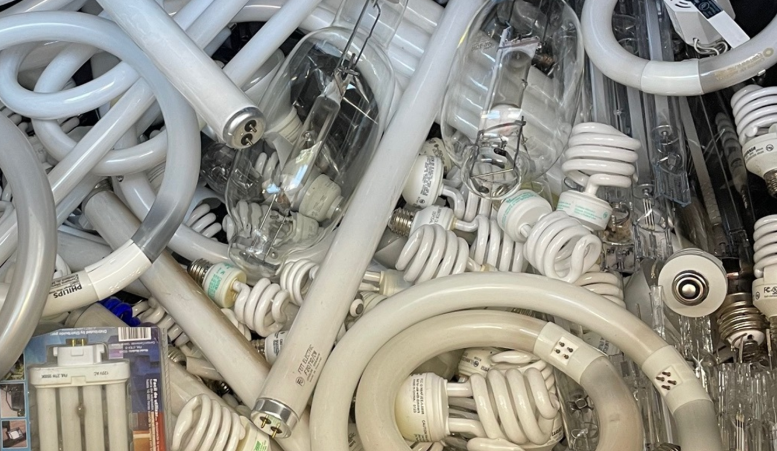
PRODUCT CARE RECYCLING WILL NO LONGER ADMINISTER LIGHTRECYCLE WASHINGTON
Product Care Recycling has notified the Department of Ecology (Ecology) that they will stop administering the LightRecycle Washington program on behalf of mercury-containing light manufacturers at the end of this year. The LightRecycle program is not ending, and producers remain obligated under Chapter 70A.505 RCW to fund and operate a collection program for mercury-containing lights. Ecology has been meeting regularly with a potential new stewardship organization, the Mercury Lights Recycling Association (MLRA), and is awaiting their final decision about whether or not they will assume responsibility for the program. MLRA currently operates programs in Vermont and Maine. Ecology will share information about the transition as soon as it is available via Gov Delivery. Not signed up to receive email updates? Join here.
Specific questions can be sent to mercurylights@ecy.wa.gov.
OREGON PREPARES FOR NEXT ROUND OF RECYCLING MODERNIZATION RULEMAKING
Oregon’s Recycling Modernization Act (RMA), EPR for Packaging, Paper and Food Serviceware, is still in the process of being implemented. Local governments are already seeing changes to their recycling programs. For example, the City of Eugene rolled out an expanded recycling list that now includes cartons, plastic tubs, and other materials newly accepted statewide. The expansion is part of Oregon’s broader effort to create consistency and improve access for all communities.
According to the City of Eugene, these additions are possible through producer funding secured under the RMA, which helps cities upgrade equipment and update education materials. It’s one of the first visible examples of Oregon’s EPR system at work at the local level.
See how Circular Action Alliance (CAA), the Producer Responsibility Organization (PRO), is implementing Oregon’s RMA at a recent Lunch & Learn: Slides & Recording
DEQ is encouraging local governments, service providers, and other stakeholders to engage in the rulemaking to improve clarity, make identified corrections and provide increased consistency across the RMA rules. Applications for three “at-large” seats are now open on the rulemaking advisory committee. This committee will play a key role in shaping how Oregon’s EPR system continues to take form.
WASHINGTON’S RECYCLING REFORM ACT MOVES FROM POLICY TO PLANNING
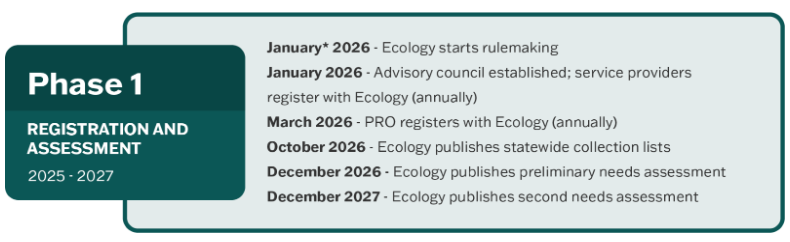
Washington’s new Recycling Reform Act (E2SSB 5284) is shifting from legislation to action. Passed earlier this year, the law establishes the state’s first extended producer responsibility (EPR) system for packaging and paper products. It requires producers to join a nonprofit Producer Responsibility Organization (PRO) that will coordinate recycling services statewide and reimburse local governments for the cost of collection and processing.
Programs & News – Other States
AT-HOME MEDICAL WASTE SUCH AS USED SHARPS ARE SURGING
Kristen Aldred, PhD, who serves as Director of Government Affairs, North America at Stericycle, now part of WM, expects the generation of medical waste in people’s homes to boom. Among the most common types of medical waste generated outside clinical settings today is sharps waste, which has surged due to the increased use of weight-loss medications like Ozempic and Wegovy (about 4% of the U.S. adult population (or about 11 million people) are using an injectable weight-loss drug). The figures are staggering and increasing rapidly. There is a growing number of Americans that live with diabetes and rely on regular injections at home.
While healthcare facilities have proper management and disposal practices for sharps waste, the options for households are limited. This leaves care-providers, patients, and families vulnerable to the risk of needlestick injuries and the potential spread of bloodborne pathogens. Moreover, the improper disposal of medical waste presents safety hazards to waste management personnel responsible for collecting curbside trash and recyclables.
 (Roman Mykhalchuk / Canva Teams)
FIRE RISK IN THE WASTE STREAM: IS THERE A “VAPE EFFECT”?
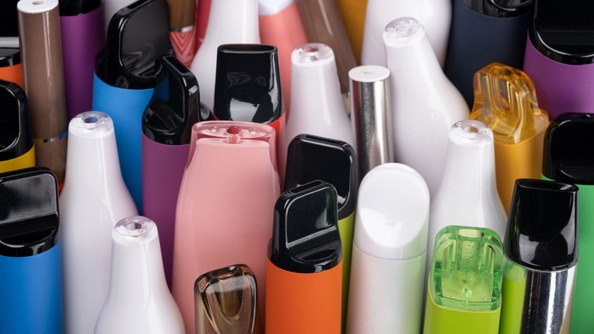
Recent data from Fire Rover’s monthly report points to a rise in facility fires across the U.S. waste and recycling industry, with some attributing the trend to a growing number of disposable vape devices entering the waste stream. Each device contains a small lithium-ion battery that can ignite when crushed or punctured in collection or processing.
July and August 2025 both set records for reported facility fires, highlighting ongoing challenges with lithium-ion battery management. While it’s difficult to separate the so-called “vape effect” from the overall increase of batteries in waste, the correlation is clear — and it underscores the need for better collection systems, public education, and safe disposal pathways as stewardship programs evolve.
BRITISH COLUMBIA APPROVES NEXT GENERATION OF PACKAGING EPR PLAN
In a recent decision, British Columbia’s Ministry of Environment and Parks formally approved the updated Packaging & Paper Product Extended Producer Responsibility Plan for Recycle BC. The approval, granted September 17, 2025, means the new program plan is effective immediately.
This update follows years of dialogue: the original plan was submitted in April 2023, and subsequent revisions were informed by feedback from the Ministry, industry, and public engagement. With this renewal, BC continues to push forward as one of North America’s more mature EPR systems, focusing on continuous improvement, stronger performance commitments, and clearer accountability mechanisms.
For partners in Canada and the U.S., BC’s evolution offers lessons in how a long-running EPR program can adapt over time without losing momentum.
CALIFORNIA’S EXPANDED ELECTRONICS & BATTERY LAW GAINS TRACTION
On the electronics side, California is also pushing forward with SB 1215, which extends EPR obligations to devices with embedded batteries. Starting this fall, consumers will see a 1.5% fee on eligible products, aiding collection and recycling infrastructure expansion.
This move reflects a growing recognition: battery-embedded electronics are a waste stream challenge. As more states adopt EPR or battery-takeback laws, advances in policy in California may be one of the better models to watch for scaling national solutions.
EPR SPURS MRFS TO UPGRADE AND PRODUCERS TO INNOVATE
Recycling facilities across the country are making infrastructure investments in response to EPR momentum. In states like California, Colorado, Pennsylvania, and Oregon, facilities are installing new sorting, compaction, and processing equipment to meet anticipated flows and performance requirements tied to producer funding regimes. Waste Dive
These upgrades aren’t just nice-to-haves—they’re critical steps to ensure municipal and regional systems can scale with higher recycling expectations. As EPR laws start to shift cost burdens and service expectations, these facility-level investments can make or break program effectiveness.
Jobs
Program Manager – Washington (Circular Action Alliance)
The Circular Action Alliance (CAA) is hiring a Program Manager to lead implementation of Washington’s new extended producer responsibility (EPR) program for packaging and paper.
This senior role will oversee all aspects of the Washington Producer Responsibility Organization (PRO), including budget development, producer engagement, collaboration with local governments and haulers, and statewide education and reporting. The Program Manager will coordinate with CAA’s national team to align operations and compliance across jurisdictions while supporting Washington’s unique program needs.
Ideal candidates bring 10+ years of leadership experience in waste, recycling, or related sectors; strong budget and stakeholder management skills; and a strategic, collaborative mindset. This is a remote position based in Washington State, with a salary range of $130,000–$160,000 annually.
Product Stewardship Specialist (Environmental Specialist 5)
The Solid Waste Management (SWM) program within the Department of Ecology is looking for a Product Stewardship Specialist to advance product stewardship and EPR policies
This role will also be responsible for coordinating with other product stewardship staff to develop internal operating policies and provide primary oversight of statewide product stewardship programs to ensure compliance with state laws and regulations. To bring these policies to action, the position will work with industry representatives, local governments, and a variety of interested parties both in-state and nationally.
-
Salary: $75,108 - $100,980 Annually
-
Location: Thurston County – Lacey, WA (This position is eligible for telework and flexible schedule options. A minimum of one day per week is required in the office.)
-
Deadline: Apply by October 30, 2025
Events & Webinars
Recording Available: NWPSC’s Lunch & Learn – Implementation of Oregon’s Recycling Modernization Act by Circular Action Alliance Oregon
Dept. Of Ecology: Washington’s Recycling Reform Act Kickoff Webinar
-
November 14, 2025 from 10am to 2pm at Ecology’s Headquarters in Lacey
-
Open for NWPSC Associate Members
Association of Oregon Recyclers (AOR) Winter Forum
2026 Washington State Recycling Association (WSRA) Conference
Engage with the Northwest Product Stewardship Council. Add your voice and join the Northwest Product Stewardship Council (NWPSC) as an Associate, Steering or Community member. Follow the NWPSC on Twitter (@StewardshipNW) for product stewardship information from Washington, Oregon and elsewhere.
|