September 2025
Programs & News – Oregon & Washington
WELCOME TO NEW NWPSC ASSOCIATE MEMBERS!
Associate Members are any local, state, regional or federal government agency or non-profit organization that supports the NWPSC mission and product stewardship policies and programs. Welcome to the following agencies that have recently joined the NWPSC:
- Clackamas County, Oregon
- Lane County, Oregon
- Washington County, Oregon
- City of Beaverton, Oregon
- City of Eugene, Oregon
- City of Gresham, Oregon
- City of Lake Oswego, Oregon
- City of Portland, Oregon
- Clark County, Washington
RECYCLING REFORM ACT CELEBRATION
On September 24th, Plastic Free Washington, Seattle Public Utilities and partners hosted a celebration in Gas Works Park to mark the passage of the Recycling Reform Act. The event brought many of the NWPSC members together with lawmakers, local government, and community advocates to spotlight this landmark law.
The Recycling Reform Act (Chapter 70A.208 RCW) establishes Washington’s first statewide extended producer responsibility (EPR) system for packaging and paper. It requires producers to join a nonprofit Producer Responsibility Organization (PRO) that will collaborate with local governments to implement the system by 2030.
Key features of the law include:
- A uniform list of recyclable materials across all jurisdictions, reducing confusion and waste stream discontinuities.
- A shift in financial responsibility to producers for collection, sorting, and recycling of packaging and paper.
- Stronger alignment between local recycling services and markets, with funding and design incentives built into the system.
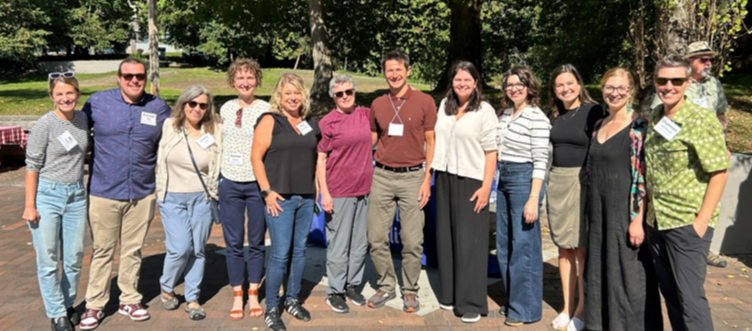
Members of the NWPSC Packaging Policy Committee that have been working on EPR for Packaging since 2019 celebrated the passage of the Recycling Reform Act with the sponsor, Rep. Berry. From left to right: Ali Blum (King County), Preston Peck (City of Tacoma), Janine Bogar (Ecology), Hannah Scholes (King County), Amy Ockerlander (King County), Kara Steward (Ecology), Adrian Tan (King County), Rep. Liz Berry, Caron Cargill (Insight Strategic Partners), Maggie Yuse (Seattle Public Utilities), McKenna Morrigan (Seattle Public Utilities) and Shannon McClelland (Association of Washington Cities). Missing from the photo is Heather Trim (Zero Waste Washington).
Implementation of the Recycling Reform Act is underway. Some upcoming key dates:
-
October 6, 2025: Deadline for Advisory Council Applications. The Advisory Council will advise Ecology and the PRO on program implementation, including statewide collection lists, infrastructure needs assessments, PRO plans and more. If you or someone you know is interested in applying, please complete or share the Advisory Council Application. After downloading and completing the application, email it to recyclingreform@ecy.wa.gov.
-
October 7, 2025 at 10am: Second kickoff webinar on the Recycling Reform Act. The webinar will start with a repeat presentation from the September 9th webinar, followed by Q&A. Register here.
-
January 31, 2026: Service Provider Registration. Service providers, including local governments with residential recycling programs, will need to register with Dept. of Ecology January 31, 2026. Keep an eye on Ecology’s website and sign up for email notices about the registration process. Registered service providers will be eligible to be reimbursed for costs, when the program starts in 2030.
Check out Ecology’s website for more information and sign up for email notices.
OREGON MATTRESS RECYCLING DIVERTS 2.3 MILLION POUNDS IN FIRST SIX MONTHS
Under Oregon’s statute (SB 1576), the program is funded via a $22.50 per-unit stewardship assessment collected at point of sale, which covers collection, transportation, processing, outreach, and oversight costs.
The program allows any Oregon resident or organization to drop off old mattresses or foundations at participating sites free of charge—regardless of the unit’s age or condition.
Other highlights from the first six months:
- 312 companies registered under the program
- Nearly 100 municipalities, community groups, and local media outlets engaged in promotion and outreach campaigns
- 41 collection events, with more scheduled over the remainder of 2025
This early success shows strong resident engagement and a solid foundation for scaling operations in rural counties and expanding access statewide.
Local governments in Washington state and British Columbia are pushing for establishing mattress EPR programs as mattresses are difficult to manage in the waste stream, costly to recycle despite being highly recyclable, and frequently illegally dumped. If you are interested in learning more about EPR for mattresses in Washington, please contact info@productstewardship.net
 APPROVAL OF AMENDMENT TO THE WASHINGTON ARCHITECTURAL PAINT STEWARDSHIP PROGRAM PLAN
In April, PaintCare submitted an amendment to the Washington Architectural Paint Stewardship Program Plan, seeking approval from the Department of Ecology to adjust the program’s fee structure. This fee increase was proposed to strengthen the program’s financial foundation and ensure its long-term viability.
On July 9, 2025, Ecology approved the amendment, marking an important step in safeguarding Washington’s paint stewardship system. The revised fees will provide the resources needed to sustain and expand core program services—including convenient paint collection, responsible recycling, and statewide education initiatives.
This decision helps guarantee that Washington residents continue to benefit from one of the nation’s leading product stewardship programs, which reduces waste, protects the environment, and saves taxpayer dollars.
You can review the full amendment request and Ecology’s approval letter on the paint stewardship website.
REP. REEVES CONTINUES WORK ON AN EPR BILL FOR TEXTILES IN WASHINGTON
Rep. Kristine Reeves has been convening interested parties to provide feedback to the EPR bill for Textiles (HB 1420) that was introduced in January this year. The bill was based on the Responsible Textile Recovery Act (SB 707) that passed in California last year.
We expect to see a revised bill in the 2026 legislative session that would reduce waste by providing funding for increased reuse, repair, and recycling of apparel and textiles in Washington. Besides reducing GHG emissions and other forms of pollution, it would also boost local businesses and create jobs.
Rep. Reeves is particularly interested in hearing from Washington-based companies, NGOs, community groups, labor organizations, and, reuse and repair service providers.
The Recycling Market Development Center has organized Common Threads: Textile Listening Series that will unravel the textile industry for a regenerative Washington. The next session: Discover How Policy Shapes the Future of Fashion is on October 2 at 11am. Register here and sign up for email notices of future textiles webinars.
Programs & News – Other States
CALIFORNIA HITS RECORD CARPET RECYCLING RATE IN 2024
In 2024, California’s carpet recycling program shattered expectations—achieving a historic 38.5 % recycling rate, well above its target of 34 %. That accomplishment wasn’t just a fluke. The state collected 82.7 million pounds of post-consumer carpet, of which 90.5 % was actually recycled.
Program enhancements helped drive this success:
- 16 new drop-off sites were added in 2024, bringing the total to 159, ensuring much broader access across California’s 58 counties.
- Subsidies and grants (15 awards totaling $881,000) supported infrastructure expansion, grants for fiber identification research, and improved drop-off connectivity.
- The state continues integrating lessons from its 2020 COVID-era Action Plan, folding in supplemental supports to stabilize market conditions.
Bob Peoples, Executive Director of Carpet America Recovery Effort (CARE), noted: “Our efforts at growing collection, reuse, recycling and innovations in market development have paid off … 2025 is well ahead of our recycling rate goal, despite the toughest market conditions since the financial crisis of 2008.”
This milestone underscores that with funding, infrastructure, and policy continuity, high-diversion goals for challenging materials like carpet are attainable. California’s trajectory also validates the role of stewardship and performance-based incentives in scaling recycling systems.
EPR CONTINUES EXPANSION INTO VAPES & HOUSEHOLD HAZARDOUS WASTE — A TURNING POINT
As batteries, vapes, compressed gas cylinders, and other household hazardous wastes (HHW) increasingly infiltrate waste streams—sparking fires, harming workers, and shifting cleanup costs onto local governments—states are starting to respond with policy action.
Nebraska is among the trailblazers: its 2025 law requires battery producers to form a stewardship organization to manage collection, safety protocols, labeling, and incident response. The state also restricts the disposal of certain vapes.
Vermont recently passed sweeping EPR legislation covering a wide range of HHW products. California lawmakers are weighing similar measures, especially focused on e-waste and battery-powered consumer devices.
These emerging laws reflect a shift in thinking: manufacturers will increasingly be held accountable not just for bringing products to market, but also for their safe end-of-life. But significant challenges remain—defining product scopes, establishing performance metrics, harmonizing cost sharing with local governments, and overcoming industry resistance.
As this wave of policy progresses, the lessons learned will help shape how states manage the riskier side of our waste stream—and push the U.S. closer to a comprehensive “circular system” for hazardous consumer products.
A PIVOTAL YEAR IN EPR POLICY
Resource Recycling reported that 2025 is proving to be a turning point for extended producer responsibility (EPR) in the United States. What was once seen as a theoretical framework or a niche solution is now moving rapidly into practice, with states across the country implementing laws that hold producers directly accountable for managing the products they put on the market.
According to the publication, the shift is clear: early programs centered on consumer awareness, but today’s EPR systems establish measurable obligations for producers, including fees, audits, reporting, and penalties. This transformation is forcing brand owners to incorporate end-of-life costs and responsibilities into their overall product strategies, not just their marketing.
Resource Recycling highlighted Oregon as the leader in this transition. On July 1, 2025, the state launched the nation’s first fully operational packaging EPR program, making producers financially responsible for collecting and recycling packaging, paper, and foodservice ware. The article also noted that California, Colorado, Maryland, Maine, Minnesota, and Washington are all developing or implementing similar systems. These programs move beyond statutes on paper to tackle the details of covered materials, fee structures, compliance mechanisms, and enforcement.
The reporting also underscored the challenges of this new era. State laws lack alignment, meaning compliance is difficult for companies operating nationally. Definitions of “manufacturer,” “producer,” and “brand owner” vary, creating confusion, and many companies are still scrambling to meet new reporting requirements. Regulators, meanwhile, must strike a balance between clear enforcement and flexible adaptation to evolving markets and technologies. Despite these challenges, Resource Recycling reported that 2025 underscores how EPR is becoming the new standard for U.S. recycling and materials management policy. The details being finalized now—on scope, costs, and performance measures—will shape the future of circularity for the next decade and beyond.
Events & Webinars
Common Threads: Discover How Policy Shapes the Future of Fashion
- Building on the success of Recycling Market Development Center’s Unraveling the Textile Industry for a Regenerative Washington webinar series, Common Threads: Textile Listening Series will create a regular cadence for conversation, sustain momentum, and foster connection among diverse perspectives and partners across the textile industry. Together, ideas and stories will be explored that can shape a more sustainable future for managing textiles.
- Register here.
- October 2 at 11:00 AM PT
Recycling Reform Act Kickoff Webinar #2
- Join us for another session of the Recycling Reform Act webinar! We’ll be covering the same content as before, but this time we’ve expanded the room to fit up to 500 attendees. If you joined us for the first webinar, we kindly ask that you leave space for new participants who haven’t had a chance yet. We’ll kick things off with a ~40-minute presentation on the Recycling Reform Act, followed by plenty of time for your questions.
- Register here
- October 7 at 10:00 AM PT
NWPSC Lunch & Learn: Implementation of Oregon’s Recycling Modernization Act by Circular Action Alliance Oregon
- Join us on for a Lunch & Learn on the implementation of Oregon's Recycling Modernization Act (RMA). The law is designed to improve the state’s recycling system through extended producer responsibility (EPR) for packaging, paper products, and food serviceware. Kim Holmes, Oregon Executive Director of the Circular Action Alliance (CAA), will share her experience as head of the producer responsibility organization (PRO) for the program that officially launched on July 1, 2025. There will be ample time for Q&A.
- October 14, 2025 from 12:00 PM – 1:00 PM PT
- Register here.
National Recycling Congress
NWPSC Annual Retreat
- November 14, 2025 from 10am to 2pm at Ecology’s Headquarters in Lacey
- Open for NWPSC Associate Members
- Contact info@productstewardship.net for more information
2026 Washington State Recycling Association (WSRA) Conference
Engage with the Northwest Product Stewardship Council. Add your voice and join the Northwest Product Stewardship Council (NWPSC) as an Associate, Steering or Community member. Follow the NWPSC on Twitter (@StewardshipNW) for product stewardship information from Washington, Oregon and elsewhere.
|