August 2025
Programs & News – Oregon & Washington
Washington: Battery Stewardship Law Rule Proposal – Comments due Sept. 10
Following an informal rule development phase, Department of Ecology has proposed rule language for the Battery Stewardship Law. The new law will establish a statewide recycling program for used batteries. It requires battery producers to fund a recycling program that will provide Washington residents with new opportunities to recycle most types of batteries from small batteries used in watches to larger batteries used in electric bikes, scooters and power tools.
Comments on the proposed rule language are due September 10, 2025.
Ecology will host two public hearings on the rule proposal via Zoom. At each public hearing, Ecology will provide a presentation on the proposed rule language, a questions and answers session, and an opportunity for participants to provide formal oral comment on the proposed rule. To participate in one of the public hearings on this proposed rule, please register in advance using one of the links below:
What’s Next for Oregon’s Packaging EPR Program
With Oregon’s landmark Recycling Modernization Act now in effect, attention is shifting from launch to implementation. Over the next few years, the state’s recycling system will expand and improve through coordinated efforts by Circular Action Alliance (CAA), the Oregon Department of Environmental Quality (DEQ), local governments, and service providers.
Key improvements include:
-
Statewide consistency: A single recycling list so every Oregonian—urban or rural—can recycle the same core materials.
-
Expanded access: Curbside recycling for more than 150,000 additional households, supported by nearly 100 new trucks.
-
Clearer education: Updated statewide guidance with simple, consistent recycling instructions.
-
New RecycleOn Centers: Phased openings through 2027 will provide drop-off options for items that don’t belong in recycling bins, such as plastic bags and lids.
Oregon’s rollout hasn’t been without challenges. The National Association of Wholesaler-Distributors and the Oregon Business & Industry Association have filed a lawsuit claiming that the law is unconstitutional. While litigation continues, implementation moves forward as planned.
Washington Advances Recycling Reform Act Implementation
The Washington Department of Ecology has launched a new public resource to guide stakeholders through the implementation of the state's newly passed Recycling Reform Act (statewide extended producer responsibility (EPR) program for packaging and paper products). The webpage includes a legislative summary, answers to frequently asked questions, and key milestones for rulemaking and program development.
Ecology's new online hub will help producers, local governments, recycling service providers, and the public track implementation progress ahead of the 2026 rulemaking process. Explore the new webpage here.
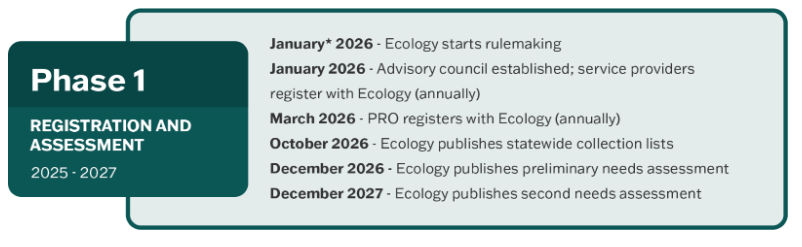
Phase 1 of the Recycling Reform Act: Service providers including local governments with residential recycling programs should be ready to register with Dept. of Ecology already in January 2026 to be reimbursed.
MetroPaint to Close After Three Decades
Metro, the Portland metropolitan region's government agency, has announced it will shutter its long-running MetroPaint program by the end of 2025. Launched more than 30 years ago, MetroPaint collected leftover latex paint from households and businesses, processed it into high-quality recycled paint, and sold it to consumers at a lower cost than new paint.
While MetroPaint was nationally recognized as a model for paint reuse, Metro reports that the cost to operate the program now far exceeds revenue from paint sales. The widening budget shortfall, combined with shifting consumer habits and competition from low-cost retail paint options, led to the decision to phase out the program.
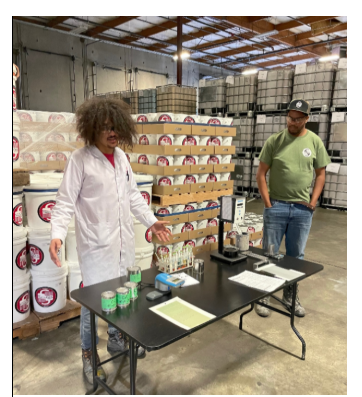
MetroPaint employees demonstrating how they develop their paint colors and maintain consistency during a WSRA tour last year
LightRecycle WA Annual Survey Results
In July, Ecology sent out an annual satisfaction survey for LightRecycle Washington, a program that allows residents and businesses to recycle mercury-containing lights for free. The survey was sent to local government contacts in solid waste and recycling and posted on their website and social media.
Ecology received a total of 42 responses, with 17 of 39 counties represented. Key findings show that although a majority of respondents feel satisfied with the convenience of collection sites, more work can be done to promote outreach and education surrounding the program. Ecology will be working with the stewardship organization administering the program to integrate feedback.
EPR Report Under Scrutiny: Gaps, Gains, and Global
A recent report from the Environmental Research & Education Foundation (EREF) reviews the effectiveness of extended producer responsibility (EPR) policies and concludes that data limitations make it difficult to evaluate their impact. While the report acknowledges improvements in recycling rates and landfill diversion for certain materials, it emphasizes a lack of baseline data, inconsistent reporting standards, and limited transparency from Producer Responsibility Organizations (PROs) as barriers to drawing definitive conclusions.
However, the report has received scrutiny for omitting comprehensive evaluations of the most developed EPR systems, including those in British Columbia and several European countries. It also does not include newer U.S. programs like Oregon’s, which has already seen nearly 2,000 producers submit data in its first month of implementation, triggering early funding for local governments. These examples demonstrate clear, measurable improvements to recycling infrastructure and access—two of EPR's core goals.
Moreover, the report’s funding sources include sectors with historical opposition to EPR legislation, and the authors concede that much of the performance data they sought is already collected by PROs but was not publicly accessible. Despite these gaps, other studies have shown that well-designed EPR programs have achieved significant gains: Recycle BC, for example, reported a 94% recovery rate and high domestic processing rates.
While consistent metrics and greater transparency are critical for long-term evaluation, the foundational benefits of EPR—including cost-shifting from local governments to producers, clearer consumer education, and incentives for design for environment—are already observable. Future research should focus not only on identifying shortcomings, but also on learning from models where EPR has demonstrated success.
Programs & News – Other States
 (Photo Courtesy Recycle BC)
Recycle BC Highlights End Market Success
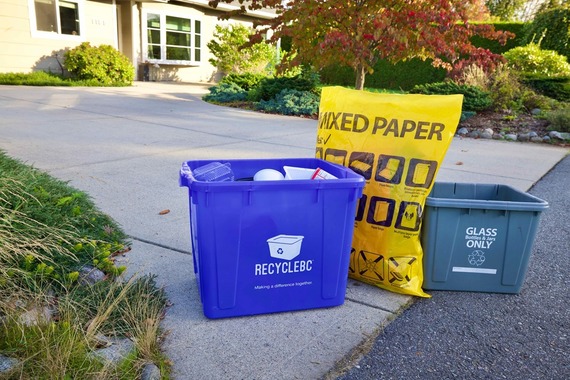
Recycle BC, British Columbia’s nonprofit Producer Responsibility Organization for packaging, released its 2024 performance report showing strong recovery and recycling outcomes. The program achieved a 94% recovery rate, with over 85% of collected materials processed within North America. Of that, more than 50% was managed by recyclers located within B.C. Recycle BC continues to be recognized as a model for North American EPR programs, prioritizing transparency, robust performance tracking, and development of domestic markets for post-consumer materials. The program is fully funded and operated by producers, removing the financial burden from local governments.
Colorado Packaging EPR Producer Reporting Deadline
July 31 marked the first major compliance deadline under Colorado’s packaging EPR law. Producers were required to report 2024 supply data to Circular Action Alliance (CAA), the state’s designated Producer Responsibility Organization. This reporting will help establish baseline data for program planning, fee structures, and infrastructure investments. Colorado’s program, passed in 2022, is modeled on best practices from other states and provinces, with implementation continuing through 2026. Officials reported strong producer engagement, though emphasized the need for ongoing education to ensure future compliance and accurate reporting.
California Hosts Public Workshop on Textile EPR
California passed the Responsible Textile Recovery Act in 2024, establishing the nation's first EPR program for textiles. As part of the law's rollout, CalRecycle hosted a public workshop on July 16, 2025, to engage stakeholders in the development of the program. The workshop highlighted considerations around accessibility, environmental goals, and managing substances of concern such as PFAS and microplastics. Feedback from the workshop will help shape regulations and guide PRO planning. This legislation marks another step forward in California's broad EPR agenda and reflects the state’s commitment to circular economy strategies for hard-to-recycle materials.
In Washington, Rep. Reeves is continuing her work on HB 1420, a Textile EPR bill modeled after California’s Responsible Textile Recovery Act. The bill is being worked on during the interim and expected to be reintroduced in the 2026 legislative session.
Celebrate Abby Boudouris' Retirement on September 18, 2025

Abby Boudouris, Senior Legislative Analyst at the Oregon Department of Environmental Quality, has played a key role in shaping EPR in the Pacific Northwest from the very early days of the NWPSC. She coordinated the Oregon DEQ Household Hazardous Waste Program for over a decade, which highlighted the need to shift responsibility for product impacts to producers.
Abby led DEQ’s efforts to pass legislation establishing EPR laws for paint, unwanted medications, printing paper and packaging, and mattresses in Oregon. She also directed the project that produced DEQ's 2050 Vision of Materials Management, and has been a strong advocate for weaving that vision into EPR legislation. Her perspective has always pushed beyond recycling to focus further upstream—challenging supply chains and producers to reduce the total environmental impacts of what we consume.
We thank Abby for more than 30 years of service and for everything she has done to advance EPR in Oregon and across the region.
If you are interested in celebrating Abby and wishing her well into her well-deserved retirement on Thursday, September 18 at 5pm at the Rose City Yacht Club (3737 NE Marine Dr. Portland, OR 97211), please RSVP here: https://www.paperlesspost.com/go/gk7bv3Wt8ZQ2nQtqQVPbV
Events & Webinars
NWPSC Lunch & Learn: Implementation of Oregon’s Recycling Modernization Act by Circular Action Alliance Oregon
-
October 14 12:00 pm – 1:00 pm (Register on Zoom)
-
Join us on Tuesday, October 14, for a Lunch & Learn on the implementation of Oregon's Recycling Modernization Act (RMA). The law is designed to improve the state’s recycling system through extended producer responsibility (EPR) for packaging, paper products, and food serviceware. Kim Holmes, Oregon Executive Director of the Circular Action Alliance (CAA), will share her experience as head of the producer responsibility organization (PRO) for the program that officially launched on July 1, 2025. There will be ample time for Q&A. Please register here for the Oct. 14 event.
Washington Battery Stewardship Law Public Hearings
HHW roundtable on propane tanks and Li-ion batteries – CWMA and City of Vancouver, BC
Recycling Reform Act Webinar
Oregon Recycling System Advisory Council Meeting (virtual)
-
September 17, 2025, 9:30am-11:30 am
-
For more information: https://www.oregon.gov/deq/recycling/pages/orsac.aspx
Sustainable Packaging Coalition Advance
2026 Washington State Recycling Association (WSRA) Conference
Engage with the Northwest Product Stewardship Council. Add your voice and join the Northwest Product Stewardship Council (NWPSC) as an Associate, Steering or Community member. Follow the NWPSC on Twitter (@StewardshipNW) for product stewardship information from Washington, Oregon and elsewhere.
|