June 2025
Programs & News – Oregon & Washington
The NWPSC recognized for its role in the success of EPR in the U.S.
Together with other product stewardship councils, the NWPSC’s achievements and leadership were acknowledged at the 2025 U.S. Product Stewardship Forum in Wheeling, Illinois earlier this month. The Forum was also PSI’s 25th anniversary. The NPWSC was the first product stewardship council to be established in the U.S. in 1998. It was initiated by local governments, and it continues to be led by local governments in Washington and Oregon. Since then, other state-based, local government-driven product stewardship councils have formed in Vermont, California, New York, Illinois, Missouri, Oklahoma, Colorado, Massachusetts, Connecticut, and Texas. Together they have generated the majority of EPR legislation in the U.S.
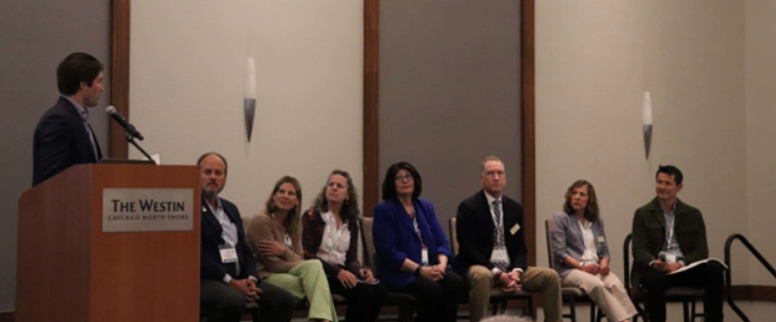 Photo: The 2025 U.S. Product Stewardship Forum hosted a panel of representatives of product stewardship councils across the country that have been essential to the success of the EPR movement in the U.S.
Oregon Lawmakers Pass Amendments to Bottle Redemption Law
In early June, Oregon Governor Tim Kotek signed SB 992, updating Oregon’s bottle bill to address growing retail safety concerns and neighborhood impacts from redemption sites marked by homelessness and drug activity. Currently, retail stores must accept beverage container returns at any time they are open, and owners of all-night convenience stores have expressed concerns about worker safety. The changes to Oregon’s bottle bill will allow all stores statewide to refuse container returns after 8 p.m. The bill also allows for the establishment of alternative redemption sites, run by nonprofits, which offer residents increased options for returning their beverage containers. Under the amended bottle bill, stores in areas with alternative redemption sites could limit or refuse hand-counted returns after 6 p.m. The updated law aims to preserve Oregon’s impressive 87% redemption rate while alleviating the pressure on retailers and surrounding communities.
Twenty-three Plastic Producers Fined Combined $277,000 for Failing to Use Enough Recycled Content in Washington
Washington’s Plastics Law2021, requires companies that produce plastic trash bags, beverages containers, household cleaner containers, and personal care product containers to include recycled content. The minimum content requirements vary by container type and ramp up over time from 2023-2036. For 2024, a minimum of 10% recycled content was required for trash bags and 15% for beverage containers. Noncompliant producers are subject to civil penalties, and the Washington Department of Ecology just announced they are fining 23 plastic producers a combined $277,000 for noncompliance based on 2024 reporting. However, according to the 2024 data provided to Ecology, almost 170 million pounds of plastic trash bags and beverage containers were sold in Washington, with roughly 75% made from virgin material, while the remaining 25% was recycled.
The Last-Minute Scramble with EPR is like Tax Season, Says Circular Action Alliance’s (CAA) CEO
With Oregon’s packaging EPR program just days away from its long-awaited kick-off on July 1 CAA’s CEO Jeff Fielkow spoke about the challenges regarding getting producers registered and reporting data by the deadline at the 2025 Packaging Recycling Summit. Fielkow noted that only a few hundred producers reported in the two weeks prior to the March 31 deadline, and CAA worried they would have to do extensive additional education; however, “everything came in … in that last week, in the last hours,” Fielkow said. However, even with the sharp uptick in producer reporting leading up to the deadline, CAA decided to add a one-month grace period for reporting. Fielkow also noted that in Oregon’s case, food service proved to be one of the most confusing areas for producers, as it was challenging to figure out who needed to report.
Programs & News – Other States
Will 2025 EPR Laws Pave the Way for More Packaging Policy?
With the passage of Washington and Maryland’s packaging EPR laws in 2025, there are now seven states with packaging EPR laws, equating to roughly one-fifth of the entire U.S. population living under a packaging EPR policy. Washington and Maryland’s laws follow a similar model to Minnesota’s law, which passed in 2024, and have received praise from industry, with Rob Kieth, membership and policy director at Ameripen stating, “I think we’re excited to see three pass in fairly quick succession, […] all of which have a little bit of consistency running through them.” With the recent movement on packaging EPR policies in the U.S. in 2025, coupled with continued interest from certain members of Congress to work on federal packaging EPR legislation, packaging EPR policies are likely to remain a hot policy for states in the coming years.
New York Legislative Session Ends, Again Without EPR
On Tuesday, June 17th, New York’s legislative session ended, and with it, so did the chances of packaging EPR passing in New York. For multiple years now, New York has introduced packaging EPR legislation without it reaching the finish line. This year, the packaging EPR bill, S 1464, authored by Sen. Pete Harckham, passed out of the Senate; however, the bill failed to make it out of the Assembly before the session ended. S 1464 would have established potentially the most robust packaging EPR program in the U.S., with requirements in the legislation regarding toxic chemical elimination/bans, aggressive packaging reduction and recycling rate performance targets, and strong reuse and postconsumer recycled content goals.
The State Packaging EPR Club Swaps Stories as Implementation Advances

, Will – wishing you all the best in D.C.!
Will Grassle, an Associate with the Product Stewardship Institute (PSI), has been supporting the NWPSC and its Steering Committee as the Council Coordinator for the past 2+ years. He is off to new adventures in Washington D.C. Will has been a pleasure to work with and done a great job of following up on all of our activities - facilitating meetings, organizing Lunch & Learns, and sending out monthly newsletters. We are grateful for everything that you have done for the NWPSC and wish you all the best with your future endeavors!
|
Events & Webinars
-
July 10 – “EPR 101 for Local Governments”
-
July 15 – “Reporting Workshop & Q&A”
-
July 21 – “Budgeting for EPR Fees”
Jobs & Opportunities
The Product Stewardship Institute (PSI) is looking for a Senior Associate for Policy and Programs
-
Location: Remove/Hybrid; Boston, Mass. base preferred.
-
Compensation: $75K - $80K plus generous benefits package
The National Stewardship Action Council (NSAC) is looking for a Deputy Director
-
Location: Remote Anywhere in the United States
-
Compensation: $130K negotiable based on experience.
Engage with the Northwest Product Stewardship Council. Add your voice and join the Northwest Product Stewardship Council (NWPSC) as an Associate, Steering or Community member. Follow the NWPSC on Twitter (@StewardshipNW) for product stewardship information from Washington, Oregon and elsewhere.
|