March 2025
Programs & News – Oregon & Washington
 (Rimmabonderanko / Canva Teams)
Oregon’s Packaging EPR Program Approved – Implementation Starts July 1, 2025
-
Providing funding to local governments and recycling service providers for improvements to Oregon’s recycling system;
- Establishing locations around the state to collect harder-to-recycle items;
-
Ensuring that collected materials are recycled responsibly;
-
Creating educational resources to help people learn about recycling changes and opportunities; and
-
Reducing environmental impacts of paper, packaging, and food serviceware through fee incentives and by capitalizing a new waste reduction and reuse program.
Producers, manufacturers and importers of packaging, paper and food serviceware must submit 2024 supply data through CAA’s portal by March 31, 2025.
Washington’s Recycling Reform Act Passes out of Senate
Washington’s EPR bill for packaging and paper products, the “Recycling Reform Act” has made significant progress in the legislature with SB 5284 passing out of the Senate in early March. The Recycling Reform Act creates financial incentives for producers of consumer goods to cut down on waste and make their packaging easier to recycle. It would:
-
Require producers of consumer goods to fund 90% of the costs of residential recycling by 2032, saving local governments and households money.
-
Establish a single statewide list of recyclables, reducing confusion about what can be put in the recycling bin.
-
Provide curbside recycling to households with curbside garbage service, an increase of half a million homes.
-
Boost the state’s residential recycling rate from 40% to an estimated 66%.
-
Reduce materials going to the landfill and create more living wage jobs.
-
Lower greenhouse gas emissions by an estimated 565,000 fewer metric tons due to increased recycling.
Programs & News – Other States
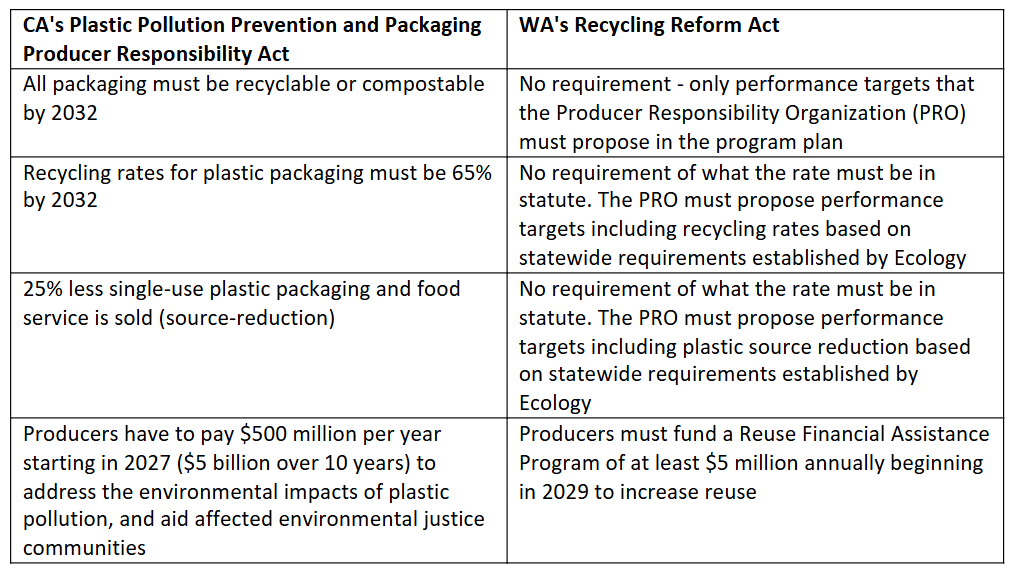
Navigating Next Steps on EPR for Packaging in California
Maryland’s Recycling Needs Assessment Sheds Lights on Possible EPR Impacts
In late February, Maryland’s statewide recycling needs assessment was published along with a recommendation report from the state’s Packaging EPR Advisory Council, both required by a Maryland law passed in 2023. The two reports outline how an EPR for packaging program could be successfully designed and implemented in Maryland, addressing the specific needs of Maryland’s recycling system. The needs assessment, conducted by environmental firm HDR, offers findings on the state of waste and recycling infrastructure and capacity in Maryland, while the Advisory Council’s report focuses on specific program design elements and implementation direction. The needs assessment concludes that EPR for packaging will improve recycling rates across the state, while increasing recycling access in currently underserved communities. Benefits are estimated to be $202 million of material value captured (an increase of $53 million from the baseline), a reduction of more than 1 million metric tons of carbon dioxide equivalent (MT CO2e), and the creation of 2,075 additional jobs.
 (FrimuFilms / Canva Teams)
Plastics and Textile Recovery Experts Convene
The 2025 Plastics Recycling Conference, held in National Harbor, Maryland, convened approximately 2,150 industry professionals to discuss advancements in plastics and textile recovery. A notable feature was the inaugural Textile Recovery Summit, where U.S. Representative Chellie Pingree addressed the summit, advocating for federal EPR legislation and national standards to alleviate local governments' burdens and support domestic textile processors.
Lawmakers Push Tennessee’s Packaging EPR Bill to 2026
Tennessee lawmakers have come to acknowledge that the state has a serious trash problem; however, what should be done to solve this problem isn’t as clear to lawmakers. The past few years have seen Tennessee lawmakers consider packaging EPR as a solution to the state’s waste issue; such as Tennessee Senator Heidi Campbell’s 2025 legislation, the "Waste to Jobs Act," (HB 0600 / SB 0269); however, the legislation has been deferred until January 2026. Senator Campbell requested the delay following discussions with the Tennessee Chamber of Commerce, a notable opponent of EPR, to allow for further stakeholder engagement. The postponement aims to build broader consensus and address concerns about potential cost pass-through to consumers and the governance structure of the proposed producer responsibility organization.
Legislation
Oregon
-
Battery EPR HB 2062, would require producers of covered batteries or battery-containing products to implement a battery producer responsibility program to fund and manage the collection and processing of batteries and battery-containing products at their end-of-life.
-
HB 2062 is scheduled for a work session in the House Committee on Climate, Energy, and the Environment on April 3rd.
-
E-Cigarettes EPR SB 1020, would require producers of inhalant delivery systems, e-cigarettes, to join an inhalant delivery system producer responsibility organization and implement a program for the collection and proper disposal of these devices.
-
SB 1020 is scheduled for a work session in the Senate committee on Labor and Business on March 27th.
-
Amendments to Oregon’s Deposit Return System for Beverage Containers:
-
HB 2068, would expand convenient access to redemption centers for Oregon residents to redeem empty beverage containers. The legislation would allow for the establishment of alternative redemption centers and producer responsibility organization depot redemption centers to improve convenient access for Oregon residents.
-
HB 2921 would modify provisions related to the siting and approval of full-service redemption centers for empty beverage containers.
-
SB 329 would direct cooperatives and retail stores to expand the use of reusable cans or bottles.
-
SB 869 specifies hours during which dealers must accept returns of beverage containers.
-
HB 3432 would permit a winery to refuse to accept and to pay the refund value of beverage containers not sold at the winery.
-
SB 963 would direct the OLCC to establish a grant program to facilitate the establishment of a full service redemption center in each city in the state with a population greater than 10,000.
-
HB 3940 would place a surcharge on the sales of beverage containers for purposes of wildfire prevention and response.
 Washington
-
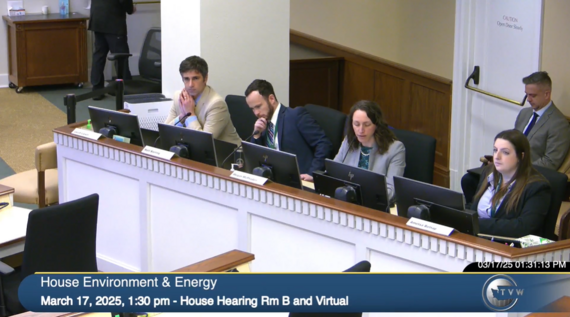
Recycling Reform Act – EPR for Packaging and Paper Products HB 1150 / SB 5284 would create an EPR program for consumer packaging and paper products in Washington. This bill builds upon the 2023 WRAP Act and 2024 ReWRAP Act, but aligns with the model policy passed in Minnesota last year. One key difference is that local governments and other service providers that want to be part of the program and receive reimbursement would be required to register as a service provider. The reimbursement that PROs must provide to service providers (including local governments) to no less than 50% of net costs by 2030, 75% by 2031, and 90% beginning in 2032. The bill requires performance targets to be established that will reduce plastic packaging and increase reuse, return, recycling and composting rates. It also requires producers to fund a Reuse Financial Assistance Program to support the development of reuse systems.
-
Recycling Refund Act – Deposit-Return System for Beverage Containers (aka Bottle Bill) HB 1607 / SB 5502 would require beverage producers to develop and implement a statewide deposit-return (recycling refund) program for beverage containers that increases recycling, refill and reuse rates through a Recycling Refund Producer Responsibility Organization (RRPRO). Consumers would be charged a refund value (deposit) of 10 cents on every covered beverage container. When the covered beverage containers are returned to collection (redemption) sites, consumers are then redeemed the refund value. Covered beverage containers include beverages in glass, metal, or plastic bottles or cans with a capacity of one gallon or less, except drugs, infant formula, milk, and meal replacement liquids. Other beverage containers could also be covered, if proposed by the RRPRO and approved by Ecology.
-
While the bills did not make it out of their respective houses, they may be considered necessary to implement the state budget as unredeemed refunds retained by the RRPRO would be subject to the Business and Occupation Tax.
-
Solar Panel Stewardship Amendment HB 1789 / SB 5175 would delay Washington’s Solar Panel/Photovoltaic Module Stewardship Takeback Program, extending the implementation timeline to ensure a successful program rollout. It also establishes an Advisory Committee to develop recommendations for the program implementation.
-
Amending Safe Medication Return HB 1422 would ensure that drug manufacturers, through their program operators, pay all department costs related to Safe Medication Return and encourages performance parity between program operators.
-
While HB 1422 did not make it pass the cut-off date, it may be considered necessary to implement the state budget.
The Electric Vehicle Battery EPR bill (HB 1550 / SB 5586), Textiles EPR bill (HB 1420) and Mattress EPR bill (HB 1901) did not make it pass the respective cut-off dates in the legislature, but work on them continues.
The NWPSC 20 years ago
David Nightingale, Principal at Special Waste Associates, reflects on the work done by the NWPSC when he was with WA Dept. of Ecology on electronics EPR legislation and the importance it had on EPR laws across the US. Thank you to David Nightingale for initiating the article and the contributions from Sego Jackson, Suellen Mele, Heather Trim and David Stitzhal!
NW Electronics Product Stewardship Laws Inspired National Push
In early 2002, several electronics manufacturers, government agencies including the US EPA, and environmental groups signed the National Electronics Product Stewardship Initiative (NEPSI). This was an agreement to develop an extended producer responsibility law for a front-end financed system to support the collection, re-use and recycling of used electronic devices.
NEPSI also called for the development of an action plan that would establish federal legislation to enforce the law and steps to be taken during the transition period. The initiative also aimed to have a detailed and nationwide system developed by the end of 2002.
The NEPSI process was led by the US EPA, and with Scott Cassell of the Product Stewardship Institute coordinating government delegates. Unfortunately, it did not result in model US legislation supported by all stakeholder groups.
In 2003 and 2004, the Washington legislature considered bills to create a producer responsibility system for computers and TVs. The 2004 WA bill morphed into a study and advisory process convened by the Department of Ecology and coordinated by Ecology’s Jay Shepard. Although stakeholder consensus was again not reached, Ecology reported back to the legislature recommending that an EPR system be developed and financed by manufacturers.
The Northwest Product Stewardship Council’s (NWPSC) response was to convene a smaller stakeholder group focused on the development of model legislation suitable for implementation in Washington and Oregon.
Importantly, although initiated by the NWPSC, the process was ultimately an industry led collaborative effort. This collaborative effort was envisioned by Sego Jackson, who had been a NEPSI delegate representing local government while working for Snohomish County, and a NWPSC member. David Nightingale with WA Dept. of Ecology and NWPSC member acted as the government sounding board and attended the industry collaborative meetings in a purely advisory role.
A number of stakeholders supporting a manufacturer-financed approach began collaborating on specific policy and potential legislation in WA. In addition to the NWPSC, key collaborators included Hewlett Packard, Washington Retail Association, Goodwill Industries, Washington Citizens for Resource Conversation (WCRC) – now known as Zero Waste Washington, Washington Conservation Action and others. The resulting 2006 bill became a priority of the Environmental Priorities Coalition. Suellen Mele, Program Director of Washington Citizens for Resource Conversation (WCRC), played a lead role in the development and passage of the law.
Events & Webinars
The U.S. Environmental Protection Agency (EPA) and U.S. Department of Energy (DOE) are hosting a virtual meeting to kick off the conversations to develop a national battery EPR framework.
-
April 7 from 11:00 am -1:00 pm Pacific
North American Hazardous Materials Management Association (NAHMMA) – 2025 Northwest Chapter Conference
-
April 8 – 10, 2025 in Troutdale, Oregon
SWANA, NAHMMA & NSAC on EPR & Hazardous Waste: a three-part webinar series focused on EPR and policy solutions for hazardous and hard-to-manage products.
-
The Solid Waste Association of North America (SWANA), the North American Hazardous Materials Management Association (NAHMMA), and the National Stewardship Action Council (NSAC) will host three webinars:
-
Wednesday, April 16, 2025: Extended Producer Responsibility (EPR) for Products that Cause Fires: Batteries, Compressed Gas Tanks, Marine Flares & More
-
Thursday, May 29, 2025 : How Do We Turn Off the Tap: Ending the Sale of Hazardous Products with No End-of-Life Plan
-
This series is free for SWANA, NSAC, and NAHMMA members. Register for individual webinars at $75 each or get full access to all three webinars for $200.
Washington State Recycling Association (WSRA) – 2025 Annual Conference
-
May 19 – 21, 2025 in Spokane, Washington
Product Stewardship Institute (PSI) – 2025 U.S. Product Stewardship Forum
-
June 3 – 5, 2025 in Chicago, Illinois
Association of Oregon Recyclers (AOR) - 2025 Annual Conference
-
June 23-25 in Bend, Oregon
Jobs & Opportunities
-
Closing Date: April 15, 2025, 4:00 PM Pacific
The National Stewardship Action Council (NSAC) is looking for a Deputy Director
-
Location: Remote Anywhere in the United States
-
Compensation: $130K negotiable based on experience.
Engage with the Northwest Product Stewardship Council. Add your voice and join the Northwest Product Stewardship Council (NWPSC) as an Associate, Steering or Community member. Follow the NWPSC on Twitter (@StewardshipNW) for product stewardship information from Washington, Oregon and elsewhere.
|