NWPSC August Newsletter
King County, Washington sent this bulletin at 08/30/2024 12:48 PM PDT
August 2024
New Video about PaintCare and EPR
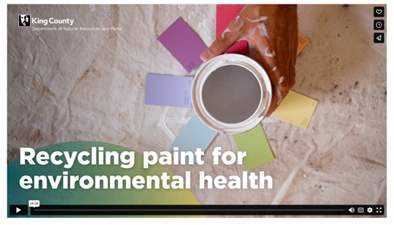
Check out the latest video from King County about Washington state’s paint recycling program.
Programs & News – Oregon & Washington
OR Mattress Recycling Program: OR DEQ Approves MRC’s Program Plan
On July 25, 2024, the Oregon Department of Environmental Quality (OR DEQ) approved the Mattress Recycling Council’s (MRC) program plan after rejecting the initial and revised program plans earlier this year. Although the OR DEQ approved MRC’s second revised program plan, OR DEQ modified multiple sections of the plan to meet the requirements of the act, making necessary changes to the plan relating to collection convenience standards, information for collection sites, and the collection and management of all program mattresses. MRC now has seven months to implement the approved program plan.
OR Recycling Modernization Act: CAA to Submit a Revised Program Plan
In March 2024, Circular Action Alliance (CAA), the producer responsibility organization tasked with managing and financing Oregon’s packaging EPR program, submitted its initial producer responsibility program plan to the OR DEQ. The plan outlines how CAA intends to implement Oregon’s packaging EPR program. CAA has been working closely with DEQ, and while CAA’s initial program plan was formally rejected in July, this was expected. Some of DEQ’s concerns regarding CAA’s program plan are regarding the overarching program performance goals and the insufficient data and estimated system costs outlined in the program plan. DEQ noted that they are “confident in CAA’s ability to ultimately produce a revised version of the Plan that meets all requirements and launch its first-in-the-nation program,” which begins July 1, 2025.
LightRecycle WA: Annual Satisfaction Survey Results
In July 2024, the Washington Department of Ecology (Ecology) sent out a satisfaction survey for the LightRecycle program, Washington’s mercury-containing lights EPR program. In total, there were 55 responses, representing 18 of the 39 counties in Washington. The survey responses show that although a majority of respondents are satisfied with the convenience of collection sites, additional collection sites would be helpful. The responses indicated that more work needs to be done to promote the visibility of the program, as several respondents suggested that its education and outreach efforts could be improved.
WA Battery Stewardship: NWPSC Lunch & Learn
On August 21, the NWPSC held a Lunch & Learn on Washington’s Battery Stewardship Program, which passed in 2023 and is expected to start July 1, 2027. Megan Warfield, Product Stewardship Unit Supervisor at Ecology, provided an overview of Washington’s Battery Stewardship Program and how local governments will be impacted and can get involved. For example, local governments that wish to be a collection site with their costs reimbursed should provide Ecology information about their associated labor and other battery collection and storage costs. A recording of the lunch & learn can be found here.
If you wish to be involved in the Battery Stewardship rulemaking, the next meeting is September 23. More information can be found here.
Programs & News – Other States
California Textiles and Reusable Propane Gas Cylinders EPR Bills Passed the Assembly Floor
California’s textiles (SB 707) and Reusable Propane Cylinders (SB 1280) stewardship bills passed off the Assembly floor. It has to pass the Senate before August 31st. SB 707 would establish a first-in-the-nation EPR for textiles program, requiring producers of apparel and textile products to assume financial and managerial responsibility in managing these products at the end of their lives. SB 1280 would help transition CA residents from using single-use propane cylinders to reusable cylinders.
Illinois Passes Portable Battery Stewardship Act
Earlier this month, Illinois Governor J. B. Pritzker signed the Illinois Portable Battery Stewardship Act (SB 3686 / Public Act 103-1033), which will establish an EPR program for portable and medium-format batteries in Illinois. The law, which will take effect on January 1, 2026, will require producers of covered batteries and battery-containing devices to manage and finance the collection, transportation, and recycling of these producers through a battery stewardship organization. This law was closely modeled after Washington’s Portable Battery Stewardship law, passed in 2023.
Eco-Modulation Requirements Set EPR Programs Apart
Eco-modulated fees are a key component of all EPR for packaging programs in the U.S. Eco-modulation aims to incentivize producers to make their packaging more sustainable or recyclable through packaging design. Packaging producers have been calling for the standardization of eco-modulated fees across the various packaging EPR programs in the U.S.; however, the proposed and expected eco-modulated fees in Maine, Oregon, Colorado, and California have very little commonality. The packaging EPR programs in Maine, Oregon, Colorado, and California all require different factors to be considered when developing their eco-modulated fees; the only factor that must be considered in all four states’ eco-modulated fee structure is the amount of post-consumer recycled content used in packaging.
Events & Webinars
-
Toxics in Packaging Clearinghouse (TPCH) Virtual Open House: September 9, at 8:00 am PT. Register here https://us02web.zoom.us/meeting/register/tZIpde-rqjIsGt30UFq2favCyfcR6I-AayrB#/registration
- Topic: Open House for state agencies and industry groups interested in understanding how the Clearinghouse helps with harmonization of and compliance with toxics in packaging regulations.
-
PSI & OR DEQ Webinar Series on Producer Preparation and Compliance for Packaging EPR:
- Webinar 4 – Consumer Goods and B2B Packaging: September 10, at 11:30 am PT. Register here https://productstewardship.us/events/oregon-packaging-epr-consumer-goods-and-b2b-packaging/
- North American Hazardous Materials Management Association (NAHMMA) – Northwest Hazardous Materials Management Conference: October 21 – 23, in Troutdale, OR. Deadline for submitting presentations is May 31, 2024. Learn more and register here https://nahmma.org/Northwest_Chapter
Engage with the Northwest Product Stewardship Council. Add your voice and join the Northwest Product Stewardship Council (NWPSC) as an Associate, Steering or Community member. Follow the NWPSC on Twitter (@StewardshipNW) for product stewardship information from Washington, Oregon and elsewhere.
 The Northwest Product Stewardship Council (NWPSC) is a coalition of government agencies in Washington and Oregon working on solid waste, recycling, resource conservation, environmental protection, public health and other issues. Together with non-government agencies, businesses and individuals, we form a network that supports product stewardship and extended producer responsibility (EPR) policies and programs. For more information, contact info@productstewardship.net or visit us at www.ProductStewardship.net.
Subscribe to the NWPSC Newsletter and read our past newsletters. For current subscribers: update your email, password, or unsubscribe on the Subscriber Preferences Page (you will need to use your email address to log in). If you have questions or problems with the subscription service, please visit subscriberhelp.govdelivery.com.