NWPSC March 2024 Newsletter
King County, Washington sent this bulletin at 03/28/2024 09:33 AM PDT
March 2024
PROGRAMS & NEWS
Washington Department of Ecology Announces Battery Stewardship Program Rulemaking
The Washington Department of Ecology (Ecology) recently announced the start of the rulemaking process for Washington’s Battery Stewardship Program, signed into law in 2023. The rule development process starts in March 2024, and draft rules will be proposed in the fall of 2025, followed by public hearings and comment periods on the draft rules for final rule adoption in the winter of 2025. The rules drafted by Ecology will clarify definitions in the law, prescribe stewardship plan and annual reporting requirements, set the agency fee to cover oversight costs of the program, establish battery management standards, and various other topics.
E-Cycle Washington Joint Outreach Funding Opportunity
The Washington Material Management & Financing Authority (WMMFA), the producer responsibility organization tasked with running Washington’s Electronics EPR Program, E-Cycle Washington, is providing joint outreach funding opportunities for Washington local governments, E-Cycle Washington Collection Sites, and other WMMFA partners interested in running E-Cycle outreach/education campaigns. Interested parties may request funding up to 50% of the total proposed campaign costs. Outreach campaigns eligible for joint funding include digital and social media campaigns, print advertising, and others. To apply for funding and for more information on the joint funding opportunity, click here.
The Mattress Recycling Council Submits Revised Mattress Stewardship Plan in Oregon
In early 2024, the Oregon Department of Environmental Quality (OR DEQ) rejected the initial stewardship plan submitted by the Mattress Recycling Council (MRC), which currently operates mattress stewardship programs in California, Connecticut, and Rhode Island. In late February, MRC submitted their revised stewardship plan addressing some of OR DEQ’s concerns including how MRC plans to handle public education, advertisement, and program promotion, and how MRC will coordinate activities with existing recycling programs. The OR DEQ has 45 days to review the revised plan and provide a formal response.
U.S. Senate Committee on Environment & Public Works Conducts Hearing on Packaging EPR
On March 6, 2024, the U.S. Senate Committee of Environment & Public Works held a hearing on packaging extended producer responsibility, “EPR: Examining Extended Producer Responsibility Policies for Consumer Packaging,” where the Committee examined how the federal government could support EPR for packaging efforts. The hearing featured leaders from environmental groups and the plastic and packaging industry, who discussed with the Committee the need for federal movement on packaging EPR to curb plastic pollution and ensure alignment among states packaging EPR programs. The hearing was recorded and published on the U.S. Senate Committee on Environment & Public Works hearings page.
Public Comment Period Open for California Packaging EPR Draft Regulations/Rules
CalRecycle, the government agency assigned to oversee California’s packaging EPR program, submitted draft regulations to the Office of Administrative Law in late February and published these draft regulations earlier this month. The public comment period on the draft regulations opened on March 8th and will remain open until April 23rd, after which a formal public hearing on the draft regulations will take place on April 23rd. The draft regulation from CalRecycle addresses any proposed adoption, amendment, or deletion to the law, and written comments shall offer recommendations, objections, or support for any element of the proposed draft regulation.
FAREWELL INTERVIEW WITH KRIS MAJOR
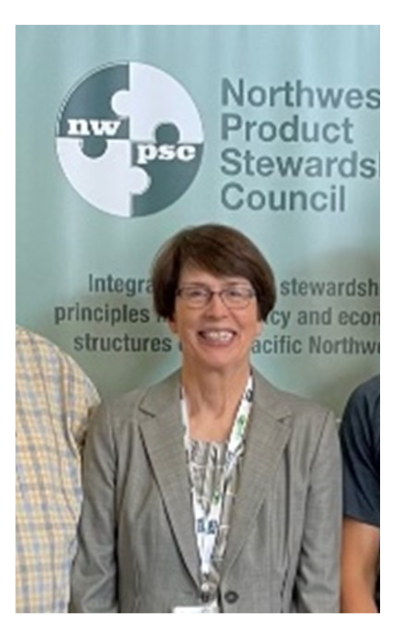 Kris Major, the lifelong Washingtonian and one of the driving leaders of product stewardship in the Northwest, bids farewell to her work at the City of Spokane and NWPSC as she enters a much-deserved retirement. Kris worked as the Waste Reduction Education Coordinator for the Spokane Solid Waste Department. She was instrumental in getting the Battery Stewardship Law passed and has been an active supporter of packaging EPR in Washington.
Learn a bit more about Kris, her work with Spokane City and the NWPSC, and what’s next in retirement in the conversation with Kris below.
Tell the NWPSC a little about yourself, Kris!
I am an Eastern Washingtonian by birth and a history educator by training, and I spent the first 25 years of my career in Boise before moving to Spokane in 2002. Instead of teaching in classrooms, I worked at historic sites and in museums until getting a job with the City of Spokane’s Solid Waste Department. Garbage was not really a calling in my youth. Instead of composting, I was learning how to spin wool, churn butter, and shoot muzzle loaders while retracing the steps of Lewis and Clark and the Oregon Trail pioneers. It wasn’t until I took the job as a waste reduction educator that a light went on - what an important message to share and a great community of industry professionals to guide me!
What made you want to work in the solid waste and product stewardship field?
I honestly just fell into the job, but I have never regretted it. Working towards waste reduction has been one of the most fulfilling things I have done professionally, and product stewardship is one of the most valuable actions states can take to curb waste at its source. Who wouldn’t love to be part of that?
What intrigued/interested you about the NPWSC?
The organization is made up of government agency representatives facing the same challenges that we face in Spokane. But I found that the eastern part of Washington is often underrepresented on statewide boards, and I wanted to change that. It has been great to represent the east side of the state and our more rural communities in these important conversations.
What was your most rewarding experience/project with Spokane City and/or the NWPSC?
Seeing hard work pay off. The passage of the paint, medicine take-back, and battery EPR bills these last few years has been very encouraging to me. I am confident we will soon get a packaging EPR bill in Washington.
What do you hope the NWPSC can achieve in the upcoming years?
Packaging EPR in Washington and either separate or inclusive legislation to address beverage containers.
What’s up next for you in retirement?
More free time to travel and enjoy outdoor recreation activities like hiking, biking, and kayaking.
LEGISLATION
Oregon
Non-EPR Waste and Recycling Bills
- Right to Repair SB 1596, would require original manufacturers of electronic equipment to provide any documentation, tool, or part to an owner of consumer electronic equipment or independent repair provider for the purpose of diagnosing, maintaining, or repairing a covered consumer electronic device. This bill has passed both chambers and is awaiting the Governor’s signature.
Washington
- Update to LightRecycle Washington HB 1185, would phase out mercury-containing lights and ensure that the existing LightRecycle EPR program can continue beyond the sunset of 2025. It also increases the amount of lights that a person may bring to a collection site. This bill was amended twice and subsequently passed out of the House. The bill has passed both chambers and was sent to the Governor on March 7th.
EVENTS & WEBINARS
- PSI Webinar Recording – Tackling Tire Waste: EPR Solutions and Success Stories: March 20, at 10 am PT. View webinar recording here – https://productstewardship.us/webinar/tackling-tire-waste-epr-solutions-and-success-stories/
-
Plastic Pollution and Recycling Modernization Act – Meetings & Webinars:
- Seventh Rulemaking Advisory Committee Meeting: April 3, at 9 am PT. Register here - https://us02web.zoom.us/meeting/register/tZYpd-Cuqz0tGdTHqJi9L_d3CkCDnCMvkpaf#/registration
- Eighth Rulemaking Advisory Committee Meeting: April 16, time 10 am PT. Register here - https://deq-oregon-gov.zoom.us/meeting/register/tZUlceqhqTkrH9EZJlxRwLCQ64_nUJsGB3kY#/registration
-
AMERIPEN Webinar Series – Preparing for Packaging Producer Responsibility in the U.S.:
- Session 3: Services to Help Collect and Report Data and Manage Fees: April 17, at 10 am PT. Register here once available - https://www.ameripen.org/epr-webinar-series-2024/
- Session 4: Learnings from Needs Assessments: May 22, at 10 am PT. Register here once available - https://www.ameripen.org/epr-webinar-series-2024/
- Session 5: Lessons Learned from Brands and PROs: June 19, at 10 am PT. Register here once available - https://www.ameripen.org/epr-webinar-series-2024/
- 2024 Washington State Recycling Association (WSRA) Annual Conference: May 14 – 16 in Vancouver, WA. Heidi Sanborn, the founding Director of both the California Product Stewardship Council, National Stewardship Action Council, and the Stewardship Action Foundation is the keynote speaker. Early bird registration by April 1st, 2024. - https://wsra.net/conference/
JOBS & OPPORTUNITIES
King County Solid Waste Division is hiring and looking for candidates for the following positions:
Engage with the Northwest Product Stewardship Council
Add your voice and join the Northwest Product Stewardship Council (NWPSC) as an Associate, Steering or Community member.
Follow the NWPSC on Twitter (@StewardshipNW) for product stewardship information from Washington, Oregon and elsewhere.
 The Northwest Product Stewardship Council (NWPSC) is a coalition of government agencies in Washington and Oregon working on solid waste, recycling, resource conservation, environmental protection, public health and other issues. Together with non-government agencies, businesses and individuals, we form a network that supports product stewardship and extended producer responsibility (EPR) policies and programs. For more information, contact info@productstewardship.net or visit us at www.ProductStewardship.net.
Subscribe to the NWPSC Newsletter and read our past newsletters. For current subscribers: update your email, password, or unsubscribe on the Subscriber Preferences Page (you will need to use your email address to log in). If you have questions or problems with the subscription service, please visit subscriberhelp.govdelivery.com.