NWPSC January 2024 Newsletter
King County, Washington sent this bulletin at 01/30/2024 01:46 PM PST
January 2024
The new year brings the opportunity for good EPR bills to be passed. The legislative session started in Washington on January 8, 2024. It is a short and intensive session with many producer responsibility related bills – read more below. In Oregon, we will be following closely the implementation of the Recycling Modernization Act (EPR for packaging and paper products) and the Mattress Recycling Program.
PROGRAMS & NEWS
Oregon Environmental Quality Commission Publishes Statewide Recycling Acceptance Lists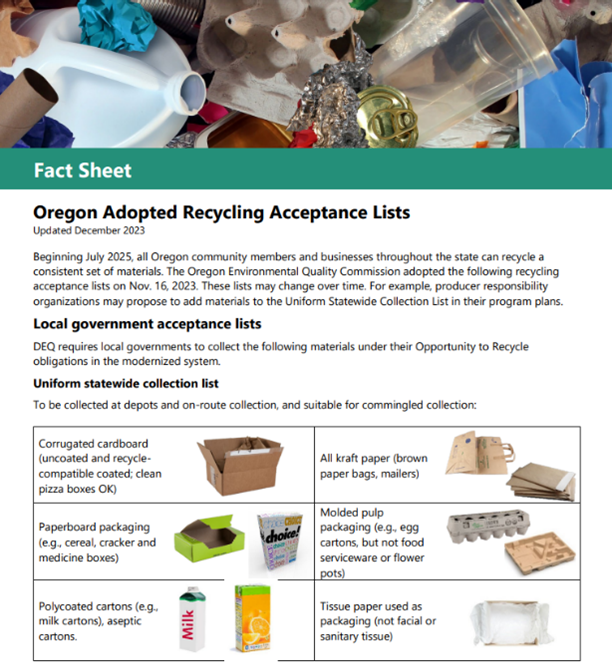
In November 2023, the Oregon Environmental Quality Commission adopted statewide recycling acceptance lists and, later in December, released a fact sheet containing the adopted lists, including the uniform statewide collection list and the producer responsibility organization (PRO) acceptance list. Beginning July 2025, all Oregon residents and businesses throughout the state will be able to recycle a consistent set of materials, including poly-coated and aseptic cartons, non-metalized gift wrap, HDPE and PP plastic tubs, buckets, and plant pots in the on-route commingled collection. The PRO will also have to provide recycling of a wide range of materials, such as plastic film and expanded polystyrene blocks.
Washington E-Cycle Program Plan Published
The Washington Materials Management & Financing Authority (WMMFA) recently submitted the new Washington E-Cycle Program plan for 2024 through 2028 to the Washington State Department of Ecology. The WMMFA received input from various stakeholders, including members of the NWPSC, in developing the 2024 program plan. The plan outlines the program’s scheme for the collection, transportation, processing, and recycling of discarded covered electronic products.
Oregon Mattress EPR Plan Rejected
In late 2023, the Oregon Department of Environmental Quality (OR DEQ) received a stewardship plan from the Mattress Recycling Council (MRC), which currently operates mattress stewardship programs in California, Connecticut, and Rhode Island. In late December, the OR DEQ rejected MRC’s program plan and requested a revised plan to be submitted before February 26, 2024. Some of the revisions/additions requested by the OR DEQ include addressing how non-program mattresses collected will be handled, how MRC plans to handle public education, advertisement, and program promotion, and how MRC will coordinate activities with existing recycling programs.
Seattle Public Utilities, the University of Washington, and an Op-Ed in the Seattle Times Indicate Support for Packaging EPR in Washington in 2024
Seattle Public Utilities (SPU) released a video promoting producer responsibility for packaging as a strategy to help Seattle reach their zero waste goals. SPU’s 2022 Solid Waste Plan Update includes producer responsibility policies and programs. The Seattle Times recently published an op-ed calling for the Washington State Legislature to pass the ReWRAP Act (HB 2049 / SB 6005) in 2024 to increase recycling rates and improve recycling program funding across the state. The op-ed calls out a study commissioned by the legislature last year, which found that policies such as Truth in Labeling, developing a statewide collection list, and recycled content standards will only increase recycling rates in WA by 1%, whereas combining these policies with EPR was estimated to increase recycling in Washington by 26%. Finally, the University of Washington’s campus newspaper, The Daily, recently published an article supporting packaging EPR in Washington. The article calls out packaging EPR as a legislative priority in 2024, calling for readers to reach out to their legislators to support producer responsibility for packaging.
Responding to the Pulp & Paper Industry: Let’s Make Paper Recycling Even Stronger with EPR
Earlier this month, ten local recycling professionals from around the country, including several members of the NWPSC, such as the City of Tacoma, Seattle Public Utilities, and King County Solid Waste Division, responded to the paper industry’s opposition to including paper products in EPR for packaging programs in a Waste Dive op-ed. The American Forest & Paper Association claims that 68% of paper is recycled, but the real recycling rates are much lower. The op-ed cites low recycling rates for cardboard and paper products, the financial burden on residents and municipalities, and other reasons why paper products should be included in packaging EPR programs.
Resource Recycling Publishes a List of Plastic-Related Bills
The 2024 legislative session is now in full swing, with dozens of extended producer responsibility and other plastic-related bills, including bans on single-use plastic bags and utensils, labeling and transparency requirements, and recycled content standards, being introduced across the U.S. Resource Recycling published a quick rundown of plastic-related bills introduced as of January 22.
Guide for EPR for Textiles
WRAP, a UK-based climate action NGO working on product stewardship, recently published a report on EPR for textiles. This report provides a summary of why EPR systems for textiles are needed worldwide and provides an overview of active or emerging textiles EPR systems in France, Netherlands, Sweden, Hungary, and other jurisdictions across the world. The report also includes links to additional reports/studies on Textiles EPR.
LEGISLATION
The following bills are expected in the 2024 legislative session.
Oregon
-
Oregon Legislative Session Begins on February 5, 2024
Google Lobbies to Pass Right-to-Repair Law in Oregon; after years of opposition from the tech industry, Google and other tech companies have shifted stances to support the right to repair movement. Google formally endorsed a right to repair bill in Oregon in 2023, SB 524, and hopes to see Oregon pass its right-to-repair legislation in Oregon’s 2024 short legislative session. Oregon’s right-to-repair program would require manufacturers of covered electronic equipment, such as computers, cell phones, and tablets, to provide access to parts, tools, and repair information about their products, which could make it easier for independent repair shops and others to repair items.
Washington
- The ReWRAP Act – EPR for Packaging and Paper Products: HB 2049 / SB 6005, the Washington Recycling and Packaging Act would create an EPR program for consumer packaging and paper products. The bill also sets minimum post-consumer recycled content requirements for different packaging materials. Both the House and the Senate bills of the ReWRAP Act have had public hearings in their respective committees. The bill has a public hearing in the House Committee on Appropriations on February 1 and scheduled for executive action on February 3.
- Update to LightRecycle Washington HB 1185, would phase out mercury-containing lights and ensure that the existing LightRecycle EPR program can continue. It would also remove the $0.95 Environmental Handling Fee and thereby create a true producer funded EPR program. This bill was voted out of the House Committee on Environment & Energy on January 29.
- EPR for refrigerant gases HB 2401. This bill would create an EPR program to ensure responsible end-of-life management of bulk refrigerants and refrigerants in appliances such as refrigerators, freezers, air conditioners, and heat pumps. Leaked refrigerant gases contribute to global warming. This bill was voted out of the House Committee on Environment & Energy on January 29.
Non-EPR Waste and Recycling Bills
- EPR for refrigerant gases HB 2401. This bill would create an EPR program to ensure responsible end-of-life management of bulk refrigerants and refrigerants in appliances such as refrigerators, freezers, air conditioners, and heat pumps. Leaked refrigerant gases contribute to global warming. This bill was voted out of the House Committee on Environment & Energy on January 29.
- Implementing Recycling Strategies HB 1900, would require a recycling system needs assessment and material characterization study in addition to updated recycled content requirements for some plastic packaging.
- Right to Repair HB 1933 / SB 6276 would require manufacturers of appliances, wheelchairs, farm equipment, and digital electronic equipment such as computers, cell phones, and tablets, to provide access to parts, tools, and repair information about their products, which could make it easier for independent repair shops and others to repair items.
- Deposit-Return System for Beverage Containers HB 2144, would establish a beverage container recycling and reuse system that places a 10-cent refund value on a wide range of beverage containers.
- Improving Washington’s Organic Material Management Systems HB 2301 / SB 6180, would amend organic material collection service requirements for local governments, residents, and businesses, establish food safety and quality labeling requirements, and ban non-compostable producer stickers.
EVENTS & WEBINARS
-
Plastic Pollution and Recycling Modernization Act
- Fourth Rulemaking Advisory Committee meeting: January 31, at 9 am PT. Register here: https://us02web.zoom.us/meeting/register/tZYlfu2grzIuH93FyWMRbOWSINsf1k4-uLea#/registration
- Fifth Rulemaking Advisory Committee meeting: February 14, at 9 am PT. Register here: https://us02web.zoom.us/meeting/register/tZAvdeuvrT4vG9GSJuyd78e8d9wHGLk_jKLb#/registration
- Sixth Rulemaking Advisory Committee meeting: March 14, at 9 am PT. Register here: https://us02web.zoom.us/meeting/register/tZ0tdu2hqDorH9PAyyWs9HCsQ1CmhYXCSUcH#/registration
- CalRecycle – SB54 Questions and Answer Session: February 1, 2024, at 10 am PT. Register here - https://us02web.zoom.us/meeting/register/tZ0vdu2vrToqGdW-s7ojvpA_kEzBg6GCvwMP#/registration
- Reverse Logistics Group Webinar - The Oregon Packaging Landscape: Learn How the RLG Pack PRO is Supporting Businesses with Compliance: February 6, 2024, at 8 am PT. Register here - https://zoom.us/webinar/register/2716959261067/WN_f570CnJWSri4iBu1bW4qEg#/registration
- Product Stewardship Institute (PSI) – Toxics in Packaging and EPR Webinar: February 15, 2024, at 11:30 am PT. Register here - https://productstewardship.us/events/toxics-in-packaging-and-epr/
Engage with the Northwest Product Stewardship Council
Add your voice and join the Northwest Product Stewardship Council (NWPSC) as an Associate, Steering or Community member.
Follow the NWPSC on Twitter (@StewardshipNW) for product stewardship information from Washington, Oregon and elsewhere.
 The Northwest Product Stewardship Council (NWPSC) is a coalition of government agencies in Washington and Oregon working on solid waste, recycling, resource conservation, environmental protection, public health and other issues. Together with non-government agencies, businesses and individuals, we form a network that supports product stewardship and extended producer responsibility (EPR) policies and programs. For more information, contact info@productstewardship.net or visit us at www.ProductStewardship.net.
Subscribe to the NWPSC Newsletter and read our past newsletters. For current subscribers: update your email, password, or unsubscribe on the Subscriber Preferences Page (you will need to use your email address to log in). If you have questions or problems with the subscription service, please visit subscriberhelp.govdelivery.com.