National Domestic Violence Hotline calls and the Social, Economic, and Overall Health impacts of COVID-19: April 12, 2023

Public Health — Seattle & King County is monitoring changes in key economic, social, and other health indicators resulting from strategies to slow the spread of COVID-19. Just as the pandemic has had disparate impacts on parts of our population, mitigation measures present more hardship for some members of our community than others. The economic, social, and health impacts data project helps inform strategies and policies to minimize those harms and maximize outcomes for all residents of King County.

How are you using the data? Share your feedback via this brief survey.

Below are highlights, but you can view the entire dashboard here


 FREE Dental, Medical, and Vision Services April 27-30 at Seattle Center

  • Patients do not need to reside in King County or Washington State to receive services.
  • Patients do not need any form of ID to receive services. All are welcome regardless of income, insurance, housing, or immigration status. 
  • Interpreters will be available
  • No advanced registration -first come, first served 
  • Free parking – Mercer St. Garage (650 3rd Ave N)
  • The following services will be available for FREE: Dental, Vision, Medical, Resources (including social work, help with health insurance, and more)

For more information check out: seattlecenter.org/patients/ 
Email: SKCClinic@seattlecenter.org 
Phone: 206.684.7200


******************** 

The following content contains material about domestic violence (DV) and suicide. This content may be triggering and/or traumatizing. 

******************** 


Social SectionEconomic SectionHealth Section

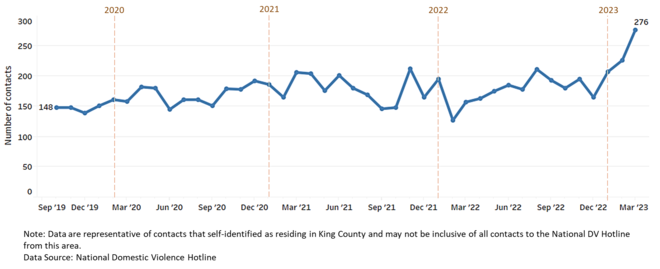
Increasing number of contacts to the National Domestic Violence (DV) Hotline by King County residents

  • The number of King County contacts (calls/texts/chats) to the National DV Hotline has been steadily increasing since December 2022.
    • As of March 2023, residents in King County made 276 contacts (calls/texts/chats) to the National DV Hotline. This is the highest number made since October 2019, the earliest for which we have data. 
    • This is a 67% increase in the number of contacts made compared to December 2022 (165 contacts) and a 75% increase compared to a year ago in March 2022 (157 contacts). 

  • When contacting the National DV Hotline, people can report more than one type of abuse. *In March 2023, the leading types of DV abuse reported in King County were:

- emotional abuse (82%)
- physical abuse (56%)
- financial/economic abuse (33%)

*This data is not shown in the dashboard; the dashboard shows the percentage of contacts by type of abuse for Oct 2019 - March 2023.

Note: Data are representative of contacts that self-identified as residing in King County and are not inclusive of all contacts to the National DV Hotline from this area.  


Number of National Domestic Violence (DV) Hotline contacts among King County residents October 2019 – March 2023

DV hotline 323

SOCIAL

Steady rates of Emergency Department (ED) visits involving domestic violence among King County residents

In February 2023, King County residents had 34.5 visits involving domestic violence per 10,000 total ED visits (179 visits). This rate is similar to the prior month and February 2022 (Jan 2023 - 33.4 per 10,000 visits; February 2022 - 35.0 per 10,000 visits).


Households receiving Basic Food benefits remain high

In March 2023, approximately 13% of all households (116,582 households) in King County were enrolled in Basic Food benefits. This is similar to the previous month (117,154 households in February 2023), but a 6% increase compared to one year ago (109,833 households in March 2022).

From March 2020-February 2023, families enrolled in Basic Food received a temporary increase in food benefits. Starting March 1, 2023, households enrolled in Basic Food receive a decreased food benefit amount consistent with pre-pandemic benefit levels. 

Public Health will be closely monitoring impacts on food security and assisting people to access food support. For more information about Basic Food benefits, contact Public Health Access & Outreach program at 1-800-756-5437.

ECONOMIC

Increase in calls to 2-1-1 from King County residents for income support/assistance

During February 13-19, 2023, King County's 2-1-1 received 208 calls seeking income support/assistance. This is twice the number of callers compared to one month ago (103 callers during January 16-22, 2023).

This increase in calls is similar to a spike in the number of callers seeking income support/assistance around the same time last year (197 callers during February 7-13, 2022).


The percent of adult renters who reported their monthly rent increased $250 or more holds steady in the King-Pierce-Snohomish county area

In the first half of March 2023, 22% of renters in the King-Pierce-Snohomish County area reported their rent increased $250 or more. This is similar to the first half of January and February 2023 where 21% percentage of renters reported rent increased $250 or more. 

HEALTH

Medicaid enrollment continues to increase

In January 2023, 527,560 people were enrolled in Medicaid in King County. This is a 32% increase (over 125,000 individuals) in Medicaid enrollment compared to March 2020, the start of the COVID-19 pandemic.  

Since the beginning of the COVID-19 pandemic, King County residents have kept Medicaid (Apple Health) coverage without needing to reconfirm their eligibility every year. However, starting April 1, 2023 eligibility returned to pre-pandemic operations. This will impact Medicaid enrollees on a rolling basis, as each month a new group comes up for renewal verification.

Click here to read about how you can keep Medicaid coverage.  

Public Health is closely monitoring the number of individuals enrolled in Medicaid in King County since we anticipate a decline in the coming months due to this policy change.


Increased rates of Emergency Department (ED) visits involving suicidal ideation among King County residents    

ED visits involving suicide ideation were higher in February and January 2023 (233.8 visits and 236.8 visits per 10,000 total ED visits respectively) than they were in December 2022 (191.9 visits per 10,000 total ED visits), but the February 2023 rate is lower than a year ago (272.9 visits per 10,000 ED visits observed in February 2022).

For questions, please write to: COVIDevaluation@kingcounty.gov 

To sign-up for this newsletter please click here