2-1-1 Crisis Connections calls and the Social, Economic, and Overall Health impacts of COVID-19: March 8, 2023

Public Health — Seattle & King County is monitoring changes in key economic, social, and other health indicators resulting from strategies to slow the spread of COVID-19. Just as the pandemic has had disparate impacts on parts of our population, mitigation measures present more hardship for some members of our community than others. The economic, social, and health impacts data project helps inform strategies and policies to minimize those harms and maximize outcomes for all residents of King County.

How are you using the data? Share your feedback via this brief survey.

Below are highlights, but you can view the entire dashboard here


The national and public health emergency declarations of the COVID-19 pandemic to end on May 11, 2023 

A series of emergency declarations have been in place since early 2020 that gave the Federal government flexibility to waive or modify certain requirements in a range of areas, including economic, social, and healthcare sectors. We will be monitoring how the lifting of these declarations will impact King County. Public Health-Seattle & King County is actively working with community partners to mitigate impacts for individuals affected by these changes.


Economic SectionSocial SectionHealth Section

Increasing calls to 2-1-1 Crisis Connections in King County

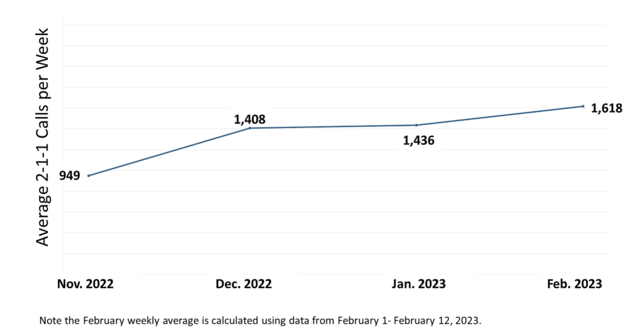
  • The average number of 2-1-1 calls per week among King County residents increased over the past few months (see graph below).


monthly calls - no title

  • Between December 2022 and January 2023, the number of callers seeking food/meals assistance increased 15% and the number of callers seeking housing assistance increased 9%.

    • Families enrolled in Basic Food received a temporary increase in food benefits, which ended March 1, 2023. We anticipate an increase in 2-1-1 callers seeking assistance related to food/meals and will be monitoring this closely.

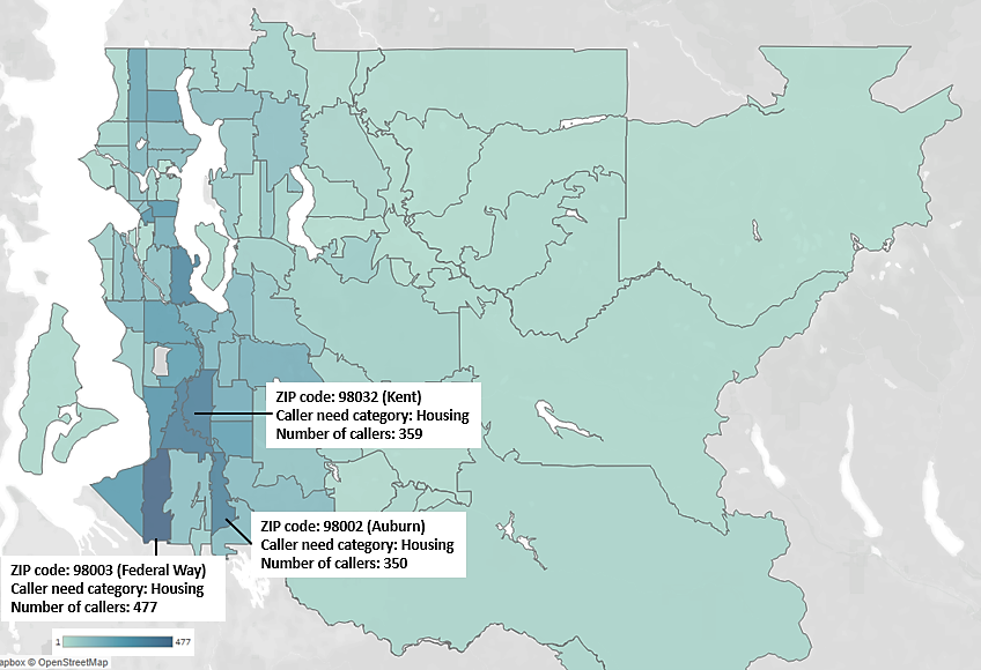
  • From December 5, 2022 to mid-February 2023, the ZIP codes (see map below) with the highest number of callers seeking housing assistance were from Federal Way (98003), Kent (98032), and Auburn (98002).


Callers to King County 2-1-1 seeking assistance with housing, by ZIP Code
December 5, 2022 - February 12, 2023

211 housing map

Note: Callers to King County 2-1-1 are deduplicated by week, and may receive multiple referrals to meet social service needs per call to 2-1-1.


ECONOMIC

After an increase in December 2022, the percent of adult renters who reported their monthly rent increased $250 or more holds steady in the King-Pierce-Snohomish county area

In the first half of February 2023, 21% of renters in the King-Pierce-Snohomish County area reported their rent increased $250 or more. This is similar to the first half of December 2022 where 26% percentage of renters reported rent increased. 


SOCIAL

Steady rate of Emergency Department (ED) visits involving domestic violence among King County residents

In January 2023, there were 33.4 visits involving domestic violence per 10,000 total ED visits. This is similar to the previous month (27.9 per 10,000 ED visits in December 2022) and to January 2022 (31.2 per 10,000 visits).


Households receiving Basic Food benefits remains high

In January 2023, 116,088 households in King County received Basic Food benefits, which represents approximately 13% of all households in King County. This is similar to December 2022 (116,215 households) but a 9% increase compared to one year ago (January 2022; 106,874 households).

From March 2020-February 2023, families enrolled in Basic Food received a temporary increase in food benefits. Starting March 1, 2023, households enrolled in Basic Food will receive a decreased food benefit amount consistent with pre-pandemic benefit levels. 

Public Health will be closely monitoring impacts on food security and assisting people to access food support. For more information about Basic Food benefits, contact Public Health Access & Outreach program at 1-800-756-5437.

HEALTH

Emergency Department (ED) visit rates involving suicidal ideation continues to decrease among King County residents aged 10 years and older

In December 2022, there were 191.9 visits involving suicidal ideation for every 10,000 total ED visits. This is the lowest rate for all of 2022 and is a significant decrease compared to the same month of the previous year (255.5 per 10,000 ED visits in December 2021).


Low percentage of adults uninsured in the King-Snohomish-Pierce County area

During February 1–13, 2023, 6% of adults (ages 19-64) in the King-Snohomish-Pierce County area reported that they lacked health insurance. In the past year, the percentage of adults reporting they lacked health insurance peaked at 9% in early-mid December 2022. 

For questions, please write to: COVIDevaluation@kingcounty.gov 

To sign-up for this newsletter please click here