New traffic collision data and the Social, Economic, and Overall Health impacts of COVID-19: October 28, 2021

Public Health — Seattle & King County is monitoring changes in key economic, social, and other health indicators resulting from strategies to slow the spread of COVID-19. Just as the pandemic has had disparate impacts on parts of our population, mitigation measures present more hardship for some members of our community than others. The economic, social, and health impacts data project helps inform strategies and policies to minimize those harms and maximize outcomes for all residents of King County.

How are you using the data? Share your feedback via this brief survey.

Below are highlights, but you can view the entire dashboard here

Economic SectionSocial SectionHealth Section

REMINDER 

Starting October 25, 2021, customers age 12 and older are required to verify full vaccination or a negative test to participate in outdoor public events of 500 or more people and indoor entertainment and recreational establishments and events such as live music, performing arts, gyms, restaurants, and bars. 

More information at: http://kingcounty.gov/verify


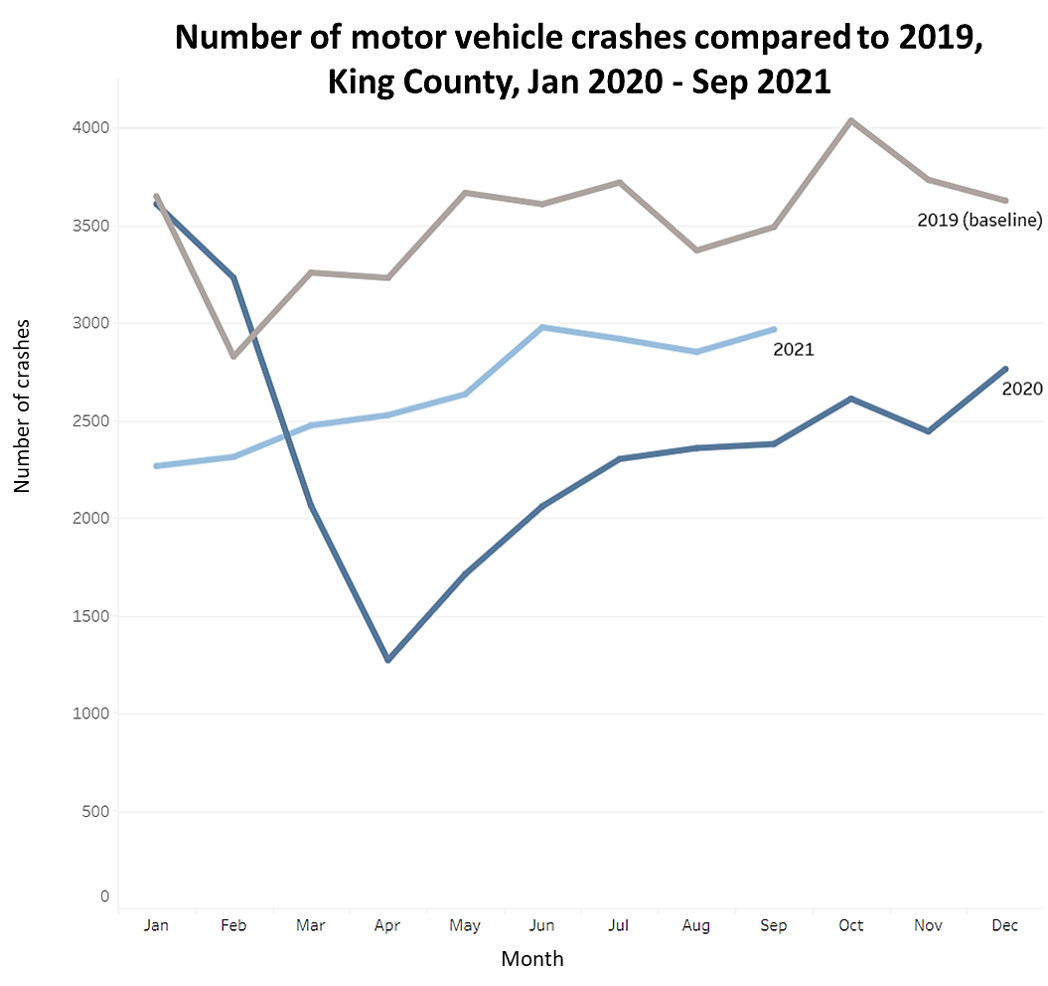
As King County fully reopens and traffic volume increases, the number of motor vehicle crashes are also rebounding to pre-pandemic levels 


MVcrashes

ECONOMIC

2-1-1 call data shows BIPOC communities are disproportionately affected

Since April 2020, 33% and 14% of callers to 2-1-1 seeking assistance for any need identified as Black/African American and Hispanic/Latinx, respectively. Compared to 7% and 10% of all King County residents who identified as Black/African American and Hispanic/Latinx, respectively.


2-1-1 call data shows racial/ethnic differences in assistance needs 

During the week of September 13-19, the most common social service needs among callers were Housing (54%), Legal and Consumer Services (20%), Information Services (15%) and Utility Assistance (15%). 
Basic needs, such as housing, food and utility assistance, continues to be a concern for callers from communities disproportionately impacted by the pandemic, including Black and Hispanic/Latinx communities.

SOCIAL

Basic Food assistance (SNAP) enrollment remains high

In September 2021, 109,146 households in King County received Basic Food assistance, which represents approximately 11.9% of all households in King County. This is a 10.1% increase compared to September 2019. 


Decreasing emergency department (ED) visits for suspected child abuse & neglect

The rate of ED visits involving suspected child abuse and neglect was 24.3 per 10,000 ED visits in September 2021. The rate has had a decreasing trend since January 2021 and is slightly lower (but not statistically different) than the rate in September 2019 (31.9 per 10,000 ED visits).

HEALTH

Increasing calls to the behavioral health crisis line

There were 8,924 behavioral health crisis calls in September 2021. This is a 35% increase compared to September 2019 (6,606 calls) and a 9% increase from September 2020 (8,168 calls).


Emerging increase in ED visits for suspected suicide attempt warrants continued monitoring

The rate of ED visits involving a suspected suicide attempt was 51.0 per 10,000 visits in September 2021. The rate of ED visits involving a suspected suicide attempt in September 2021 increased from the previous month (August 2021: 39.8 per 10,000 visits), and is higher (but not statistically different) than the rate in September 2019 (41.8 per 10,000 visits).

This work is funded by Public Health — Seattle & King County, the Washington State Department of Health, and the Centers for Disease Control and Prevention’ s (CDC) Epidemiology and Laboratory Capacity for Prevention and Control of Emerging Infectious Diseases ( ELC) Cooperative Agreement (CK19 - 1904 ).

For questions, please write to: COVIDevaluation@kingcounty.gov

To sign-up for this newsletter please click here