|
|
 
King County launches a beta-version Climate Change GIS Open Data Portal
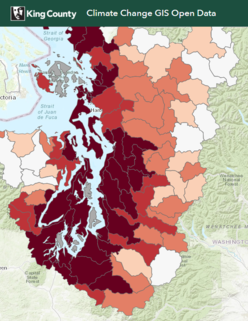
Providing information on climate change as geospatial data, through platforms such as GIS (Geographic Information System), can help the public and decision makers better understand how climate impacts can vary over time and space. This information can also be helpful in planning for climate change, allowing users to visualize how specific climate impacts may affect communities, infrastructure, facilities, and natural resources.
King County has created a beta-version Climate Change GIS Open Data portal for GIS professionals to support the use of spatial analysis in preparing for and adapting to the impacts of climate change. The portal includes a variety of climate change data layers for the Puget Sound basin developed by the UW Climate Impacts Group for the 2015 Puget Sound State of Knowledge: Climate Change in Puget Sound report. Data include historical and projected changes in temperature, precipitation, snowpack, and streamflows. Users can use the site to view or download GIS data for the Puget Sound basin. Data sets are still being configured and added so be sure to check back if you don't find what you need just yet.
|
Financial support for small food and farm businesses impacted by COVID-19
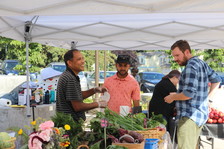
The King County Agriculture Program has compiled a list of resources to provide financial support for farmers and food businesses impacted by COVID-19. This list provides resources and information on programs that can help farmers and food businesses access financial support programs through local, state, and federal organizations and agencies.
The local financial support opportunities include: Local Loan programs for Food Businesses, SBDC Business Resiliency Guide, and Amazon's $5 million Neighborhood Small Business Relief Fund. The state financial support opportunities include financial assistance through the Washington State Department of Revenue and employer and worker assistance through the Washington State Employment Security Department. The state also provides information regarding insurance assistance, including event cancellation insurance, which you can read more about here.
|
King County Equity and Social Justice COVID-19 Community Response Grants

In response to the COVID-19 outbreak, King County's Office of Equity and Social Justice (OESJ) has set up a Anti Hate and Bias Response Fund and a Community Response Fund.
You can find other COVID-19 financial resources and basic needs support at the community, county, state, and federal level compiled by the City of Seattle (resources are not limited to Seattle).
Anti Hate and Bias Response Fund
King County will invest $50,000 in organizations that can develop community centered public messaging in response to bias and hate incidences, with priority to Asian Pacific Islander communities. Funded organizations must agree to participate in regular, online meetings and to a series of message development, outreach and reporting activities that can help inform immediate and future anti hate and bias policies at King County. Please download the Anti Hate and Bias Response Fund application at the OESJ website. You can find anti-stigma resources here.
Community Response Fund
3/31 UPDATE: Due to high volumes, receipt of applications is temporarily suspended but continue to check the OESJ website for updates.
These grants will be awarded to community based organizations and other stakeholders serving impacted communities at the highest risk of immediate and long term negative health, social and economic impacts, with an emphasis on communities located near isolation, quarantine and recovery sites.
|
|
|
|
|
Need something to listen to? King County Serves as a Carbon Coach on KUOW's Biggest Carbon Loser Series

Prior to the COVID-19 outbreak, Seattle's NPR public radio station KUOW produced a reality-radio reduce-your-carbon-footprint competition called the Biggest Carbon Loser.
Each contestant had a "carbon coach" and King County employee, Tom Watson, was coaching one of them! Tom manages the EcoConsumer program in the Solid Waste Division of the Department of Natural Resources and Parks.
KUOW’s Biggest Carbon Loser series aimed to see how deeply three Seattle-area residents could cut their carbon footprints -- from travel, food, energy, and more -- while navigating their daily lives. Whoever cut their carbon footprint the most won the coveted title of Biggest Carbon Loser.
You can listen to episodes of KUOW's 5-minute segments about how these contestants have worked to reduce their individual carbon footprints and the challenges and limitations they faced.
|
You can learn more about County climate actions and strategies on our website. Find information on our Strategic Climate Action Plan (SCAP), Partnerships and Collaborations, and Initiatives and Programs. Learn more about climate change, its impacts in King County, and what you can do.
|
|