|
View this e-bulletin in your browser.
What you'll find in this issue:
- One week without driving, lifelong benefits
- Recommendations for things to read/watch/listen to
- Events and trainings to keep on your radar
- Grants and funding opportunities
- Opportunities to present and publish
- Surveys to take
- Plenty of useful resources!
This news piece is adapted from the October 2025 edition of this newsletter.
One week without driving, lifelong benefits
Today is the start of Week Without Driving, an annual transportation campaign from Nondrivers Alliance and America Walks challenging us to travel without getting behind the wheel of a car. The campaign highlights how the one third of Americans who already don’t or can’t drive year-round experience their communities. Whether you’re a nondriver yourself or rely on cars every day, participating in Week Without Driving is an opportunity to reflect on what it takes to commute where we live or travel without driving access.
I regularly bike commute and occasionally drive, so I felt confident about switching all of my trips to active ones when I took the challenge last year. But Week Without Driving quickly corrected my expectations. If someone in my veterinarian’s office had looked across the street the first afternoon of the challenge, they would have seen nondriving humbling me in real time.
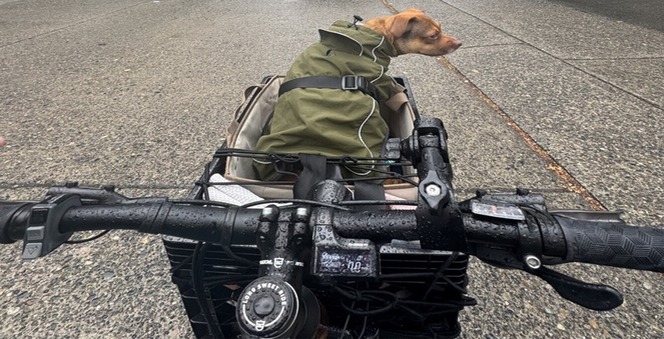 If we go for enough rainy rides maybe she’ll even let me put her rain hat and goggles on.
The riding itself for that trip – going to and from the vet’s office with my dog to get her booster shots – was great despite a downpour. I was able to weave together a bunch of quiet local streets with lots of speed bumps for nearly the entire trip. My dog let me put her in a raincoat. This was living! But I’d never ridden to the vet before and hadn’t realized the office didn’t have bike parking. I needed to cross the street twice to find a place to lock up. I also underestimated how easy it would be to lock and attach a rain cover to my bike while wrangling my leashed-but-energetic dog.
It’s significant that parking was the hardest part of my trip. Some people taking the challenge will attempt trips they ultimately can’t finish. I was able to complete this trip by bike on roads that felt comfortable to me and had reliable transit to fall back on if something went awry. Meanwhile, many of us live in or travel through places where bike facilities don’t link up, let alone feel comfortable to use.
Taking this challenge forces us to acknowledge how well our networks serve people traveling in different ways, which can change our opinions of travel modes themselves. Biking feels scary? Bus doesn’t come frequently enough? It’s probably not the biking or the bus that’s the problem. It’s often the context in which people are made to undertake walking, biking etc. that makes things tough.
Active transportation and transit can be healthy, convenient, affordable and FUN. But without comfortable, continuous routes like people driving always have access to, nondrivers must get creative, take unfortunate risks and/or miss out on opportunities because they can’t get from A to B.
Nondrivers include everyone from children to those with disabilities, from older people to those who can’t afford cars – but any of us could become part of this population for a period of our lives. Even those of us who can choose to drive already need to walk or roll at the start and end of those trips. Offering consistent facilities for nondrivers means everyone gets to use the transportation network. It also keeps everyone safer and gives us freedom to pick the best travel method for every trip.
Building streets that give us a little wiggle room in choosing how we travel, ultimately helping all of us travel more safely/reliably? Not really a radical ask!
We’re working hard at the state level with the legislature’s help to close access gaps and improve existing active transportation infrastructure. We’re carrying out the Complete Streets requirement for state transportation projects and strengthening our strategic highway safety plan with the Safe System Approach. Our division facilitates local safety grants like the Safe Routes to School, Pedestrian/Bicyclist and Sandy Williams Connecting Communities Programs. We also manage programs that give people the skills and tools to ride bikes comfortably and confidently, like our Statewide School-Based Bicycle Education Program, WE-Bike E-Bike Rebate Program (apply for a rebate today!) and E-Bike Lending Libraries Program.
This work is personal: We and our loved ones travel in Washington, too.
Are you taking the challenge? We’d love to learn about your experience! Share photos and debriefs on your week with us at WSDOTActive@wsdot.wa.gov.
We add new trainings as we find them, so the list changes with every issue. Some of these offer continuing education credits. All times are shown in Pacific Standard Time.
All items are webinars unless a location is noted and are free of charge unless they are a conference or professional course (we try to note when there is a fee).
October is Pedestrian Safety Month!
- Oct. 1 – 8: Week Without Driving
- Oct. 5, 6:30 p.m., virtual and Seattle, WA: Week Without Driving Book Talk and Discussion with Sidewalk Nation Author Michael Pollack (Nondrivers Alliance)
- Oct. 6, 10 a.m.: When the Public Pushes Back: Turning Distrust into Productive Dialog (Municipal Research and Services Center (MRSC))
- Oct. 6, 12 noon: Bringing Power Home: Reframing place through the lens of class and race (Frameworks Culture Change Project)
- Oct. 7: Walk to School Day
- Oct. 7, 10 a.m.: Vision Zero National Advocacy Call: Bike/Walk Central Florida’s Best Foot Forward program (Vision Zero Network)
- Oct. 7 – 9, Vancouver, WA: 2026 Annual Conference Home (APA Washington Chapter)
- Oct. 7 – 9, Wenatchee, WA: Stronger Together: 2026 Washington State Trails Conference (Washington State Trails Coalition)
- Oct. 7 – Nov. 18: Implementing the Safe System Approach Course (ITE)
- Oct. 9, Anchorage, AK: 2026 Region 10 Transportation Conference (Pacific NW Transportation Consortium/PacTrans)
- Oct. 14, 7 a.m.: Climate Resilience in Drainage: Culverts, Bridges, Fords, and Road Surface Drainage (International Road Federation, AnyWay Solutions and World Bank Roads to Resilience (IRF-R2R) Webinar Series)
- Oct. 15, 9 a.m.: TRB Webinar: Lighting for Pedestrian Safety (Transportation Research Board (TRB)
- Oct. 20, 5:30 p.m., Seattle, WA: Tour of Seattle’s First Roundabout (Association of Pedestrian and Bicycle Professionals WA State)
- Oct. 20 – 22, Wenatchee, WA: 2026 IACC Conference (Infrastructure Assistance Coordinating Council) Featuring presentations on funding opportunities for Washington communities, includes WSDOT Active Transportation and Local Programs Divisions, and Short Course on Local Planning by Washington State Department of Commerce.
- Oct. 20 – 22, Minneapolis, MN: 2026 Safe Routes to School National Conference (Safe Routes Partnership)
-
Oct 20-22: Positive Culture Framework Training (Montana State University Center for Health & Safety Culture)
-
Oct. 21, 12 noon: The Fall Line Trail: Secrets from a Transformative Regional Trail in the Richmond, VA Region (Association of Pedestrian and Bicycle Professionals (APBP)
- Oct. 22, 5:30 p.m., Seattle, WA: Tour of Seattle's First Roundabout (APBP WA State Chapter)
-
Oct. 28, 7 a.m.: Slope Stability & Erosion Control: Bioengineering, Nature-Based Solutions, and Structural Approaches. IRF-R2R Webinar Series
Oct. 28-29: New York, NY, Vision Zero Cities Conference (Vision Zero Network)
Oct. 29, 10 a.m.: Prescription Trails: Leveraging the Science of Trail Therapy (American Trails, donations appreciated)
November
Save the Date:
- The Coordinating Council on Access and Mobility Technical Assistance Center (CCAM-TAC) is requesting proposals for the 2027 Community Rides Pilot Grant Program. The program offers awards of up to $100,000 to innovative local transportation pilots. Deadline: October 19, 2026, by 2 p.m. PST
- The Washington State Department of Commerce has ongoing climate planning grants and technical assistance available to local governments across the state.
Keep track of all of the USDOT’s discretionary funding opportunities at the DOT Discretionary Grants Dashboard. Also, a full listing of pedestrian- and bicycle-related federal funding programs is available through FHWA.
Have any funding opportunities people should know about? Send them to WSDOTActive@wsdot.wa.gov.
Have an upcoming project, open house, public comment opportunity? Construction projects people should know about as they relate to biking/walking? Compliments on a project? Send to WSDOTActive@wsdot.wa.gov.
Calls for applications:
Calls for papers/presentations/abstracts:
-
TRB Conference on Rural and Tribal Transportation: Abstracts sought for the annual conference in Westminster, CO. Deadline: October 9.
-
Infrastructures: Sustainable Infrastructures for Urban Mobility, 2nd Edition: The publication "features selected papers from the LWC Conference but also welcomes high-quality contributions from the broader research community." Deadline: October 30.
-
2027 Safe Mobility Conference (Safety 21): Submissions sought for the Safe Mobility Conference in Boston, MA, March 22-24. Deadline: November 9.
-
Ecological Frontiers: Urban Ecology: "This special issue focuses on four key areas: urban socio-ecological systems, urban resilience, ecosystem services and health, and smart governance." Deadline: December 30.
-
Vehicles: Emerging Transportation Safety and Operations: Practical Perspectives, 3rd Edition: The publication "seeks original contributions within this research area, covering topics that include, but are not limited to, applications of safety methods along with emerging technologies, the evaluation of traffic studies, before–after studies of safety countermeasures, operation-based safety and other impact studies, emerging trends in traffic safety and operations, surrogate measures, and applications of data-driven safety and operation methods with CAV-generated data, third-party data, or other synergized data sources." Deadline: February 24.
-
Disabilities: Transportation and Disabilities: Challenges and Opportunities: "This Special Issue explores innovative transportation solutions that promote accessibility and inclusion. From adapted transport services to autonomous vehicles, digital navigation aids, and training programs for using regular transit systems, numerous emerging approaches have the potential to transform community mobility for persons with disabilities. Within a disability perspective, we invite researchers to contribute original studies that address transportation challenges faced by people with any kind of disabilities, development of solutions that can facilitate mobility, or assessment of those solutions. By bringing together interdisciplinary perspectives, this Special Issue aims to advance knowledge and foster evidence-based strategies that enhance transportation services for people with disabilities. We welcome submissions from diverse fields, including transportation studies, urban planning, rehabilitation sciences, disability studies, engineering, and policy research." Deadline: October 30.
We share new papers, established databases, thoughtful essays, and even older research that was ahead of its time. If these are helpful to your existing work or spark a new project: Email WSDOTActive@wsdot.wa.gov to let us know!
If you read this far, thank you! You're finding something of value here and you know someone else who should receive this kind of news. Forward WSDOT Walk and Roll to others and share the subscription link on social media (tag it #WSDOTactive).
Hannah Weinberger
Communication Lead, WSDOT Active Transportation Division
hannah.weinberger@wsdot.wa.gov
|



