|
The August edition, back with more events!
Our August newsletter had barely left our outboxes when we caught wind of a bunch of great September events. We also noticed an error needing correction: We mistakenly described Dr. Katherine Idziorek, a University of Virginia researcher and co-organizer of the 2026 Seattle Disaster Relief Trials, as being one of the co-organizers affiliated with the University of Washington. We hope you'll accept this trove of new events as a token of our reader appreciation!
What you'll find in this issue:
- Disaster Relief Trials debrief
- Accessible, active, age-friendly mobility
- Providing safe routes to school
- Recommendations for things to read/watch/listen to
- Events and trainings to keep on your radar
- Grants and funding opportunities
- Opportunities to present and publish
- Surveys to take
- Plenty of useful resources!
Riding as Emergency Response: Racing in the 2026 Seattle Disaster Relief Trials
It’s easier to think about disaster preparation when you’re having fun
When I got into cycling, I expected there to be sweat. I expected exercise, commutes I’d enjoy, and enviable helmet hair.
I did not expect cycling to involve becoming a self-deputized emergency responder. But when the 2026 Seattle Disaster Relief Trials sent more than 40 of us out on cargo bikes to practice mutual aid from the saddle on Saturday, July 25, I learned firsthand that using bikes during emergencies makes sense and feels important for the transportation planning world to account for.
It’s a lesson hundreds of people worldwide have gleaned during Trials, emergency response exercises masquerading as parties on wheels, since cofounders Mike Cobb, Ethan Jewett and Travis Wittwer organized the first one in Portland in 2012.
People like the cofounders and this year’s organizers (among them University of Washington scientists) know that when disasters bring down energy grids, overwhelm first responders and render roads unsafe to drive, they can also isolate communities from days to weeks. But cyclists can make trips that people driving cars, trucks, and emergency service vehicles can’t. They can shuttle supplies and news between other neighborhood helpers to keep communities going, especially if they work together.
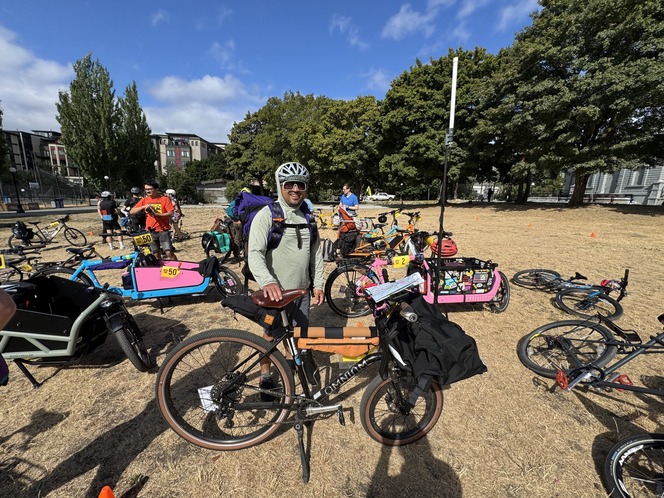 Cyclists raced an array of bikes, from analog steel roadsters to mini cargo bikes equipped with mesh communications gear, as shown here.
Dozens of people in the emergency preparedness and cycling communities converged to help these messages land in Seattle, which is vulnerable to many disasters including floods and earthquakes. New this year, the organizers set up the Trials so riders could contribute to scientific research. We filled out surveys and shared GPS route data with the researchers to inform their national Bicycle Resilience Hub, a project studying the relationship between bikes and disaster response.
Cyclists whipped in and out of the event’s base at Cal Anderson Park to collect and turn in three paper manifests full of maps and challenges reflective of tasks that could come up in an emergency. Volunteers facilitated challenges, ran ham radios, tuned bikes and even powered a sound system with a stationary bike.
I teamed up with fellow e-bike riders Paul and Alicia to tackle the day. Without smartphones, we relied on our mental maps and knowledge of Seattle streets to pick the best routes between task locations, then get ourselves from A to B. Without knowing how hard or long we’d need to ride with potentially cumbersome cargo, we kept our motors off or in eco mode.
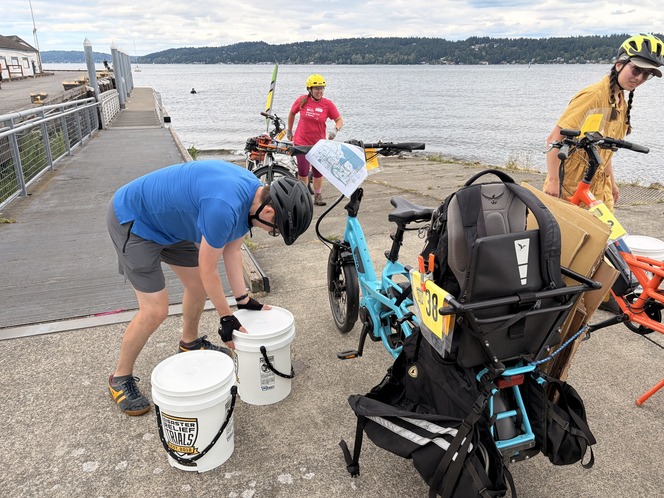 Cyclists prepare buckets of water scooped from Lake Washington for transport on cargo bikes.
The Trials sent us in all directions to harvest plants from a community food forest, deliver food to food banks, pass messages about the condition of communications infrastructure, check for landslides (thankfully, we found none), measure an aftershock (we jumped on seismometers to generate seismic activity), water a real farm with water we collected in buckets from Lake Washington, lift our bikes over rock walls, and more while carrying three eggs (all of ours survived!).
Five hours and 31 miles later, we finished the Trials with huge appreciation for the bike routes we do have, the event organizers, disaster prep resources and all the volunteers who dedicated the day to teaching us somewhat-unexpected life skills. (We also discovered we’d only used about 20 percent of our bike batteries – workouts were had!) The event continued the Trials’ track record of running incident-free.
As we traded phone numbers and complimented each other’s bikes at the end of the day, I thought about all the infrastructure we rely on to stay resilient. Radio towers, reinforced buildings and roads are infrastructure. But so are skills, local knowledge, and the kinds of relationships the Trials helped us build. Communities with stronger ties are more resilient before and during emergencies – and there’s not a lot that will help you bond more quickly than five hours of learning, laughs, and fruit snacks.
Quotable: After the event, University of Virginia scientist Dr. Katherine Idziorek shared this with participants on behalf of the organizers:
“We were also able to gather GPS data that demonstrates how useful bicycles can be for disaster response and recovery, which will push this new area of research further and hopefully move us closer to greater inclusion of bicycles and the bicycle community in disaster preparedness and response planning. What a day!”
Accessible, active, and age-friendly: Mobility freedom for a lifetime
By Barb Chamberlain, Director, Active Transportation Division
Everyone deserves access to comfortable, connected transportation. Access can be a measure of proximity: Are you close enough to a bike network that it’s convenient to use? But it’s also a measure of how well transportation networks serve travelers of all ages and abilities.
Your accessibility needs as a traveler will change as you age. What can Current You do for Future You to plan for transportation independence over the years?
I hosted a workshop on this topic at the Bike Walk Roll Summit in April with cohost Aditi Kambuj, Urban Design Manager with Seattle Department of Transportation. Aditi and I invited people to think about how they move around now, and how they could sustain their access to transportation through life changes, disability, the effects of aging, and in general, from physical and mental resilience to how climate and weather will affect their movements.
We shared a few statistics to put this exercise in context:
- By 2050, 23 percent of Washington state’s population will be age 65 or older. (Numbers and percentages will be higher in places promoted as great for retirees.)
- By 2034, people older than 65 will outnumber children under 18 in Washington.
- Men outlive their ability to drive safely by seven years on average, women by 10 years. (The AAA Foundation for Traffic Safety study used a gender binary in their analysis.)
- One in three Americans will experience a disability lasting 90 days or more before age 65.
- Up to 44 percent of Americans may face a disability lasting nearly five years in their lifetimes.
- More than one in four Americans (28.7 percent) have some kind of disability.
- Most people who are blind lose their sight later in life.
- Approximately 30 percent of Washington’s population don’t or can’t drive. This percentage includes children. School-age children have transportation needs, too, and age-friendly transportation needs span all ages and stages.
The Summit workshop challenged people to work through a set of questions that could spark your own brainstorming or a family conversation.
-
Defining your good day: Capture some of the elements of a good day for you personally. What do you do? Where do you go? Who are you with? Write a few sentences, make a bullet list, or illustrate it.
-
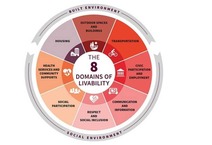
AARP Domains of Livability: These may come in handy as you enjoy thinking about a good day.
 |
|
- Outdoor spaces & buildings
- Transportation
- Housing
- Social participation
- Respect & social inclusion
- Work & civic engagement
- Communication & information
- Community & health services
|
Which domains are most important to you?
-
Going places: List a destination or two in your personal good day. How are you getting there now? What would you do if you couldn’t use that travel mode?
-
Livability from a fresh perspective: Keep that good day in mind, and other days you would enjoy. Shift perspective to consider changes in your abilities, income, or family structure as you get older. What changes as you think about your good day?
-
Mapping your personal plan for transportation independence: Connect what matters with transportation: Sketch a quick map of a typical route to something in your good day, or your neighborhood. What would make it more age-friendly? What if you’re on one of those journeys from a different perspective—would it be possible to go at all?
-
Identify barriers: What barriers can you identify to using your current and future modes? These could be barriers for you as you are today. Or they could be barriers for Future You, who might have changes in physical ability, income, family composition, destinations you need to reach, ability to withstand extreme temperatures, or something else.
-
Bonus question: How can you engage with your community’s plans for transportation, land use, housing, and other topics that can affect your future mobility freedom? How livable is your community? Do you live in an age-friendly community, or one that can move in that direction? Does your city have an age-friendly approach to street design?
By now you’ve thought through how transportation affects your ability to access everything from food and healthcare to friends, hobbies, and community life. AARP developed a Livable Communities framework for the growing network of Age-Friendly Communities and Age-Friendly States. Kirkland, Puyallup, Renton, Seattle, Tacoma, and White Salmon all have joined the network. Washington became the eleventh state to join.
The state also established the goal of becoming dementia-friendly. The Dementia-Friendly Washington Learning Collaborative provides networking and resource-sharing opportunities for people working toward dementia-friendly communities in Washington state. They currently have organizers in the Seattle area, Spokane, and on Orcas Island. Sign up to receive updates by emailing: dementiafriendlywa@gmail.com.
I’ve been involved in a statewide Age- and Dementia-Friendly Washington work group for the past two years. We’ve developed an action plan for state government grounded in data and input from community forums and the work group. It reflects community voices and focuses on what the state could do in the next three years. It’s now available as a draft for comments from state and local agencies, tribes, and organizations (deadline Sept. 4, 2026).
Bonus question: Will you work for that accessible, active, and age-friendly future for yourself and others? What’s something you really want your community to do to become more age-friendly? Who might be a partner in this goal? What’s one thing you commit to doing to make your community more age-friendly?
Your next step: Develop your personal plan for maintaining transportation independence for life!
Washington state is at the front of the pack supporting Safe Routes to School
School is just starting up and we’re already getting grades we’re excited to put on the fridge.
Safe Routes Partnership released its annual State Report Cards assessing how well states are “supporting walking, biking and Safe Routes to School through policy, funding, and practice.” Washington scored in the top ranking tier, second only to California (congratulations, California!) and one place better than in the 2024 rankings.
The report highlights how well we apply federal funds to active transportation opportunities, while creating a policy envelope committing our state to further development. We’re grateful to support our partners in developing infrastructure, policy and education that normalizes active transportation for travelers of all ages.
While the report cards are meant to help states celebrate our wins, they also ask us to reflect on what more we can do to foster opportunities for children and their neighbors to enjoy walking. We’re excited to continue serving more communities with technical assistance, funding for infrastructure and programming, and the largest statewide bicycle education program in the country.
-
Listen: Stop Benchmarking Copenhagen: The Cities You Should Be Learning From Instead (Mobility Forum with Jinhua Zhao via Spotify)
-
Read: Washington State Leads Nation in Kids Bike Safety Education (Cascade Bicycle Club)
-
Read: Street mural brings calm to downtown Ridgefield traffic (The Columbian)
-
Read: Violence, Power, and Ideology: The Uncomfortable Truths of Automobility (Urban Cycling Institute)
- When it comes to arguments against driving dependence, author Ashton Rohmer writes, “we need to think of streets with fewer cars as more peaceful streets. More importantly, for those of us who work to combat car dependence, we need to think of ourselves as peacebuilders.”
- Rohmer, who specializes in both planning and peace and conflict studies, goes on to lay out four takeaways from research into transportation reform. These takeaways center on the continuing struggle to identify the problem – to name, define, and analyze the language and rhetorical elements of conversations about transportation reform.
-
Read: This New England City Hasn't Had a Traffic Death in Three Years (Governing)
-
Read: Battle Ground in the midst of historic year for roadway, pedestrian infrastructure improvements (The Reflector)
-
Read: Need for speed? Driving above the speed limit costs you — and doesn’t actually save much time (Associated Press)
-
Read: The Roundabout: Safe Travels Quarterly (WTSC)
We add new trainings as we find them, so the list changes with every issue. Some of these offer continuing education credits. All times are shown in Pacific Standard Time.
All items are webinars unless a location is noted.
September
- Sept. 3, 10 a.m.: Choose Your Own Adventure: Welcoming & Preparing Trail Users with Disabilities (American Trails)
- Sept. 3, 12 noon: MC LMS - 2026 U.S. Federal Policy Webinar - 3rd Quarter (APBP)
- Sept. 4, 12 noon: Moving to the Next Step: Institutionalizing a Safe System Approach (NACTO)
- Sept. 8, 8 a.m.: (Gil Penalosa)
- Sept. 9, 11 a.m.: Paving the Path: The Role of Trail Funding in Parks & Rec (Rails to Trails Conservancy)
- Sept. 9, 11 a.m.: From Grant to Groundwork: Funding Accessible Trails (Society of Outdoor Recreation Professionals)
- Sept. 10, 12 noon: IIHS & VZN Present: Safe Systems Success Stories (Vision Zero Network)
- Sept. 15, 1 p.m.: Program Delivery and Progress: Public Transportation and Active Transportation (WTSC)
- Sept. 16, 12 noon: Planning Complete Streets for Neurodivergence (APBP)
- Sept. 17, 9 a.m.: How to design for cars in people-centred places with Happy Cities and Mobycon (Happy Cities)
- Sept. 17, Vancouver, WA: Field Course in Active Transportation Safety and Complete Streets Design - Vancouver WA (PACTRANS)
- Sept. 17, 12 noon: Decide and Provide: Vision-Led Planning and Trip Generation (ITE)
- Sept. 19, 9:30 a.m.: Parkland Community Trail Opening Celebration (ForeverGreen Trails, Pierce County Parks)
- Sept. 22 – 24, Shoreline, WA: Synchro Training for Transportation Professionals (PacTrans/WDI)
- Sept 22, 10 a.m.: The Intersections of Transportation and Homelessness (UCLA Institute of Transportation Studies)
- Sept. 23, 11 a.m.: (Society of Outdoor Recreation Professionals)
- Sept. 24: (Rails to Trails Conservancy)
- Sept. 28 – 30, Hartford, CT: 2026 AASHTO Safety Summit and Peer Exchange (AASHTO)
- Sept. 30, 11 a.m.: Food and Culture Along the Trail (Society of Outdoor Recreation Professionals)
- Sept. 30, 11 a.m.: (Rails to Trails Conservancy, no direct link yet)
October
Save the Date
Keep track of all of the USDOT’s discretionary funding opportunities at the DOT Discretionary Grants Dashboard. Also, a full listing of pedestrian- and bicycle-related federal funding programs is available through FHWA.
Have any funding opportunities people should know about? Send them to WSDOTActive@wsdot.wa.gov.
Have an upcoming project, open house, public comment opportunity? Construction projects people should know about as they relate to biking/walking? Compliments on a project? Send to WSDOTActive@wsdot.wa.gov.
Calls for applications:
Calls for nominations:
Calls for papers/presentations/abstracts:
We share new papers, established databases, thoughtful essays, and even older research that was ahead of its time. If these are helpful to your existing work or spark a new project: Email WSDOTActive@wsdot.wa.gov to let us know!
If you read this far, thank you! You're finding something of value here and you know someone else who should receive this kind of news. Forward WSDOT Walk and Roll to others and share the subscription link on social media (tag it #WSDOTactive).
Hannah Weinberger
Communication Lead, WSDOT Active Transportation Division
hannah.weinberger@wsdot.wa.gov
|



