|
The State Public Health Officials of California, Hawai'i, Oregon, and Washington Recommend Vaccination Against the Measles Amid 30-year High in Cases
Read the press release here
Introducing Vaccine Ordering Essentials: New Tools for Accurate, Timely Orders
This webinar introduces Vaccine Ordering Essentials: Six Steps to Success, a new e-learn, and its companion job aid, the Vaccine Ordering Guide. Together, these resources walk providers through the ordering process and offer a quick reference for placing accurate, timely orders. The session also covers the latest respiratory season updates, including current guidance and what providers should know when ordering respiratory vaccines in the months ahead.
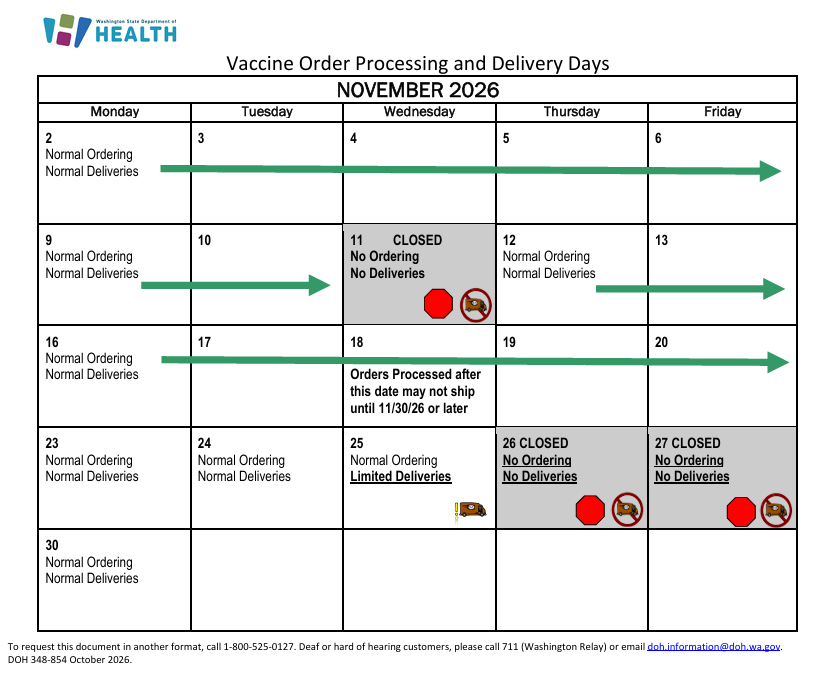
Please review the Holiday Shipping Calendar when planning your vaccine ordering over the next few weeks. Please notice the limited and no shipping days and ensure you are ordering enough to get through the limited shipping days. We are still approving up to 45-day supply of vaccine until December 15th. Please ensure you keep enough inventory on hand in case of shipping delays, but not too much that a power outage may create extensive loss. Keep in mind that today is the last day for order processing to ensure your order is received by November 30th and December 8th is the last day to place an order to ensure your order is received before the new year.
Pfizer has notified CDC of a temporary supply constraint resulting in shipping delays for their 12+ year COVID-19 vaccine (NDC# 00069-2631-10) due to higher-than-anticipated ordering demand:
- The delays impact both CDC and private orders for this vaccine.
- The delays are expected to impact orders placed from 11/10 until the supply constraint resolves over the next few weeks.
- The vaccine will remain available for provider orders.
- Pfizer will fulfill orders once additional supply becomes available around the end of November.
- The shipping delays do not impact Pfizer’s 5-11 year COVID-19 vaccine.
Moderna and Sanofi’s COVID-19 vaccines for 12+ years remain available for ordering without shipping delays.
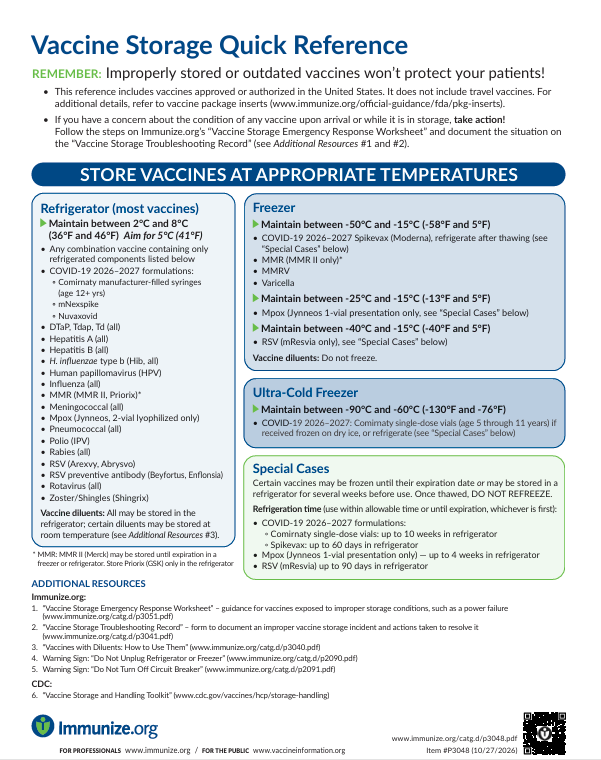
Please help us reduce COVID-19 vaccine waste by following these storage and handling practices:
- Pfizer brand 12+ pre-filled syringe: do not store in freezers, only in fridge until expiration.
- Pfizer brand 5-11 years single dose vial: store in ultracold freezer until expiration, can be stored in fridge for up to 10 weeks only.
- Moderna 12+ prefilled syringe: store in freezer until expiration date, can be stored in fridge up to 60 days only.
- Moderna 6 months-11 years prefilled syringe: store in freezer until expiration date, can be stored in fridge up to 60 days only.
- Novavax 12+: store in fridge only until expiration.
Please store COVID-19 vaccines to ensure the longest shelf life possible. Only move limited doses to fridge as needed for administration to extend shelf life and reduce waste.
Reminder: When moving COVID vaccine to a refrigerator it will need to be labeled with a Beyond Use Date (BUD) that is earlier than the printed expiration date. The BUD becomes the new expiration date.
For more detailed storage information, please visit the COVID-19 Vaccine-at-a-Glance Guide.
The last day to earn continuing education credit (CE) for the 2026 Vaccine Coordinator Training is December 11, 2026. To apply for CEs, you’ll need to complete Module 10 in TRAIN. If you haven’t finished Module 10 yet, now is a good time to complete it so you don’t miss the chance to earn credit. CEs are available for nurses, medical assistants, pharmacists and pharmacy technicians.
Please refer to the Vaccine Coordinator Training Instructions for more information on applying for CEs.
Reminder: IPV multi-dose vial is good through the expiration date on the vial and does not need to be wasted 30 days after the vial is punctured. Please help us avoid waste by using through the expiration date.
See the letter from Sanofi Pasteur about the use of the IPV multi-dose vial.
Many providers are asking about administering 2 doses of Beyfortus 50mg/0.5mL for infants since they would like to use up this product before the RSV season ends. Immunize.org’s Ask the Experts and the AAP (American Academy of Pediatrics) FAQs provides a response to this question.
What is the recommended dose of nirsevimab (Beyfortus)?
Nirsevimab (Beyfortus, Sanofi) dosing is based upon weight and/or age. It is available in 50-mg or 100-mg manufacturer-filled syringes (MFS). Infants younger than 8 months and weighing less than 5 kgs (11 lbs.) should receive a 50-mg dose, given as a 50-mg MFS. Infants younger than 8 months and weighing 5 kg (11 lb.), or more, should receive a single 100-mg dose, given as a 100-mg MFS. Infants and toddlers age 8 months through 19 months who need nirsevimab should receive a 200-mg dose, given as two 100-mg MFS.
Avoid administering two 50-mg MFS to an infant who needs a 100-mg MFS. The 50-mg MFS is intended for the smallest infants. The cost of the 50-mg and 100-mg MFS are equivalent, despite the difference in dose; insurance plans may not cover the cost of two doses given to an infant not recommended to receive two doses. Only high-risk children age 8 through 19 months are recommended to receive two (100-mg) MFS doses at the same visit. See the Immunize.org standing order template as a useful resource.
Why are two separate 100-mg manufacturer-filled syringe (MFS) injections of nirsevimab (Beyfortus, Sanofi) recommended for infants age 8 months and older who need a 200-mg dose, but we should not give two 50-mg MFS injections to infants who need a 100-mg dose?
The 50-mg manufacturer-filled syringes (MFS) of nirsevimab (Beyfortus) should be reserved for infants weighing less than 5 kilograms (less than 11 pounds). The cost of a single MFS is the same, whether it is a 50-mg MFS or a 100-mg MFS. Insurers are likely to cover only the cost of one MFS dose to an infant younger than age 8 months. Only high-risk children age 8 through 19 months are recommended to receive two (100-mg) MFS doses at the same visit.
RSV Inventory Management: If your clinic has doses of 50mg Nirsevimab that will not be used before the end of this season, please advertise those doses and reach out to other providers nearby, such as hospitals, who could more easily use the product.
Additional RSV resources:
Immunize.org recently updated the Vaccine Storage Quick Reference to include updated storage information for mpox vaccine, RSV, and 2026–27 COVID-19 vaccine formulations. Edits include:
- COVID-19: Includes 2026–27 products and updates age indications and refrigeration instructions.
- Mpox: Both Jynneos 1-vial and 2-vial presentations are listed with their separate storage requirements. The 1-vial presentation has an allowable-refrigeration period of 4 weeks (some now-expired lots had FDA authorization for a longer refrigeration period).
- RSV: mResvia is listed under its label-indicated freezer temperature range (−40°C to −15°C) with guidance allowing refrigeration for up to 90 days.
- RSV preventive antibody products: Both Beyfortus and Enflonsia are listed.
- Dengue vaccine: Dengvaxia (Sanofi) was removed because it is no longer manufactured and all U.S. doses expired.
|