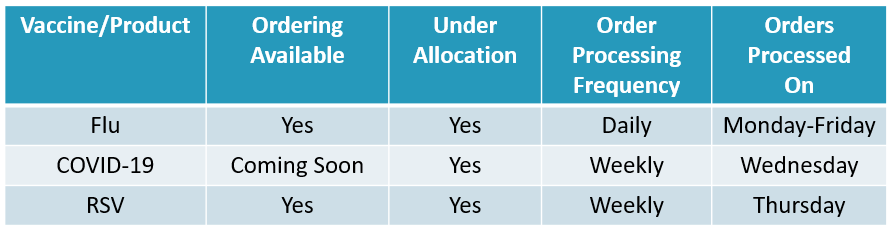
- Allow at least 3 days for order approval from time of submission for accountability checks
- Orders need to be in "Pending State Approval" status in the IIS by close of business the weekday before the processing day
- If there is not enough vaccine in allocation, orders will be reduced based on the Vaccine Allocation and Equity Plan
-
The 2026-2027 COVID-19 vaccine has been approved but is not yet available. Until then, the 2025-2026 vaccine remains available while supplies last.
- Patients at higher risk for severe illness should not wait for the new formulation if they are due for vaccination now.
- Patients who expect to travel should also consider vaccination before their trip to allow time for protection to develop.
- Patients that receive a 2025-2026 dose can also receive the 2026-2027 formulation when it becomes available, as long as the recommended interval between doses has passed.
- Ordering guidance for 2026–2027 vaccines will be shared as soon as we receive notice from CDC.
-
Remaining inventory of 2025-2026 COVID-19 vaccine should continue to be safely stored refrigerated between 36°F and 46°F (2°C to 8°C) - do not discard or attempt to return unexpired vaccine.
- We will share additional information and guidance on next steps in upcoming Vaccine Blurbs.
The purpose of this message is to share a provider letter from GSK about a labeling issue. This issue impacts three lots of GSK’s 2026-2027 Flulaval vaccine that providers may receive through the Childhood Vaccine Program.
The issue involves the linear barcode on the syringe labels of three lots of FluLaval® TIV Pre-filled Syringe 0.5 ml: X7YH3, 5JJ7Y and GK3LS. No other batches or products are impacted by this issue.
The linear barcode printed on the syringe product label contains an incorrect National Drug Code (NDC). Specifically, scanning the linear barcode returns the NDC associated with the FluLaval 2025/2026 product. However, the vaccine contained within the syringe is the correct FluLaval 2026/2027 product.
Please be assured that the information printed on the syringe label, including the product name, lot number, expiry date and NDC, is correct. In addition, the 2D barcode contains the correct product identification, lot number and expiry date information. Syringes are packed in a 10-unit packaging box. The packaging box contains the correct printed information, 2D barcode and linear barcode.
GSK’s investigation has confirmed that the product itself remains fully compliant with approved quality specifications. The issue is limited to the incorrect NDC in the syringe linear barcode and does not affect the quality, potency, safety, efficacy, sterility or performance of the vaccine.
Detailed information is available in the provider letter. Follow up questions should be directed to GSK at 1-888-825-5249.
The Washington State Department of Health (DOH) has released updated immunization schedules for children and adolescents, and for adults. See also our September 17 press release.
The recommendations are based on evidence from leading medical and public health organizations.
The updated schedules include Washington-specific guidance for respiratory virus vaccines. The recommendations generally align with guidance released on September 4, 2026, by the West Coast Health Alliance (WCHA).
One important difference: Washington recommends COVID-19 vaccination for all adults age 19 and older, including adults who do not have additional risk factors.
Under chapter 43.70 RCW DOH has the authority to issue immunization recommendations and related guidance to health care providers about who should receive certain vaccines, when they should be given, and under what conditions. Certain insurance coverage and funding under the state's universal Childhood Vaccine Program must be provided for vaccine recommended by DOH.
What changed?
The 2026-2027 DOH immunization schedules include these clinical updates:
-
RSV prevention for infants: More high-risk criteria were added for babies ages 8-19 months entering their second RSV season who should get nirsevimab.
-
RSV vaccine during pregnancy: The recommended time for maternal RSV vaccination was extended from September through January to September through March 1, based on guidance from the American College of Obstetricians and Gynecologists (ACOG).
-
RSV vaccine for adults: An RSV vaccine recommendation was added for immunocompromised adults ages 19 and older.
-
Flu vaccine for adults 65 and older: mFlusiva, a recently licensed mRNA flu vaccine, was added to the existing preferred vaccines: Fluzone High-Dose, Fluad adjuvanted, and Flublok recombinant.
-
COVID-19 vaccine: 2025-26 COVID-19 vaccine references were removed from the adult schedule, and language was updated to refer more generally to previous doses.
-
Meningococcal vaccine: MenACWY recommendations were updated to align with the American Academy of Pediatrics (AAP). The minimum age for the first dose of MenQuadfi is now 6 weeks, instead of 2 years. The indications in the notes section were also updated.
Where to find the current recommendations
Visit the updated Vaccine Recommendations webpage to find:
- Current Washington state immunization recommendations.
- The childhood and adolescent immunization schedule.
- The adult immunization schedule.
- Frequently asked questions.
- Related guidance for health care providers and local health jurisdictions.
Please review the updated schedules and use them when assessing patients and recommending vaccines.
Vaccine access
All vaccines recommended by DOH remain available at no cost for children under age 19 through Washington's Childhood Vaccine Program (CVP) at participating providers.
Uninsured adults ages 19 and older can receive recommended vaccines at no cost through the Adult Vaccine Program (AVP).
For questions about Washington's immunization recommendations, visit Vaccine Recommendations | Washington State Department of Health
We're currently seeing an issue with FluLaval influenza vaccine in the IIS. For doses to decrement from your inventory, the following information must match between your EHR and the IIS:
- Vaccine product (CVX)
- Lot number
- Manufacturer
- Funding source
For FluLaval, the IIS lists the manufacturer as ID Biomedical (IDB), while some EHRs are sending GlaxoSmithKline (SKB) as the manufacturer. The mismatched manufacturer is preventing decrementation of doses as they are administered.
If you are experiencing this issue, update the manufacturer for FluLaval lots in your EHR to ID Biomedical (IDB), then resubmit the vaccination records to the IIS. This should resolve the issue.
If your EHR does not send updates to the IIS, you can edit the manufacturer directly in the IIS vaccination record. Contact the team at WAChildhoodVaccines@doh.wa.gov with any questions.
DOH hosted a webinar on September 17 to discuss respiratory season clinical overview and vaccine recommendations, vaccine allocation and ordering, and strategies to improve clinic workflow for respiratory season vaccines. The recording is now available and continuing education credits are available by creating an account or logging in to TRAIN.org.
The Help Eliminate Pain in Kids & Adults Collaborative released the “Reducing distress during vaccine injections: 2026 clinical practice guideline update.” To help reduce vaccination distress, the guideline recommends choosing coping strategies before and/or during vaccination, using an evidence-based tool, the CARD system (Comfort–Ask–Relax–Distract). Key recommendations include:
-
Process: Education of everyone about distress-reducing interventions, and use of these strategies
-
Procedural: Adoption of methods, such as rapid injection technique without aspiration, that minimize distress and promote more positive vaccination experiences. In addition, administer vaccines in order of increasing distress, with the least distressing vaccine given first
-
Physical: For infants 12 months and younger, oral solutions such as breastfeeding, bottle-feeding, sweet-tasting liquids, or pacifiers
-
Pharmacological: Topical anesthetics at injection sites for all ages
-
Psychological: Distraction techniques, such as toys and singing for infants, and music and digital distractions or toys and games for older children and adults
 |
Are you missing order sets? All providers must submit a Respiratory Vaccine Choice form to select RSV and/or COVID-19 vaccine order sets for the respiratory season. You will not have access to a respiratory order set without a completed form. Send completed forms to WAChildhoodVaccines@doh.wa.gov and don't forget to include your PIN in the subject line of your email.
|